What Is Polyol Molecular Weight?
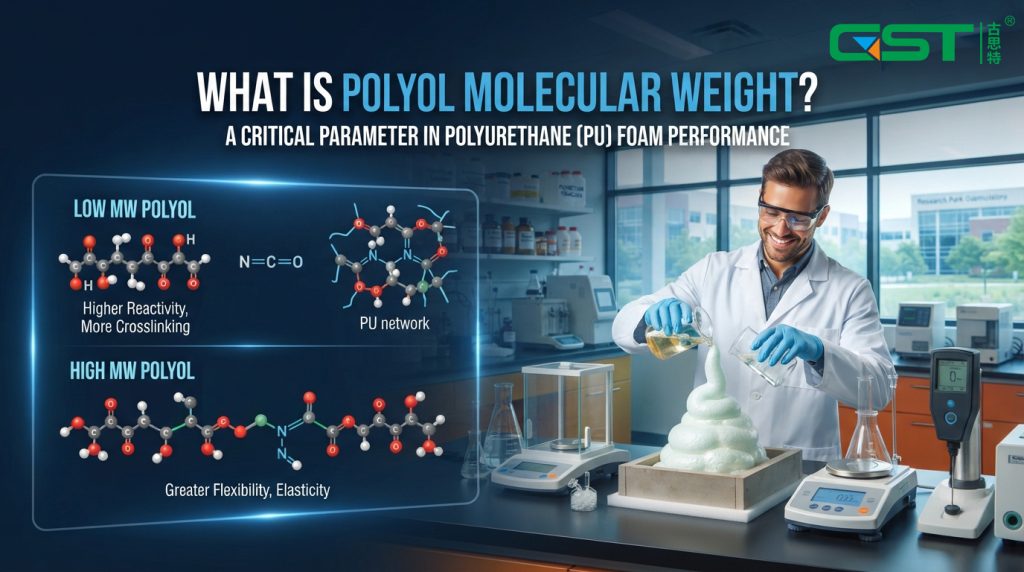
When working with polyurethane (PU), formulators often focus on hydroxyl value, functionality, viscosity, and reaction speed. But there is another important parameter behind foam performance: polyol molecular weight.
So, what exactly does it mean, and why does it matter in PU formulation?
What Is Polyol Molecular Weight?
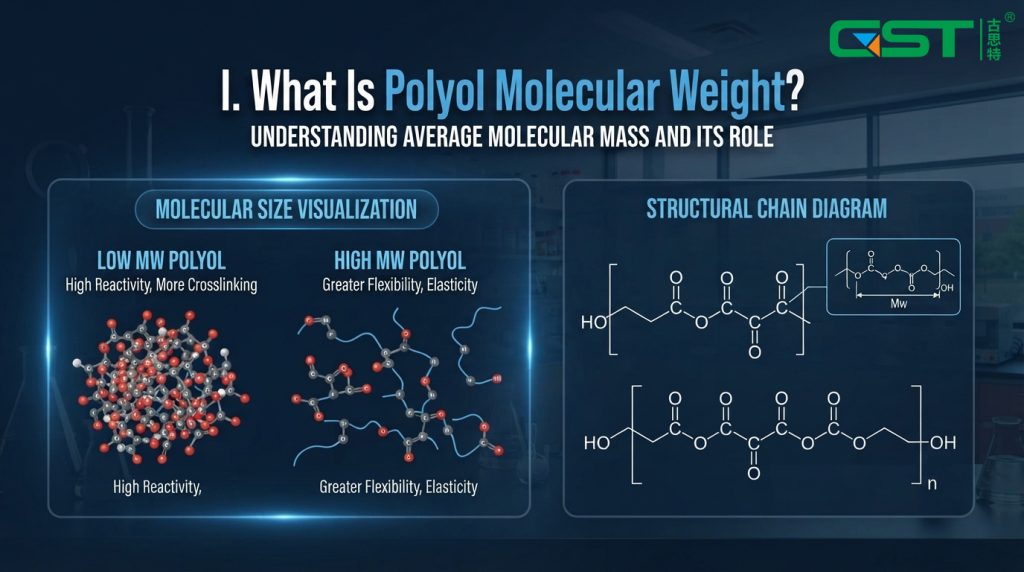
Polyol molecular weight refers to the average molecular mass of polyol molecules.
In simple terms, it tells us how large the polyol molecules are. Molecular weight is closely related to the polyol’s functionality, hydroxyl value, viscosity, flexibility, and reactivity.
For polyurethane applications, different molecular weights can lead to very different foam structures and physical properties.
For example:
- Lower molecular weight polyols generally have more hydroxyl groups per unit of mass and can contribute to higher reactivity and crosslinking.
- Higher molecular weight polyols generally provide longer molecular chains, which can contribute to greater flexibility and elasticity.
The key is not simply choosing a “higher” or “lower” molecular weight. The right choice depends on the final application and the entire formulation.
Why Does Polyol Molecular Weight Matter?
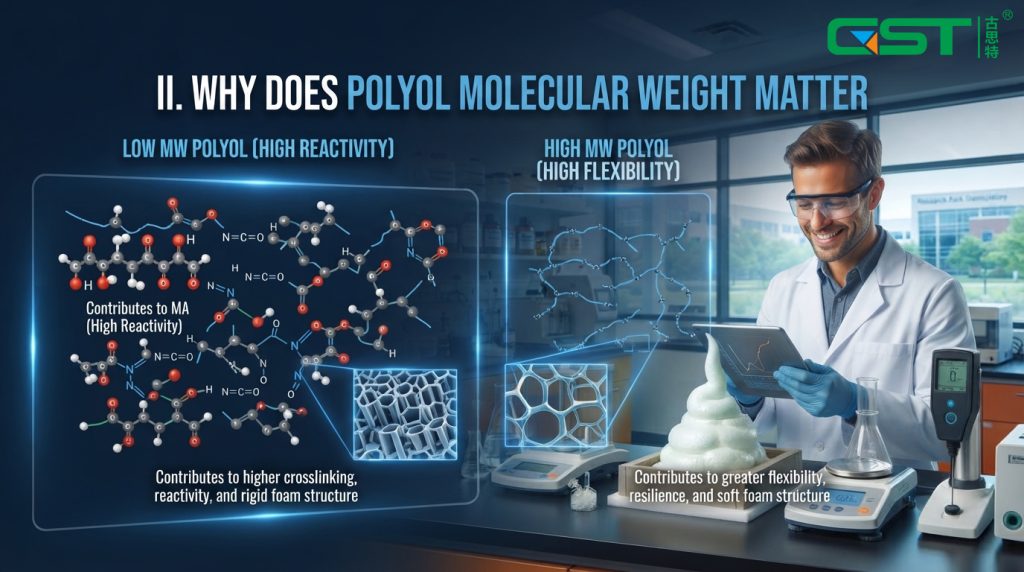
Polyurethane foam is a balancing game.
Polyol molecular weight can influence:
Foam structure:
It affects how polymer chains develop during foaming and can influence cell structure and stability.
Flexibility and resilience:
The molecular structure of the polyol contributes to whether the final foam feels soft, flexible, resilient, or more rigid.
Hardness:
Changing the polyol structure can alter the balance between soft segments and hard segments in the polyurethane network.
Reaction behavior:
Molecular weight is connected with hydroxyl concentration and therefore affects the isocyanate/polyol reaction balance.
Processing:
Polyol viscosity and reaction characteristics can influence mixing, flow, mold filling, cream time, rise time, and demolding.
That is why simply changing one polyol to another with a similar specification can sometimes produce an unexpected result.
How Does It Work in PU Foaming?
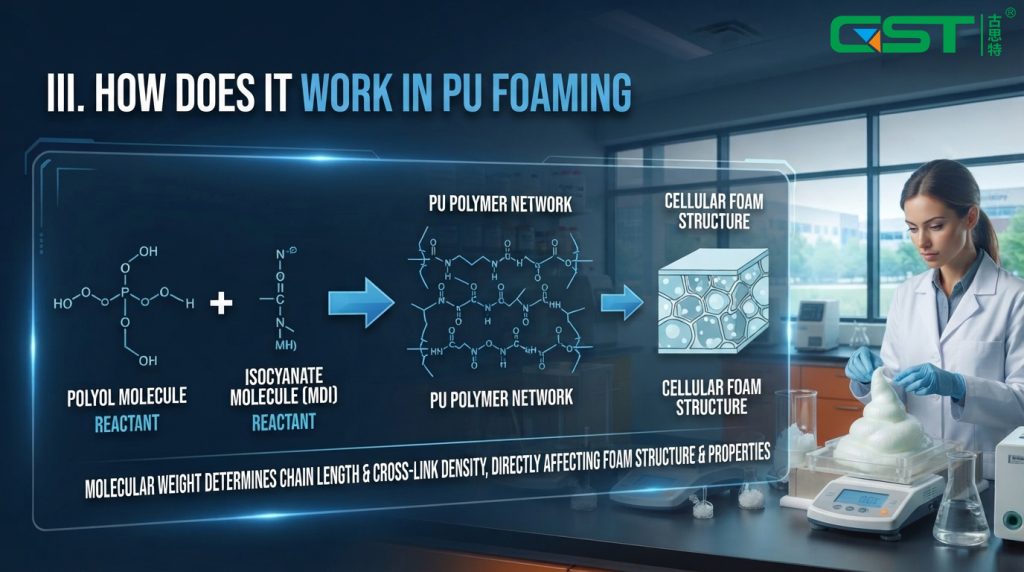
Think of polyol molecules as the “building blocks” of polyurethane.
During foaming, polyol reacts with isocyanate while catalysts, silicone surfactants, blowing agents, and other additives control the reaction and foam formation.
A simplified process looks like this:
Polyol + Isocyanate → Polyurethane Polymer
At the same time, the blowing reaction creates gas that expands the material into foam.
The molecular weight of the polyol influences the length and density of the molecular chains formed during this process.
However, molecular weight does not work alone.
A practical PU formulation must balance:
Molecular Weight + Functionality + Hydroxyl Value + Isocyanate Index + Catalyst System + Surfactant + Blowing System
This is why experienced PU formulators look at the entire formulation rather than one parameter.
Common Problems Caused by Incorrect Polyol Selection
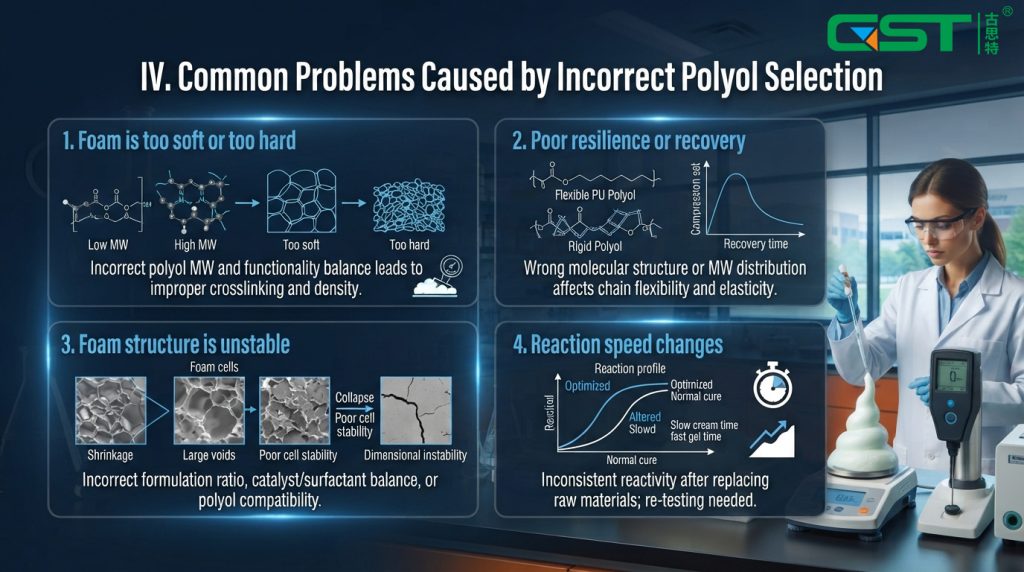
1. Foam is too soft or too hard
The selected polyol structure may not match the required hardness and density.
Solution:
Adjust the polyol combination, polymer polyol level, isocyanate index, and other formulation parameters together.
2. Poor resilience or recovery
For high-resilience and flexible foam, the molecular structure of the polyol system plays an important role.
Solution:
Optimize molecular weight distribution, functionality, polymer polyol content, and catalyst balance.
3. Foam structure is unstable
Incorrect formulation balance can result in large cells, uneven cells, shrinkage, or poor dimensional stability.
Solution:
Review the complete reaction system, including polyol, catalyst, silicone surfactant, blowing agent, and processing conditions.
4. Reaction speed changes after replacing raw materials
Two polyols with similar basic specifications may still behave differently during foaming.
Solution:
Re-test cream time, rise time, gel time, density, cell structure, hardness, resilience, and other key physical properties before production.
How Can GST Help?

Choosing polyol molecular weight is only one part of PU formulation development.
At GST, we focus on the complete polyurethane system.
As a PU combination material supplier and formulation solution provider, GST can support customers with:
Customized PU Combination Materials
We can develop systems according to different applications, densities, hardness requirements, resilience, processing methods, and production conditions.
Formulation Development
Our R&D team can optimize the relationship between polyols, isocyanates, catalysts, surfactants, blowing agents, and additives.
Laboratory Sampling & Testing
We can conduct laboratory foaming tests and adjust the formulation based on foam performance and customer requirements.
Existing Formula Optimization
If a customer already has a formulation but experiences problems such as unstable density, poor resilience, slow recovery, shrinkage, or inconsistent reaction speed, GST can help analyze and optimize the system.
Technical Support
From material selection and trial production to production adjustment, GST provides technical guidance to help customers move from laboratory testing to stable production.
The Bottom Line
Polyol molecular weight is not just a number on a technical data sheet.
It is one of the parameters that influences how a polyurethane system reacts, forms its molecular structure, and ultimately performs.
The real question is not:
“Which molecular weight is better?”
It is:
“Which molecular weight and polyol combination is right for my application?”
That’s where formulation expertise matters.
GST — PU Combination Materials & Formulation Solutions
From raw material selection to customized PU systems, formulation development, sampling, testing, and technical support, GST helps customers build polyurethane solutions around their actual production requirements.
Tags: Polyether Polyol, Polyol, Polyol Hydroxyl Value, Polyol Molecular Weight, Polyol Molecular Weight in Polyurethane, Polyol Selection for Polyurethane, Polyurethane, Polyurethane Foam Formulation, Polyurethane Foam Properties, Polyurethane Polyol, PU Combination Materials, PU Foam, PU Foaming, What Is Polyol
PREVIOUS:What Is Polymer Polyol?
CATEGORIES
LATEST NEWS
- BASF Ludwigshafen Incident:...
- What Is Polyol Molecular We...
- What Is Polymer Polyol?
- Polyether Polyol vs Polyest...
- What Is Polyester Polyol?
- What Is Polyether Polyol?
- What Is Polyol?
- Why Is Reaction Balance Cri...
- Blowing Reaction vs Gelling...
- How Molecular Structure Det...
CONTACT US
Tel:+86 18688691634
Email:sam@1688pu.com
Add:No. 91 Central East Rd, Luxi Village, Gaobu Town, Dongguan 523283, China.