Flexible vs Rigid Polyurethane Foam
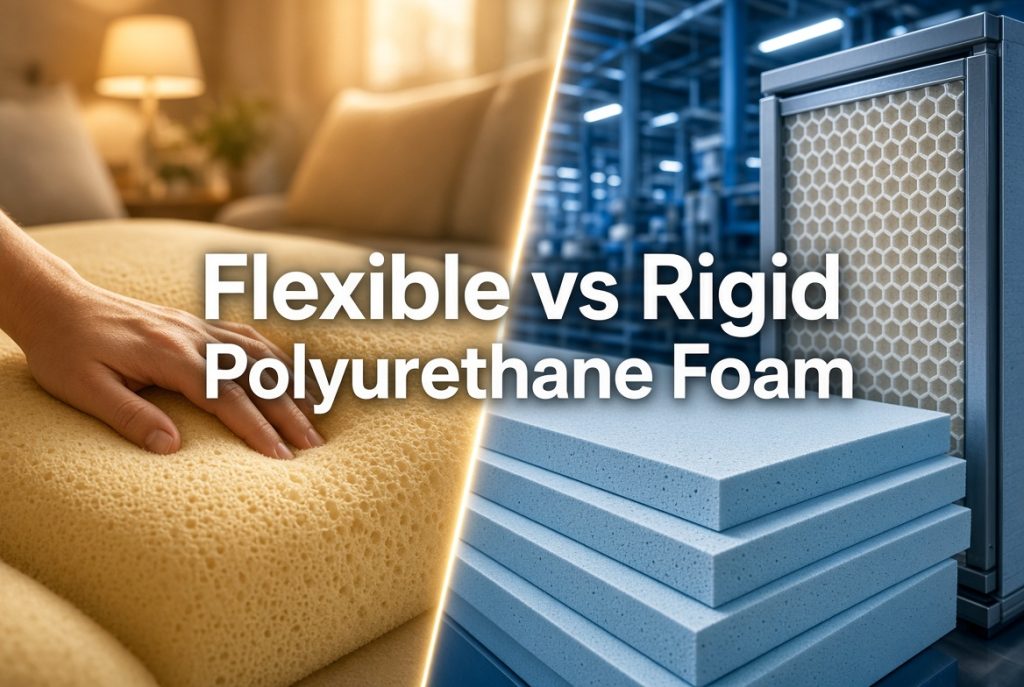
Polyurethane foam is not just “foam.” Depending on its formulation and processing method, it can be engineered to be soft and flexible or strong and rigid. Flexible polyurethane foam (flexible PU foam) and rigid polyurethane foam (rigid PU foam) are two major categories, each designed for very different performance requirements.
So, what is the difference between them? Why are both needed? How do they work, and what should manufacturers do when problems occur?
1. What Are Flexible and Rigid Polyurethane Foam?
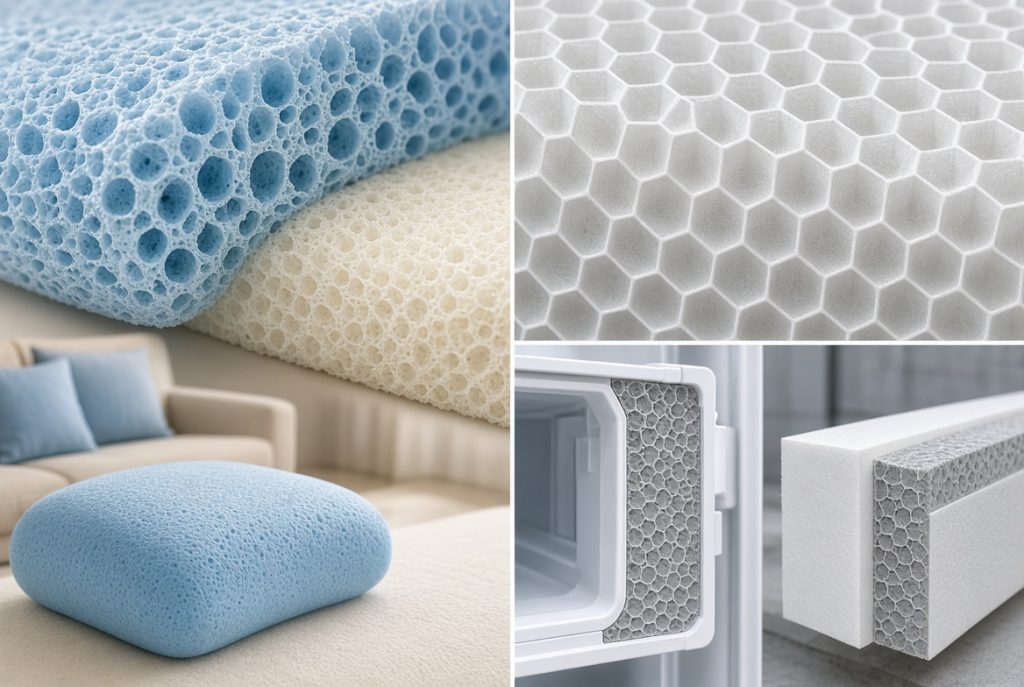
Both flexible and rigid polyurethane foams are produced through the reaction of polyols and isocyanates, together with catalysts, blowing agents, surfactants and other additives.
The key difference is their cell structure, formulation and mechanical properties.
Flexible polyurethane foam is designed to deform under pressure and recover its shape. It is commonly used in mattresses, pillows, sofas, automotive seats, cushions and other comfort applications.
Rigid polyurethane foam, on the other hand, has a more stable and closed-cell structure. It provides excellent thermal insulation, dimensional stability and structural support, making it widely used in refrigerators, cold storage, insulation panels, construction and spray insulation.
In simple terms:
Flexible PU foam = comfort + elasticity
Rigid PU foam = insulation + strength
2. Why Do We Need Both?

Different applications require completely different foam characteristics.
Imagine a sofa cushion made from rigid foam—it would be uncomfortable. Conversely, using highly flexible foam for refrigerator insulation would provide poor thermal insulation and insufficient structural stability.
Flexible foam is needed when manufacturers care about:
- Softness and comfort
- Resilience and recovery
- Compression performance
- Air permeability
- Long-term seating or cushioning performance
Rigid foam is preferred when the priority is:
- Low thermal conductivity
- High insulation performance
- Dimensional stability
- Lightweight structure
- Good adhesion and mechanical strength
The advantage of polyurethane is that its molecular structure can be chemically and physically adjusted to meet different application requirements.
3. How Do Flexible and Rigid PU Foams Work?
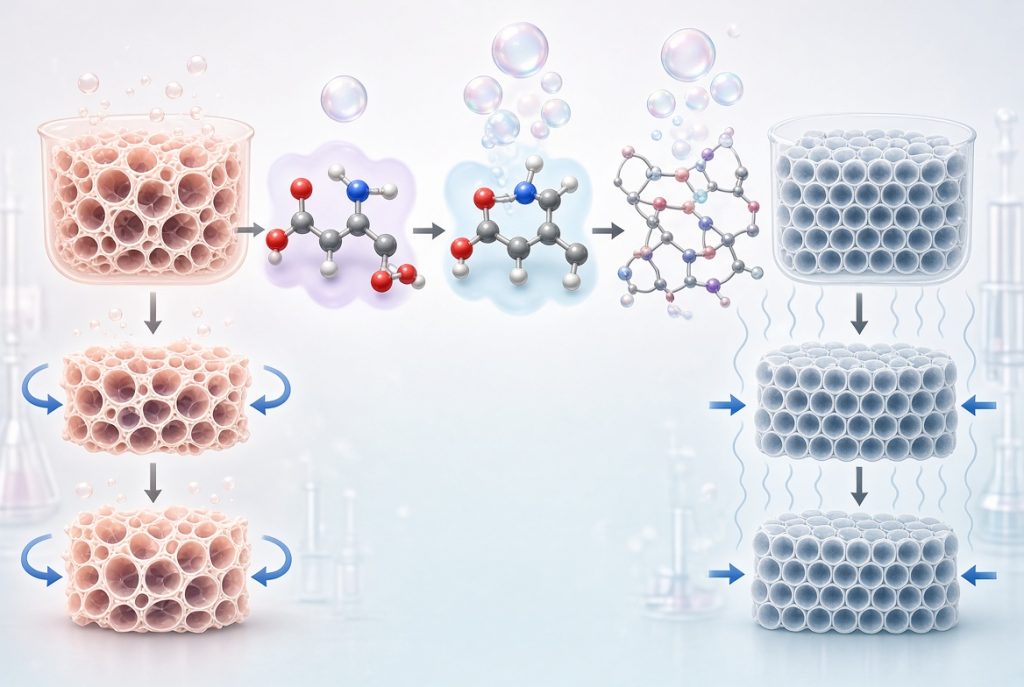
The basic principle is similar: polyol and isocyanate react to form polyurethane, while the blowing system generates the cellular structure.
But formulation design determines what the final foam will look and behave like.
For flexible foam, the formulation is optimized to create a structure that can repeatedly compress and recover. Factors such as polyol type, isocyanate index, catalyst balance, surfactant and density all influence the final resilience, hardness and cell structure.
For rigid foam, the formulation is designed to generate a stable cellular structure, often with a high proportion of closed cells. This helps reduce heat transfer and gives the foam its excellent insulation properties.
This is why polyurethane foam is highly customizable: small changes in formulation can create significant differences in foam performance.
4. Common Problems and How to Solve Them
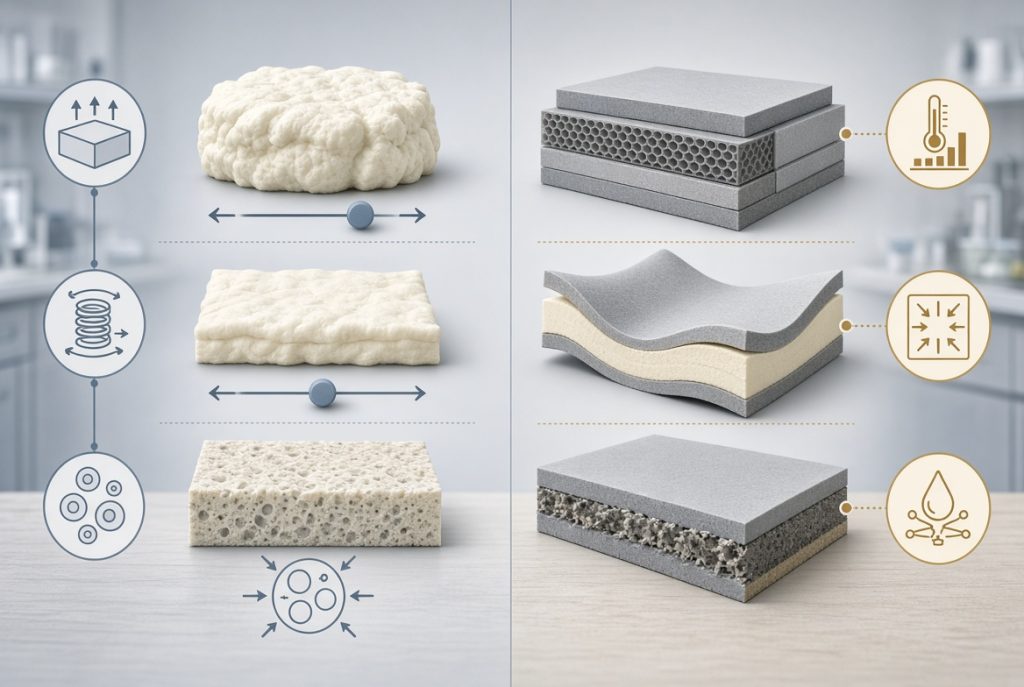
Even with the right raw materials, foam production can encounter problems.
Flexible Foam Problems
Foam is too hard or too soft
Possible causes include incorrect formulation ratios, density variation, polyol selection or catalyst imbalance.
Poor resilience or slow recovery
The formulation, cell structure, polymer structure and catalyst system may need adjustment.
Uneven cells or surface defects
Mixing efficiency, surfactant selection, blowing balance and processing conditions should be checked.
Rigid Foam Problems
Poor insulation performance
Cell structure, blowing-agent efficiency, density and processing conditions are key factors.
Shrinkage or dimensional instability
This may result from an inappropriate formulation balance, insufficient curing or excessive internal stress.
Poor adhesion
Substrate temperature, surface condition, formulation compatibility and reaction characteristics should be evaluated.
The important point is that foam defects are usually not solved simply by changing one raw material. A systematic approach combining formulation, equipment and processing conditions is often required.
5. How Can GST Help?
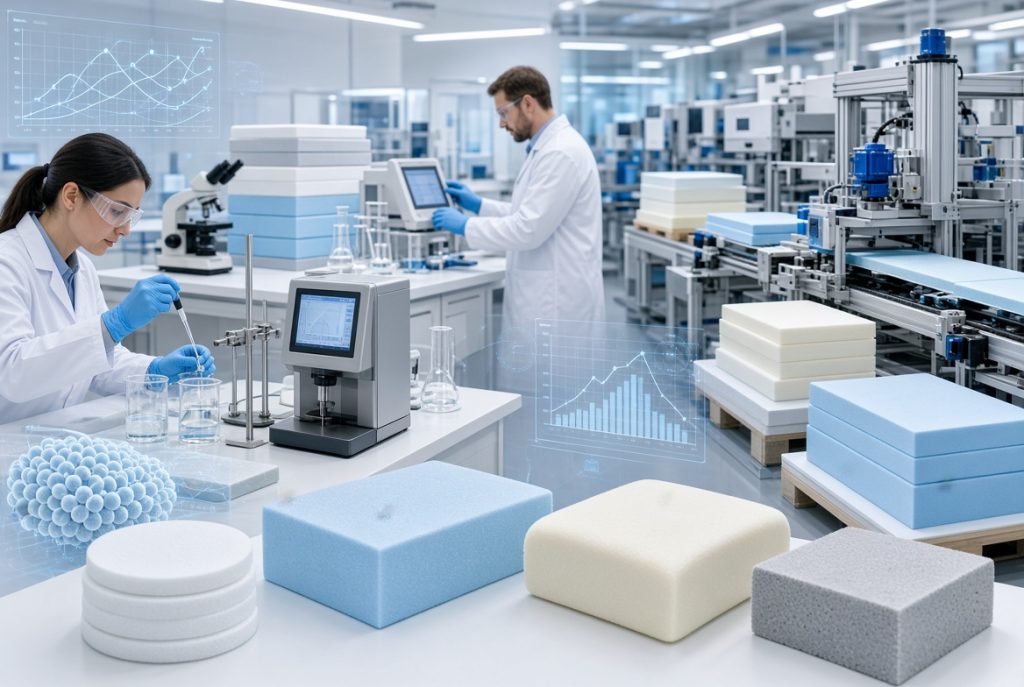
For manufacturers, choosing between flexible and rigid polyurethane foam is only the first step. The real challenge is developing a formulation that works consistently on the production line.
GST provides polyurethane combination materials, customized formulations and application-focused technical solutions for different foam applications.
Depending on your product requirements, GST can help optimize:
- Flexible PU foam systems for cushions, mattresses, pillows, automotive seats and other applications
- High-resilience and memory foam systems for comfort and specialty products
- Rigid PU foam systems for insulation panels, refrigerators, cold storage and spray insulation
- Density, hardness, resilience and cell structure
- Reaction profile and processing window
- Formulation compatibility with existing production equipment
- Customized systems for specific products and manufacturing conditions
Instead of simply supplying raw materials, GST focuses on the complete application process—from formulation development and laboratory testing to production optimization and technical support.
6. Flexible or Rigid: Which One Is Right for You?

There is no universally “better” polyurethane foam.
The right choice depends on the application.
| Requirement | Flexible PU Foam | Rigid PU Foam |
| Comfort | ★★★★★ | ★ |
| Resilience | ★★★★★ | ★★ |
| Thermal insulation | ★★ | ★★★★★ |
| Structural support | ★★★ | ★★★★★ |
| Typical density | Low–medium | Low–medium |
| Typical applications | Mattresses, pillows, sofas, seats | Refrigerators, panels, cold storage, insulation |
The key is not simply choosing flexible or rigid, but selecting the right polyurethane system and formulation for the specific application.
Conclusion
Flexible and rigid polyurethane foams may come from the same basic polyurethane chemistry, but their performance can be completely different.
Flexible PU foam focuses on comfort, elasticity and recovery, while rigid PU foam focuses on insulation, strength and dimensional stability.
When formulation problems appear, successful production often requires more than adjusting a single ingredient. It requires an understanding of raw materials, formulation chemistry, reaction behavior, equipment and processing conditions.
With GST’s polyurethane combination materials, customized formulations and technical application support, manufacturers can develop foam systems that are not only suitable for the product—but also optimized for real production.
Looking for the right flexible or rigid polyurethane foam solution? Contact GST to discuss your application, formulation requirements and production challenges.
CATEGORIES
LATEST NEWS
- Aromatic vs Aliphatic Isocy...
- What Is Modified MDI?
- MDI vs TDI: What’s th...
- TDI 80/20 vs TDI 65/35
- What Is TDI?
- What Is Polymeric MDI (pMDI)?
- What Is MDI?
- What Is Isocyanate?
- How to Select the Right Pol...
- How Does Polyol Affect Foam...
CONTACT US
Tel:+86 18688691634
Email:sam@1688pu.com
Add:No. 91 Central East Rd, Luxi Village, Gaobu Town, Dongguan 523283, China.