TDI 80/20 vs TDI 65/35
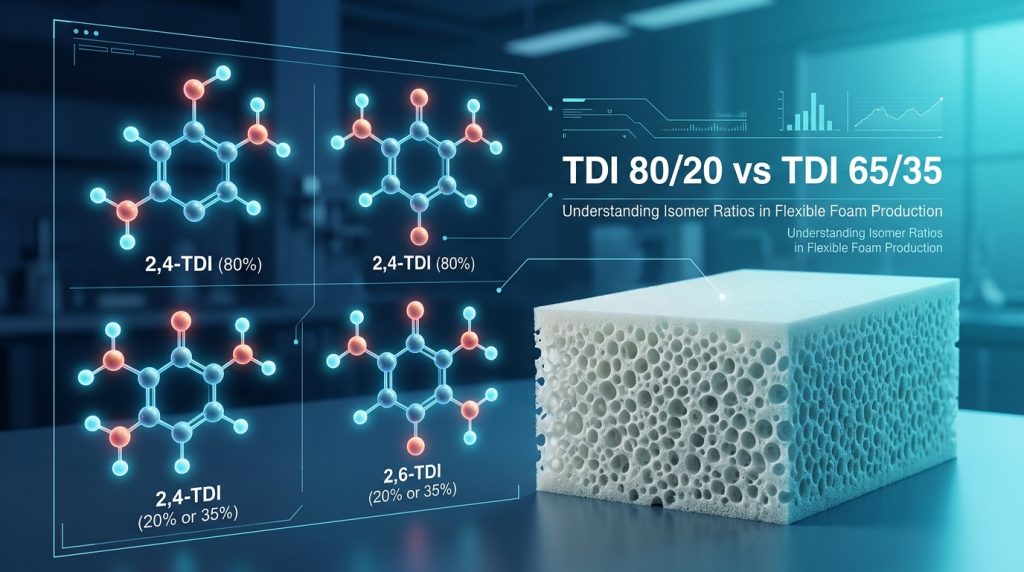
TDI 80/20 vs TDI 65/35: What Is the Difference?
When developing flexible polyurethane foam, many manufacturers focus on polyol, density, or catalyst—but overlook another important variable: the TDI isomer ratio.
So, what is the difference between TDI 80/20 and TDI 65/35, and why can changing the TDI grade affect your foam production?
What Are TDI 80/20 and TDI 65/35?
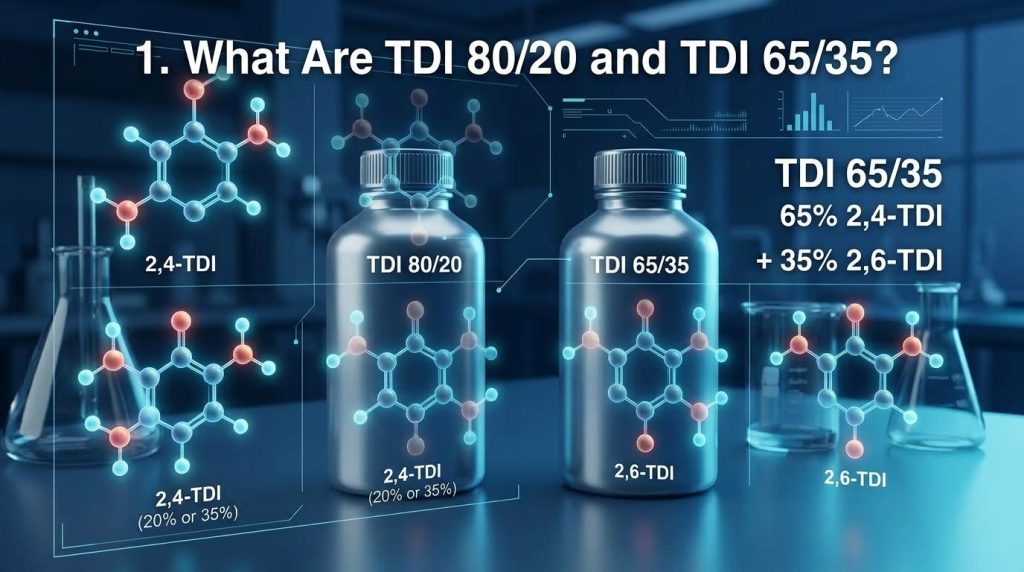
TDI stands for Toluene Diisocyanate, one of the key isocyanates used in polyurethane production.
Commercial TDI commonly contains two isomers: 2,4-TDI and 2,6-TDI.
- TDI 80/20: approximately 80% 2,4-TDI + 20% 2,6-TDI
- TDI 65/35: approximately 65% 2,4-TDI + 35% 2,6-TDI
TDI 80/20 is widely used in flexible slabstock foam, while TDI 65/35 is also used in specific flexible-foam formulations and may be blended with TDI 80/20 depending on the formulation and application.
Why Does the Ratio Matter?
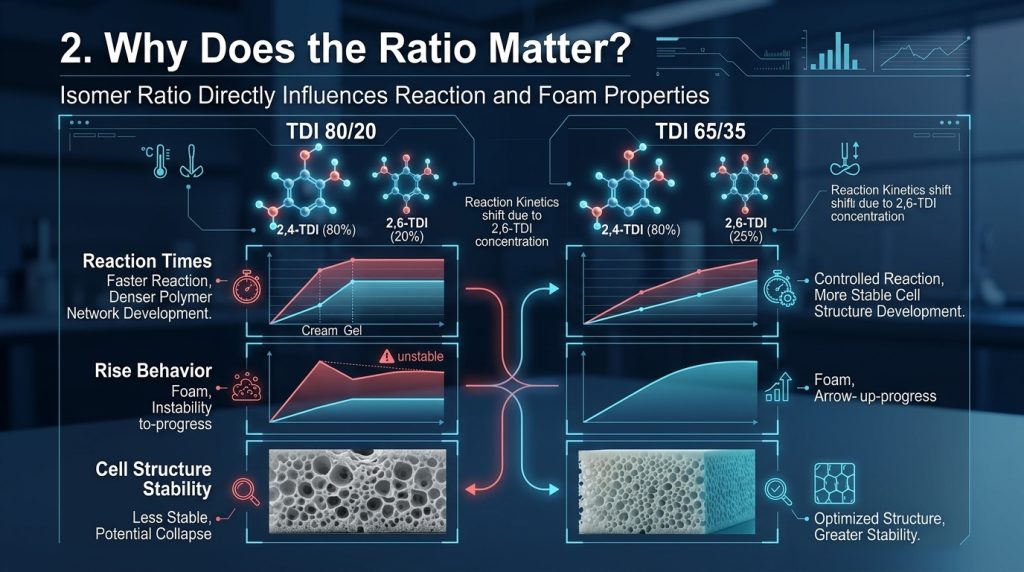
At first glance, both materials are simply TDI. But the different 2,4/2,6 isomer ratio changes the reaction behavior.
The two isomers have different molecular structures and reactivity. Therefore, changing from 80/20 to 65/35 can affect:
- Cream time
- Gel time
- Rise behavior
- Catalyst response
- Cell structure
- Foam stability
- Processing window
In other words:
The same formulation calculation does not necessarily mean the same production behavior.
This is why simply replacing TDI 80/20 with TDI 65/35 without rechecking the formulation can create unexpected results.
How Does TDI Work in PU Foam?
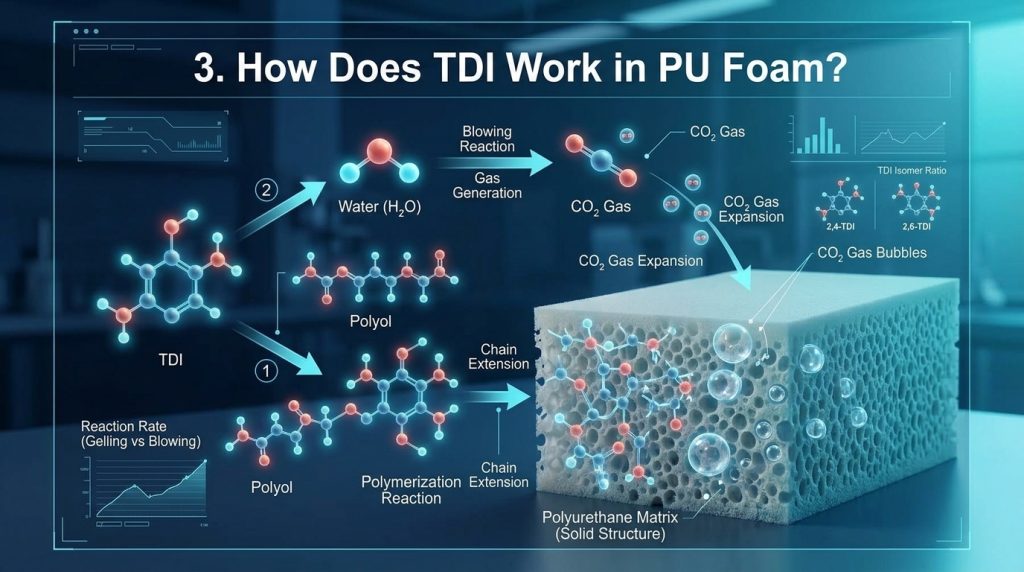
During foaming, TDI reacts with hydroxyl-containing components such as polyols to form polyurethane.
At the same time, water can react with isocyanate to generate CO₂, which contributes to foam expansion, while the polyurethane-forming reaction helps build the polymer network.
The final foam therefore depends on the balance between blowing, gelling, and polymer formation.
Changing the TDI isomer ratio can shift this reaction balance. That means catalyst levels, water, polyol characteristics, and isocyanate index may need to be reviewed together.
TDI is not an isolated ingredient—it is part of the whole formulation system.
Common Problems When Switching TDI Grades
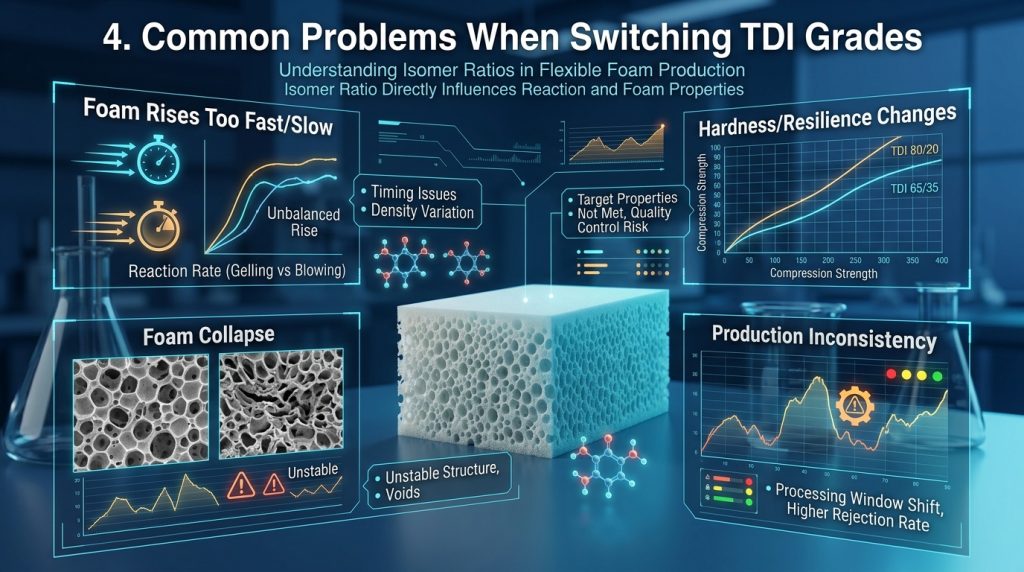
Foam Rises Too Fast or Too Slowly
Changing the TDI grade can change reaction timing.
Solution: Re-evaluate catalyst balance, water level, polyol reactivity, and processing temperature instead of simply adjusting one component.
Foam Collapses or Has Poor Cell Structure
An imbalance between the blowing and gelling reactions may result in unstable foam structure.
Solution: Check the complete formulation, including TDI ratio, catalyst system, surfactant, water, and polyol.
Hardness or Resilience Changes
Even when density appears similar, changes in reaction kinetics and polymer structure can affect the final physical properties.
Solution: Optimize the formulation around the target hardness, resilience, density, and application rather than changing TDI alone.
Production Becomes Inconsistent
A formulation developed for one TDI grade may not perform identically with another grade.
Solution: Conduct laboratory trials and establish a new processing window before full-scale production.
How Can GST Help?

At GST, we understand that polyurethane formulation is about system balance—not simply selecting individual raw materials.
If you are using TDI 80/20, TDI 65/35, or considering switching between them, our R&D team can help evaluate the complete formulation.
GST can provide:
PU Combination Materials
Pre-designed systems that integrate key formulation components for specific foam applications.
Customized Formulation Development
Adjustment of polyol, TDI, catalyst, surfactant, water, additives, and isocyanate index according to the required foam performance.
Laboratory Sampling & Testing
Small-scale trials to evaluate reaction behavior, density, hardness, resilience, cell structure, and other physical properties.
Formula Replication & Optimization
If you already have a foam sample or existing production formula, GST can help analyze the target performance and optimize the formulation.
Production Technical Support
From laboratory trials to production validation, GST can provide technical guidance to help manufacturers achieve more stable processing and consistent foam quality.
TDI Selection Is Only the Starting Point
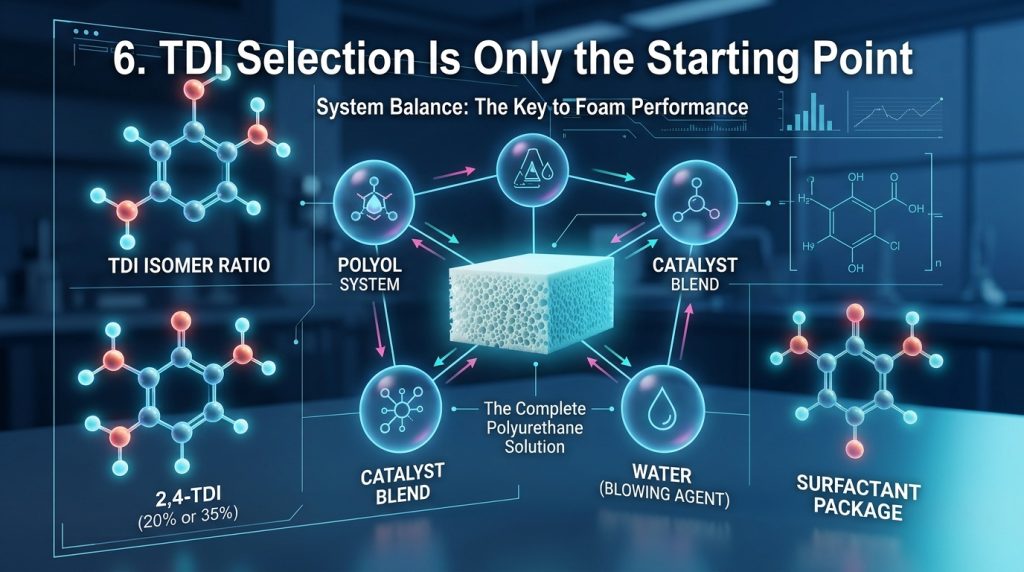
There is no universal answer that TDI 80/20 is always better than TDI 65/35—or vice versa.
The right choice depends on the polyol system, formulation design, target foam properties, production process, and application.
For manufacturers, the bigger question is not simply:
“Which TDI should I buy?”
It is:
“Which TDI + polyol + catalyst + water + surfactant system can reliably deliver my target foam?”
That’s where GST can help.
From PU combination materials and formulation R&D to laboratory testing and production technical support, GST helps manufacturers develop a complete polyurethane solution instead of working with individual raw materials one by one.
Have a TDI 80/20 or 65/35 formulation to optimize? Contact GST for a formulation evaluation and sample solution.
PREVIOUS:What Is TDI?
CATEGORIES
LATEST NEWS
- Aromatic vs Aliphatic Isocy...
- What Is Modified MDI?
- MDI vs TDI: What’s th...
- TDI 80/20 vs TDI 65/35
- What Is TDI?
- What Is Polymeric MDI (pMDI)?
- What Is MDI?
- What Is Isocyanate?
- How to Select the Right Pol...
- How Does Polyol Affect Foam...
CONTACT US
Tel:+86 18688691634
Email:sam@1688pu.com
Add:No. 91 Central East Rd, Luxi Village, Gaobu Town, Dongguan 523283, China.