What Is TDI?
TDI (Toluene Diisocyanate) is one of the most important raw materials in polyurethane (PU) production. It is widely used in flexible polyurethane foam, including mattresses, sofas, automotive seats, office chairs, pillows, and other cushioning applications.
Although TDI is only one component in a PU system, its reaction characteristics have a significant impact on foam quality, production stability, and final product performance.
So, what exactly is TDI, and how does it affect polyurethane foam?
What Is TDI?
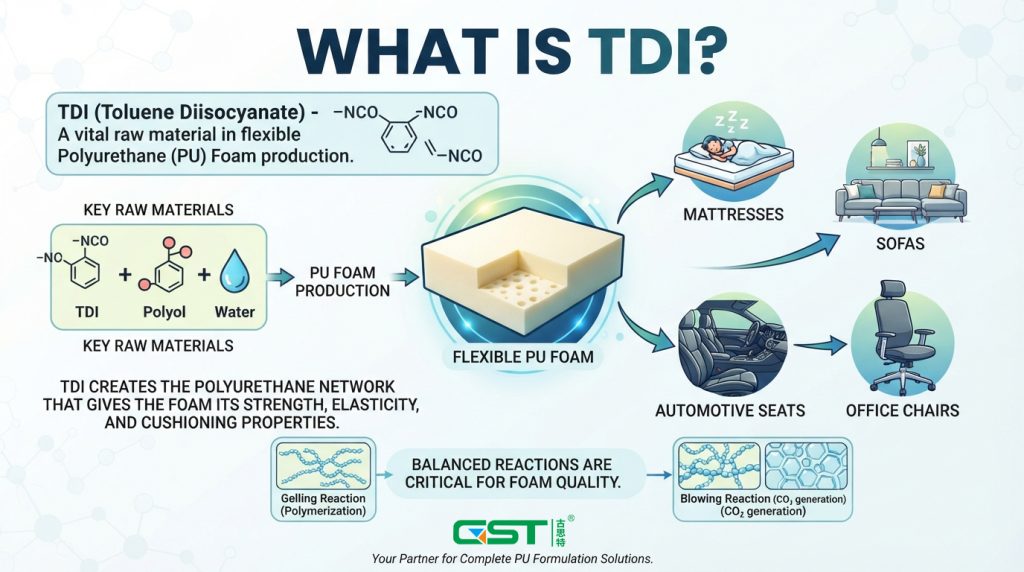
TDI, short for Toluene Diisocyanate, is an aromatic diisocyanate containing two reactive –NCO (isocyanate) groups.
The most common commercial types are:
- TDI 80/20 (80% 2,4-TDI + 20% 2,6-TDI)
- TDI 65/35 (65% 2,4-TDI + 35% 2,6-TDI)
In polyurethane production, TDI reacts with polyols to form polyurethane polymers that provide the foam structure and mechanical properties.
Simply explained:
Polyol provides the flexible structure.
TDI creates the polyurethane network that gives the foam its strength and elasticity.
Why Is TDI Important in PU Foam?
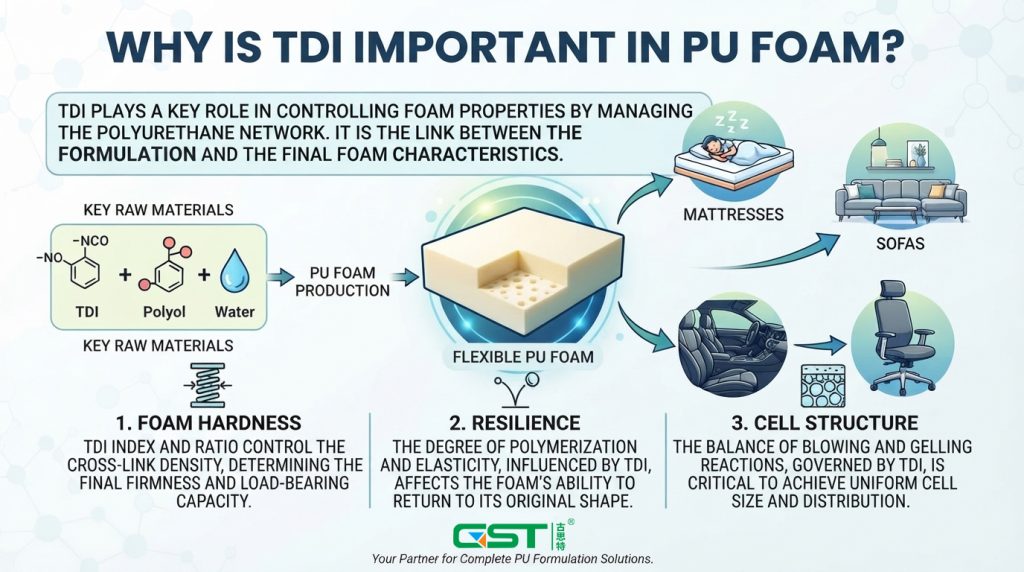
For flexible foam applications, TDI plays a key role in controlling:
- Foam hardness
- Resilience
- Tensile strength
- Elongation
- Compression performance
- Cell structure
- Processing behavior
The right TDI selection and dosage help manufacturers achieve stable foam quality.
However, TDI is not used alone. Its performance depends on the complete formulation system, including:
- Polyol characteristics
- Water level
- Catalyst balance
- Silicone surfactant
- Additives
- Mixing conditions
A small adjustment in TDI balance can significantly influence the final foam performance.
How Does TDI Work?
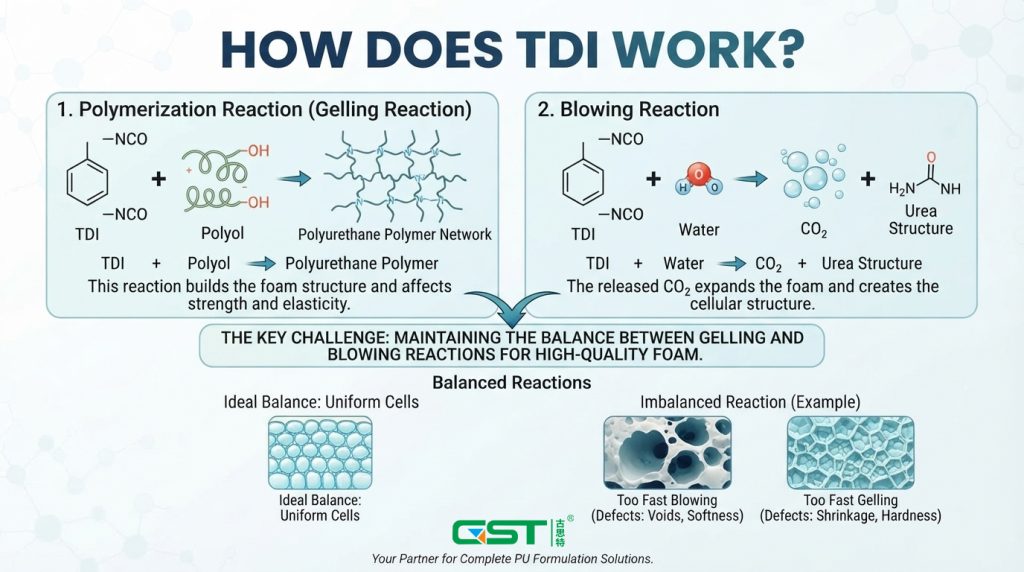
During PU foaming, TDI reacts mainly through two important reactions:
1. Polymerization Reaction (Gelling Reaction)
TDI reacts with polyol hydroxyl groups (-OH) to form polyurethane chains.
TDI + Polyol → Polyurethane Polymer
This reaction builds the foam structure and affects strength and elasticity.
2. Blowing Reaction
TDI reacts with water to generate carbon dioxide (CO₂).
TDI + Water → CO₂ + Urea Structure
The released CO₂ expands the foam and creates the cellular structure.
The key challenge is maintaining the balance between:
Gelling reaction + Blowing reaction
Too fast or too slow reactions can create foam defects.
Common Problems When Using TDI
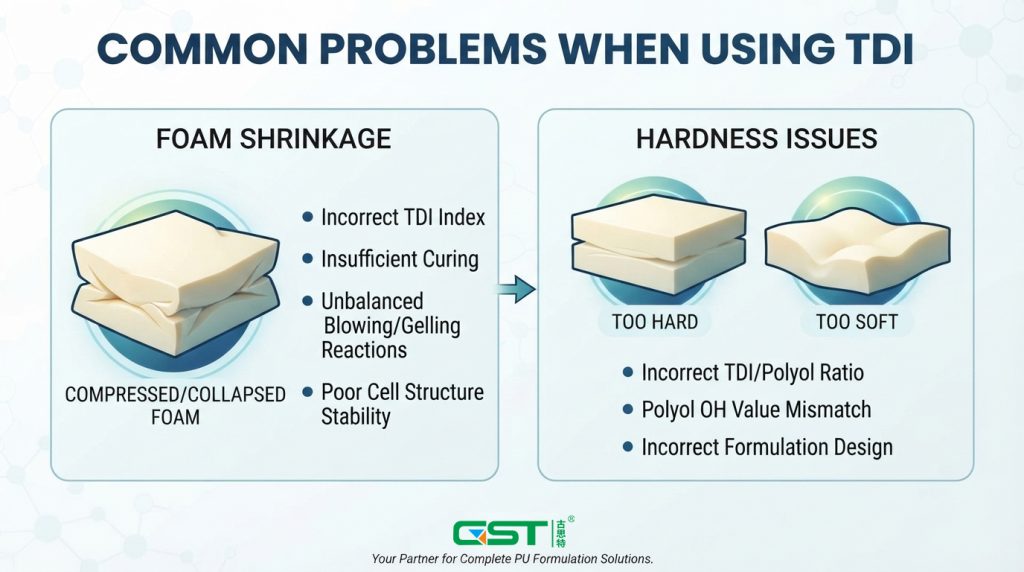
Foam Shrinkage After Production
Possible causes:
- Incorrect TDI index
- Insufficient curing
- Unbalanced blowing and gelling reactions
- Poor cell structure stability
Foam Is Too Hard or Too Soft
Possible causes:
- Incorrect TDI/polyol ratio
- Polyol hydroxyl value mismatch
- Incorrect formulation design
Uneven Cells or Large Voids
Possible causes:
- Poor catalyst balance
- Silicone surfactant compatibility issues
- Mixing problems
- Incorrect reaction speed
Production Is Unstable Between Batches
Possible causes:
- Raw material temperature changes
- Equipment differences
- Inconsistent formulation control
- Lack of reaction balance optimization
How Can These Problems Be Solved?
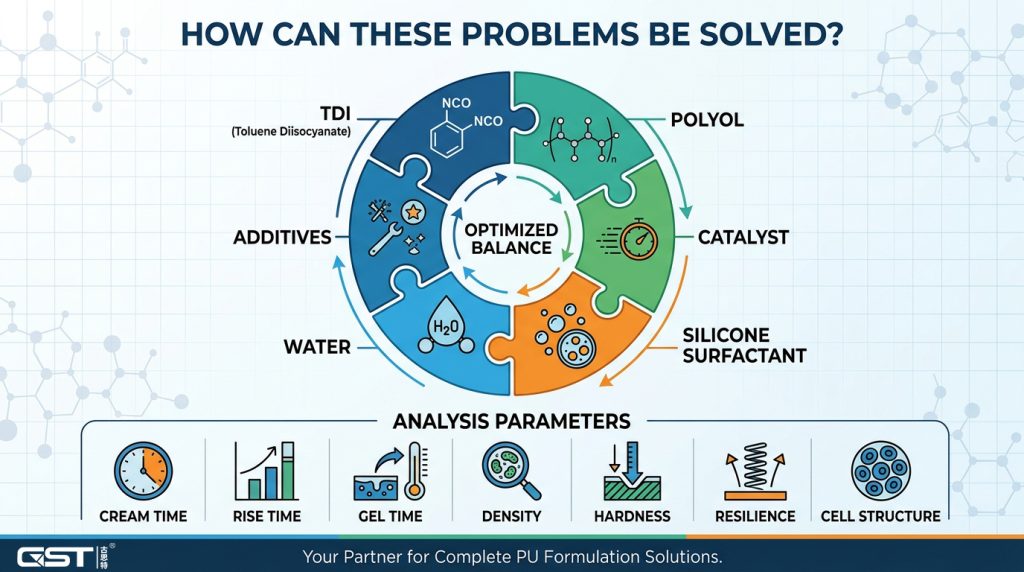
TDI-related foam problems are usually not solved by changing TDI alone.
A successful PU system requires optimization of the entire formulation:
TDI + Polyol + Catalyst + Silicone + Water + Additives + Processing Conditions
By analyzing:
- Cream time
- Rise time
- Gel time
- Density
- Hardness
- Resilience
- Compression set
- Cell structure
the formulation can be adjusted to achieve better production stability and final performance.
How GST Supports Your PU Formulation
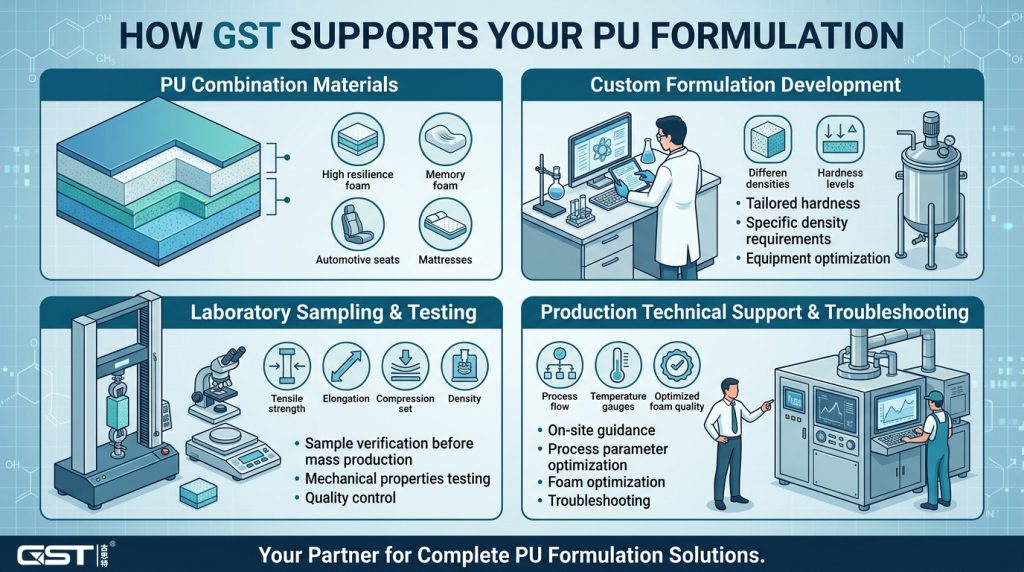
At GST, we provide more than polyurethane raw materials.
We focus on PU combination materials, formulation development, and application solutions to help customers achieve stable production.
PU Combination Materials
GST develops pre-balanced PU systems for applications such as:
- High resilience foam
- Memory foam
- Automotive seats
- Furniture cushions
- Pillows and mattresses
Custom Formulation Development
Our technical team can optimize formulations based on:
- Target hardness
- Density requirements
- Resilience performance
- Production equipment
- Processing conditions
Laboratory Sampling & Testing
Before mass production, GST can provide sample testing and formulation verification to reduce trial costs and development time.
Formula Optimization & Troubleshooting
For customers with existing formulations, GST can help analyze foam problems and optimize the balance between TDI, polyol, catalysts, and additives.
Production Technical Support
From laboratory trials to factory production, GST provides practical guidance to improve foam consistency and production efficiency.
TDI Is Not Just a Raw Material—It Is Part of a Complete PU System
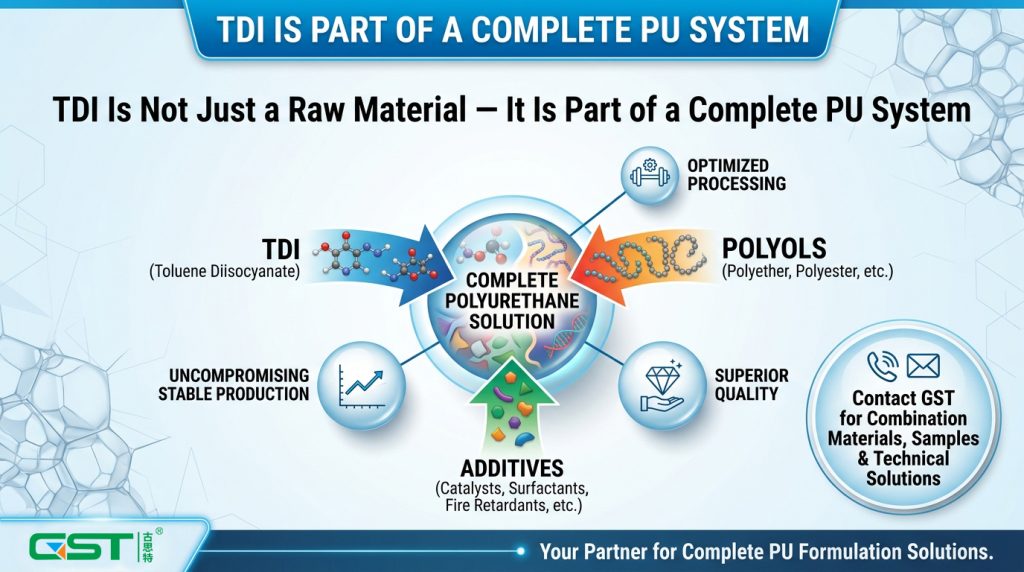
Choosing the right TDI is important, but achieving excellent polyurethane foam performance requires the right balance of the entire formulation.
With experience in PU combination materials and formulation development, GST helps customers move from individual raw materials to complete polyurethane solutions.
Need support with TDI-based PU formulation development or foam optimization?
Contact GST for combination materials, samples, and technical solutions.
PREVIOUS:What Is Polymeric MDI (pMDI)?
CATEGORIES
LATEST NEWS
- What Is TDI?
- What Is Polymeric MDI (pMDI)?
- What Is MDI?
- What Is Isocyanate?
- How to Select the Right Pol...
- How Does Polyol Affect Foam...
- What Is Hydroxyl Value (OH ...
- What Is Polyol Functionality?
- BASF Ludwigshafen Incident:...
- What Is Polyol Molecular We...
CONTACT US
Tel:+86 18688691634
Email:sam@1688pu.com
Add:No. 91 Central East Rd, Luxi Village, Gaobu Town, Dongguan 523283, China.