What Is Crosslinking in Polyurethane?
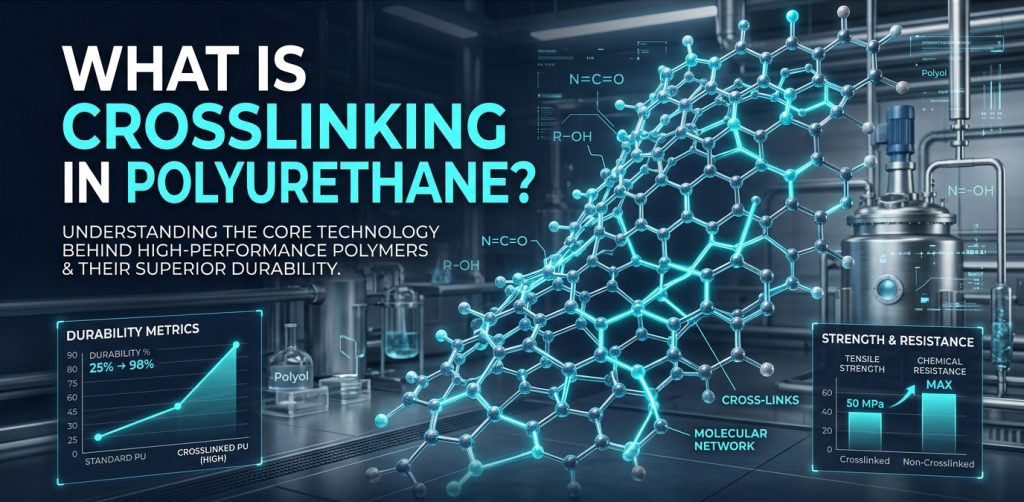
Polyurethane (PU) is known for its flexibility, strength, durability, and versatility. But behind these properties is a critical chemical process that is easy to overlook: crosslinking.
Crosslinking is one of the key factors that determines how a polyurethane material behaves after curing. It can influence hardness, elasticity, dimensional stability, heat resistance, chemical resistance, and durability.
So, what exactly is crosslinking in polyurethane? Why is it important? And how can the right PU formulation achieve the desired crosslinking level?
Let’s break it down.
1. What Is Crosslinking in Polyurethane?
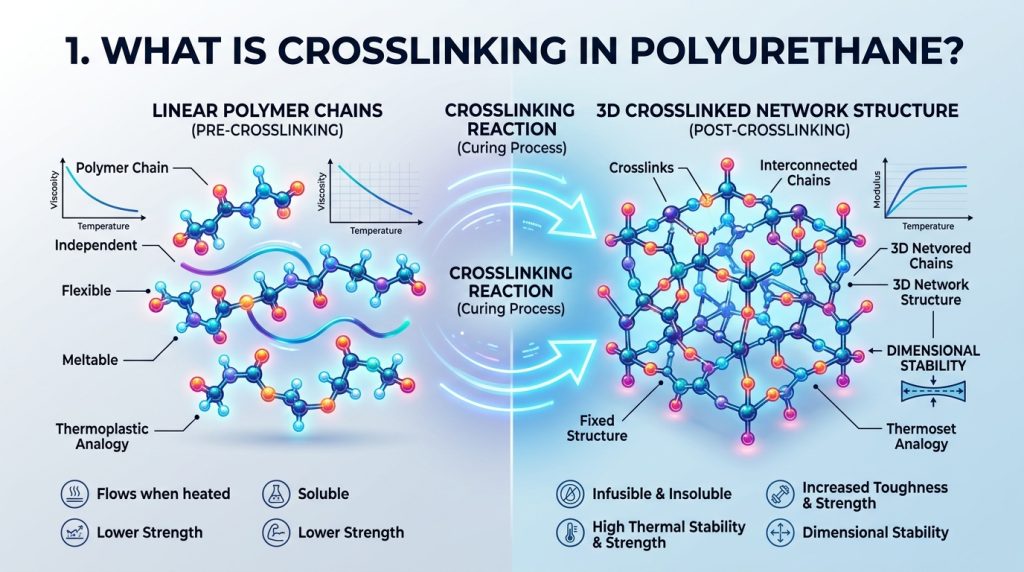
In simple terms, crosslinking is the formation of chemical connections between polymer chains, creating a three-dimensional network structure.
During polyurethane formation, isocyanates react with compounds containing active hydrogen groups, such as polyols. Depending on the functionality and formulation, some molecules can connect with multiple polymer chains.
Instead of having mostly independent polymer chains:
Polymer Chain → Polymer Chain → Polymer Chain
crosslinking creates a network:
Polymer Chain ↔ Polymer Chain ↔ Polymer Chain
This network structure can make the final polyurethane material more stable and resistant to deformation.
The degree of crosslinking is therefore an important factor in determining the final performance of PU products.
2. Why Does Polyurethane Need Crosslinking?
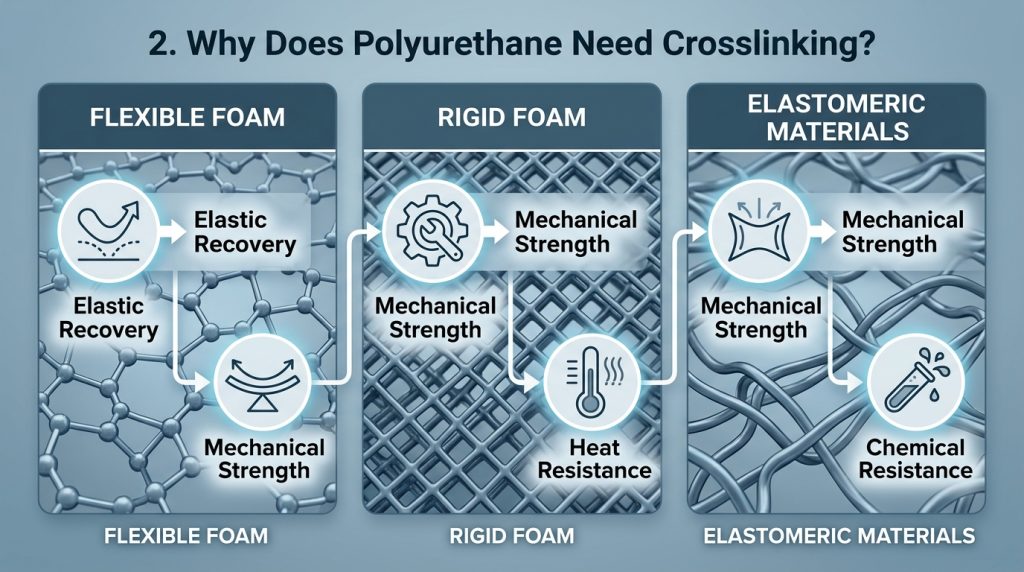
Not every polyurethane application requires the same degree of crosslinking.
A flexible foam, for example, needs enough network structure to maintain its shape while still allowing the material to deform and recover.
A rigid foam requires a stronger three-dimensional structure to achieve dimensional stability, rigidity, and insulation performance.
Crosslinking can help improve:
- Mechanical strength
- Elastic recovery
- Dimensional stability
- Heat resistance
- Chemical resistance
- Compression resistance
- Long-term durability
However, more crosslinking does not always mean better performance.
Too little crosslinking may result in poor strength, excessive deformation, or insufficient dimensional stability.
Too much crosslinking may make the material too hard, brittle, or less elastic.
The real goal is not “maximum crosslinking”—it is the right crosslinking structure for the application.
3. How Does Crosslinking Work in Polyurethane?
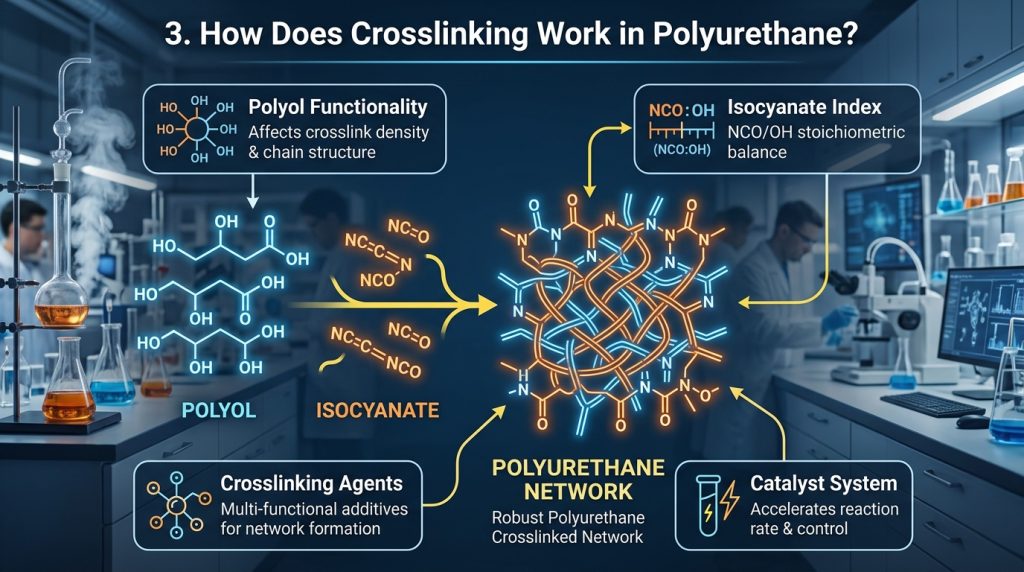
Crosslinking is closely related to the functionality of raw materials and the balance of the formulation.
Polyols with different functionalities provide different numbers of reactive sites. Isocyanates can react with these sites and form urethane and, under certain conditions, other structures that contribute to network formation.
The basic concept can be simplified as:
Polyol + Isocyanate → Polyurethane Network
Several factors can influence the resulting network structure:
Polyol Functionality
Higher-functionality polyols generally provide more opportunities for network formation.
Isocyanate Index
The ratio of isocyanate to active hydrogen groups has a major influence on the reaction balance and final properties.
Catalyst System
Catalysts control reaction speed and selectivity. The right catalyst package helps coordinate cream time, rise time, gel time, curing, and final network development.
Crosslinking Agents
Specific crosslinkers or chain extenders can be introduced when additional control over hardness, strength, elasticity, or network density is required.
Formulation & Processing Conditions
Temperature, moisture, mixing, mold conditions, and processing equipment can all influence the final polyurethane structure.
This is why polyurethane formulation is not simply about choosing raw materials—it is about controlling the entire reaction system.
4. Common Crosslinking Problems in Polyurethane
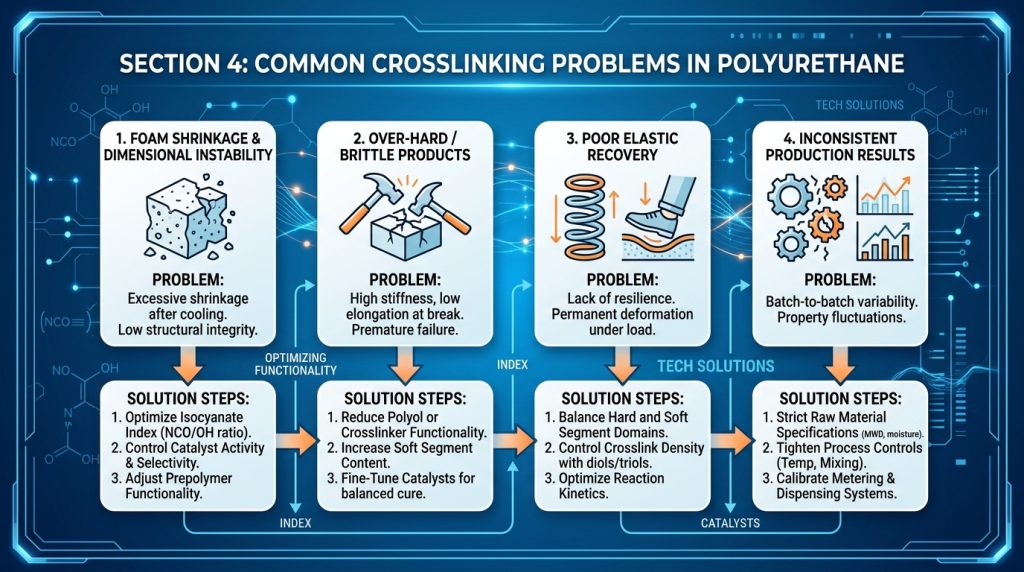
In actual production, crosslinking-related problems may appear as:
Problem 1: Foam Shrinkage or Poor Dimensional Stability
The network structure may not provide sufficient structural support, or the formulation and processing conditions may be unbalanced.
Possible solutions:
Optimize polyol functionality, isocyanate index, catalyst balance, foam density, and processing conditions.
Problem 2: Product Becomes Too Hard or Brittle
Excessive network density can reduce flexibility and elongation.
Possible solutions:
Adjust the polyol structure, crosslinker level, hard-segment content, and overall formulation balance.
Problem 3: Poor Elastic Recovery
Insufficient network structure or an inappropriate soft-segment/hard-segment balance may affect recovery.
Possible solutions:
Optimize polyol selection, crosslink density, catalyst system, and foam cell structure.
Problem 4: Inconsistent Production Results
Even a well-designed formulation can produce unstable results if raw materials, temperature, moisture, mixing, or equipment conditions fluctuate.
Possible solutions:
Control raw material specifications, reaction parameters, component ratios, and processing conditions as a complete system.
5. How Can Crosslinking Be Optimized?
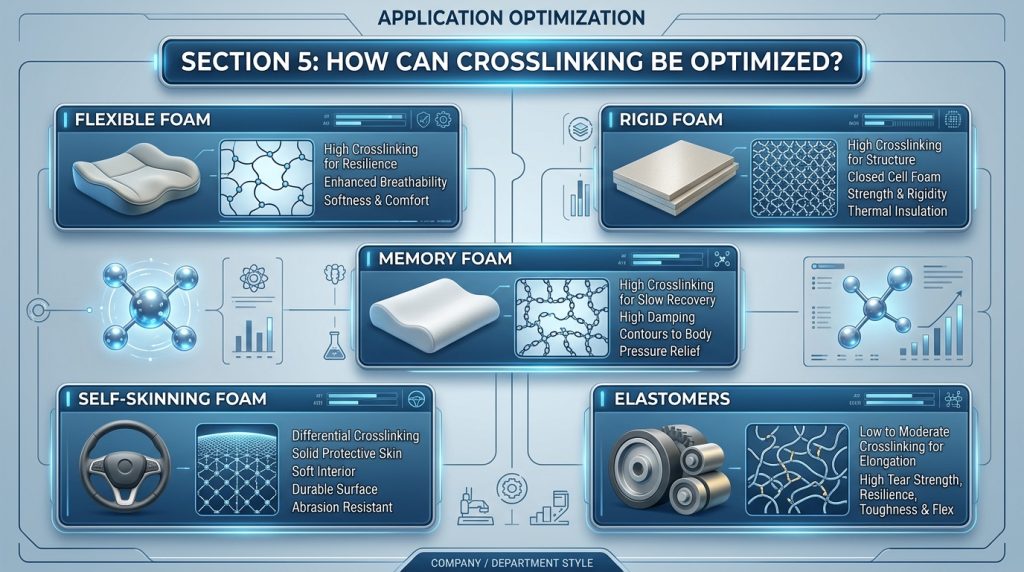
There is no universal crosslinking formula for every polyurethane application.
The ideal formulation depends on the final product.
For example:
Flexible Foam
Focuses on elasticity, softness, resilience, compression recovery, and comfort.
Rigid Foam
Requires a stable network structure for rigidity, dimensional stability, and thermal insulation.
Memory Foam
Needs a carefully controlled polymer network to balance slow recovery, softness, support, and durability.
Self-Skinning Foam
Requires coordinated control of reaction kinetics, density distribution, skin formation, and internal structure.
Elastomers
Require a carefully designed balance between flexibility, strength, hardness, and resistance to deformation.
Therefore, crosslinking should be considered as part of a complete polyurethane formulation strategy, rather than an isolated chemical parameter.
6. How Can GST Help?
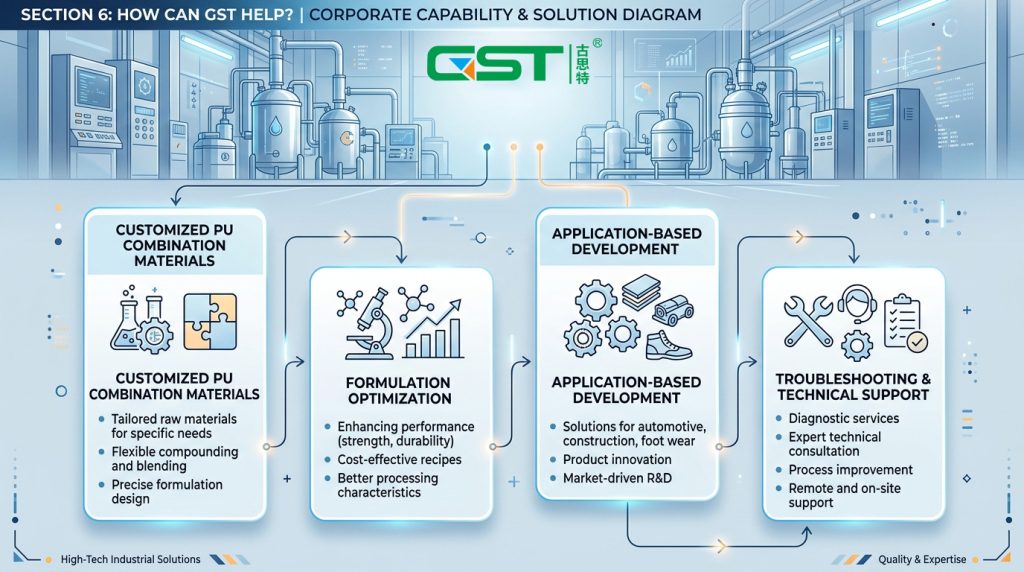
At GST, we understand that customers are not simply buying polyurethane raw materials—they are looking for a stable formulation and a reliable application solution.
GST provides polyurethane combination materials, formulation development, and technical support for different applications.
Our technical solutions can focus on:
Customized PU Combination Materials
Based on the customer’s product requirements, production process, equipment, and target properties, GST can develop suitable combination materials for different polyurethane applications.
Formulation Optimization
We can help optimize key parameters such as:
- Polyol structure and functionality
- Isocyanate index
- Catalyst balance
- Crosslinking level
- Density
- Hardness
- Resilience
- Reaction profile
Application-Based Development
Instead of focusing only on laboratory data, GST evaluates the actual production process and finished-product requirements.
From flexible foam and rigid foam to memory foam, self-skinning foam, elastomers, and other PU applications, formulation design can be adjusted according to the customer’s needs.
Troubleshooting & Technical Support
If you experience problems such as shrinkage, poor recovery, excessive hardness, brittleness, unstable density, slow curing, or inconsistent production, GST’s technical team can help analyze the formulation and processing conditions and develop an optimization strategy.
Conclusion
Crosslinking is one of the hidden factors behind polyurethane performance.
It determines how polymer chains connect, how the material responds to mechanical stress, and how well the final product maintains its properties over time.
But the key is balance.
The right crosslinking level, combined with the right polyols, isocyanates, catalysts, additives, processing conditions, and formulation design, can turn a basic PU reaction into a high-performance polyurethane product.
From formulation design to combination materials and application support, GST helps customers turn polyurethane chemistry into practical production solutions.
If you are looking for a customized polyurethane formulation or combination material, feel free to contact GST for technical consultation and application support.
PREVIOUS:What Is Polyurethane Polymerization?
CATEGORIES
LATEST NEWS
- Polyether Polyol vs Polyest...
- What Is Polyester Polyol?
- What Is Polyether Polyol?
- What Is Polyol?
- Why Is Reaction Balance Cri...
- Blowing Reaction vs Gelling...
- How Molecular Structure Det...
- Soft Segment vs Hard Segmen...
- What Is Crosslinking in Pol...
- What Is Polyurethane Polyme...
CONTACT US
Tel:+86 18688691634
Email:sam@1688pu.com
Add:No. 91 Central East Rd, Luxi Village, Gaobu Town, Dongguan 523283, China.