MDI vs TDI: What’s the Difference?

Choosing the right isocyanate is one of the most important decisions in polyurethane formulation. MDI and TDI are both key raw materials for polyurethane, but they differ in chemical structure, reactivity, processing behavior, and typical applications.
So, which one is right for your product—and how can the right formulation improve foam performance?
What Are MDI and TDI?
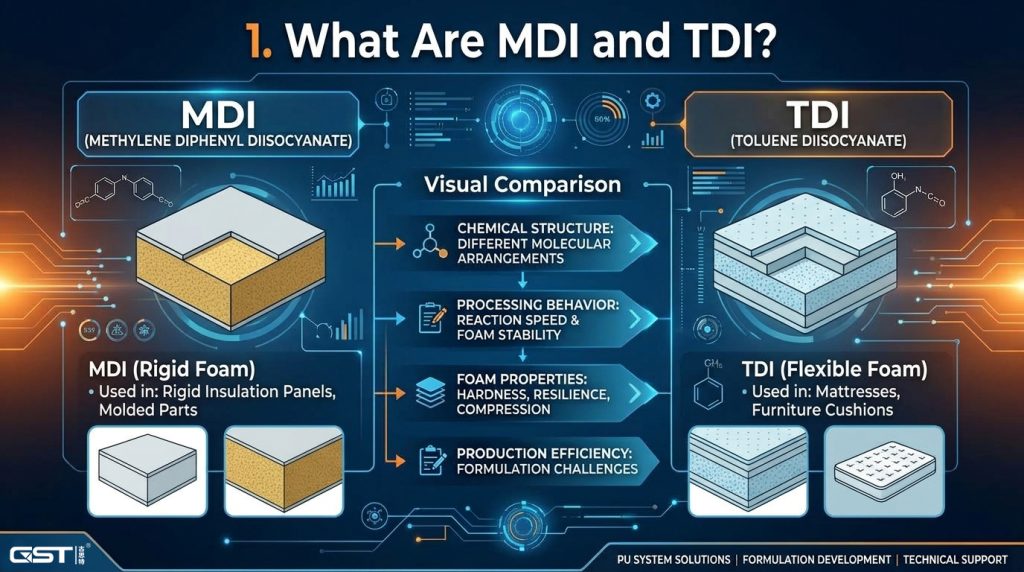
MDI stands for Methylene Diphenyl Diisocyanate, while TDI stands for Toluene Diisocyanate. Both contain reactive isocyanate groups that react with polyols to form polyurethane.
The main difference lies in their molecular structures and the types of products they are commonly used to manufacture.
- MDI (Methylene Diphenyl Diisocyanate): Commonly used in rigid insulation foam, flexible molded foam, integral-skin foam, and other polyurethane applications. Polymeric MDI (pMDI) is widely used in rigid foam systems.
- TDI (Toluene Diisocyanate): Widely used in flexible slabstock foam for mattresses, furniture cushions, and other cushioning products.
These are typical applications, not absolute limitations. The appropriate choice depends on the complete formulation and the required product performance.
Why Does the Choice Matter?
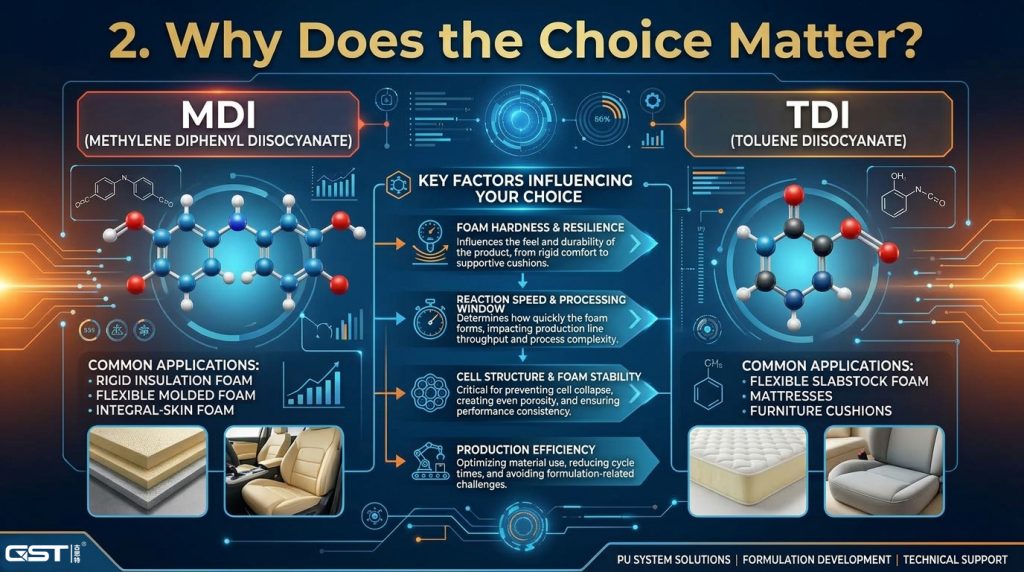
MDI and TDI can produce different processing behaviors and polymer structures. Selecting the wrong system for an application may lead to formulation challenges, unstable foaming, or unsatisfactory physical properties.
The choice can influence:
- Foam hardness and resilience
- Reaction speed and processing window
- Cell structure and foam stability
- Compression performance
- Dimensional stability
- Production efficiency
For manufacturers, the goal is not simply to choose MDI or TDI. It is to select an isocyanate system that works reliably with the polyol, catalysts, surfactants, blowing agents, and production process.
How Do MDI and TDI Work?
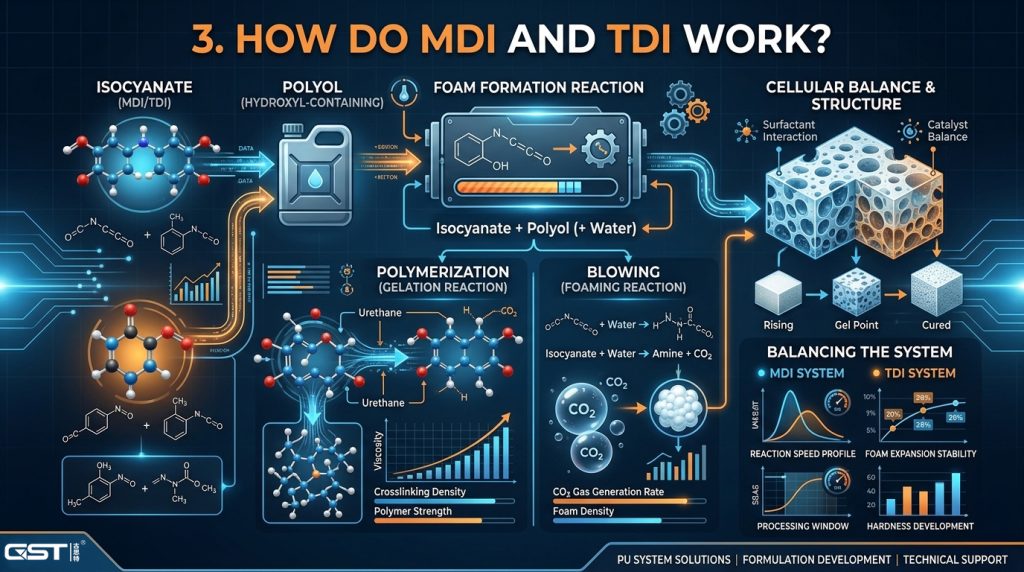
Both MDI and TDI react with hydroxyl groups in polyols to form polyurethane linkages.
In water-blown foam systems, isocyanates also react with water, generating carbon dioxide that helps expand the foam. Meanwhile, polymer formation builds the structure needed to stabilize the growing cells.
However, MDI and TDI differ in molecular structure and reaction behavior. Their effects on viscosity, crosslinking, reaction balance, and final foam properties depend on the specific grade and formulation.
The key is balancing the isocyanate with the entire PU system—not adjusting one ingredient in isolation.
Common Problems and How to Solve Them
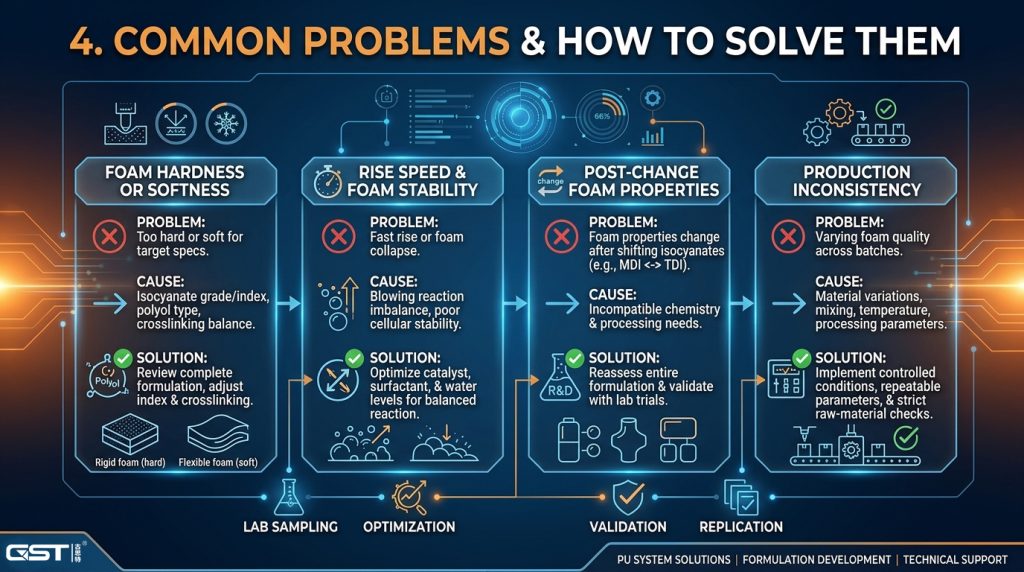
Problem 1: Foam Is Too Hard or Too Soft
The cause may involve the isocyanate grade, isocyanate index, polyol characteristics, density, or crosslinking balance.
Solution: Review the complete formulation and test adjustments against the target hardness, resilience, and compression performance.
Problem 2: Foam Rises Too Fast or Collapses
An imbalance between the blowing reaction and polymer-forming reaction can cause poor foam stability. Changing the isocyanate may also change the reaction profile.
Solution: Evaluate the catalyst system, water content, surfactant, polyol reactivity, isocyanate index, and processing temperature together.
Problem 3: Foam Properties Change After Switching Isocyanates
A formulation designed for TDI cannot automatically be transferred to an MDI-based system, or vice versa. Their chemistry and processing requirements may differ substantially.
Solution: Reassess the formulation, conduct laboratory trials, and validate the new system before full-scale production.
Problem 4: Production Is Inconsistent
Variations in raw materials, mixing, temperature, equipment, and processing conditions can all affect foam quality.
Solution: Establish suitable raw-material specifications, controlled processing conditions, and repeatable formulation parameters.
How Can GST Help?
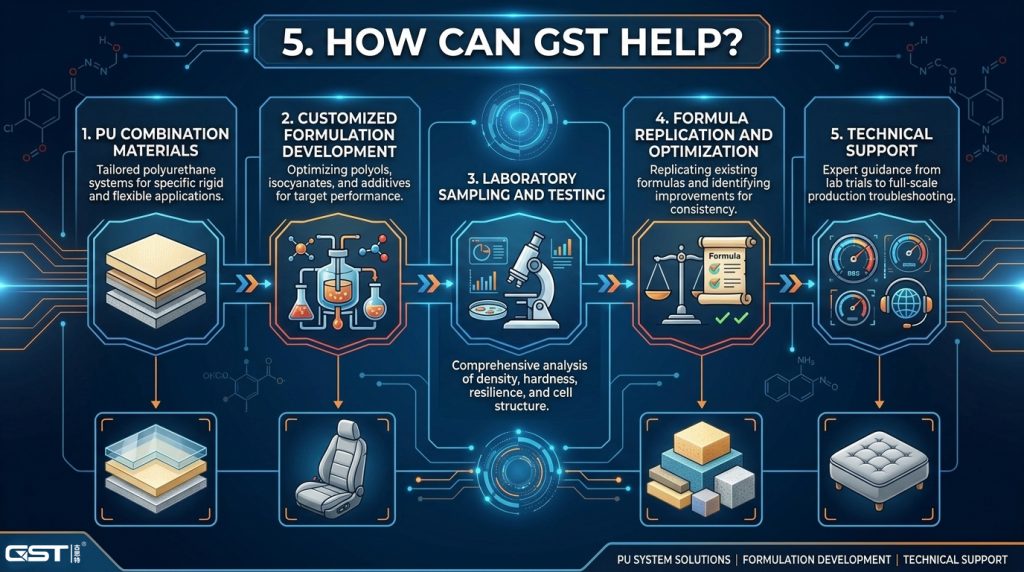
At GST, we focus on polyurethane system solutions—not simply the supply of individual raw materials.
Our team helps manufacturers match formulation design with their target application, foam performance, and production requirements.
PU Combination Materials
GST provides polyurethane combination materials for applications including high-resilience foam, flexible foam, rigid insulation foam, and other specialized PU products.
Customized Formulation Development
Our R&D team can optimize polyol selection, isocyanate compatibility, catalysts, surfactants, blowing agents, and additives to meet specific product requirements.
Laboratory Sampling and Testing
We can help evaluate foam density, hardness, resilience, cell structure, reaction behavior, and other relevant physical properties through formulation trials.
Formula Replication and Optimization
If you already have a foam sample or an existing formulation, GST can help assess the target performance and develop an appropriate optimization strategy.
Technical Support
From laboratory development to production trials, we help customers troubleshoot foaming problems and improve process consistency.
For many manufacturers, using a suitable, application-oriented PU combination material can reduce the need to develop a complete formulation from individual raw materials and help shorten the path to production validation.
Conclusion: MDI or TDI—which Is Better?
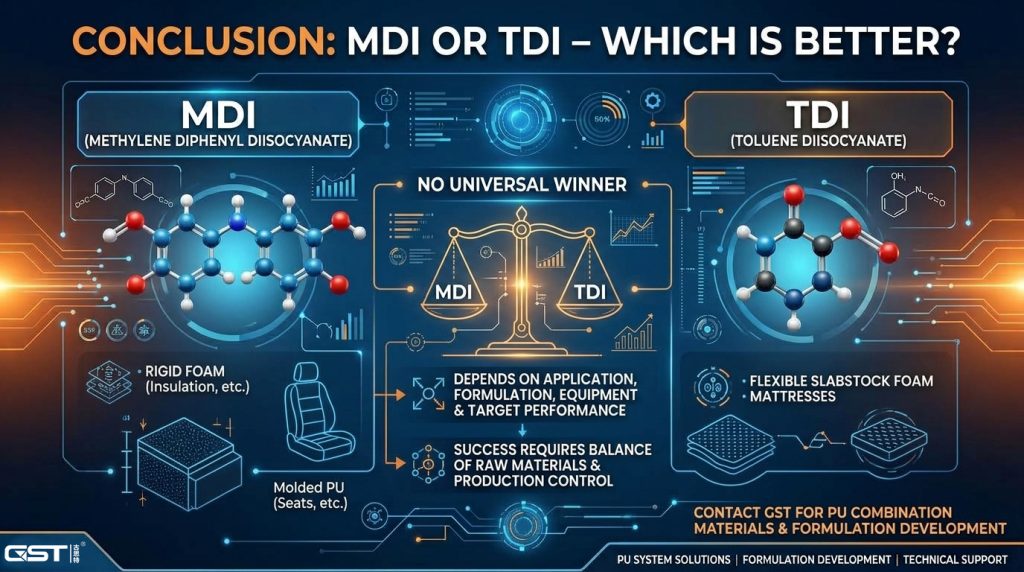
There is no universal winner.
MDI is widely used in rigid foam and many molded PU applications, while TDI is widely used in flexible slabstock foam. The right choice depends on the product, formulation, equipment, processing conditions, and target performance.
More importantly, selecting the right isocyanate is only the beginning. A successful polyurethane solution requires the right balance of raw materials, formulation design, and production control.
Need help choosing between MDI and TDI?
Contact GST for PU combination materials, customized formulation development, laboratory sampling, and technical support tailored to your application.
PREVIOUS:TDI 80/20 vs TDI 65/35
CATEGORIES
LATEST NEWS
- Aromatic vs Aliphatic Isocy...
- What Is Modified MDI?
- MDI vs TDI: What’s th...
- TDI 80/20 vs TDI 65/35
- What Is TDI?
- What Is Polymeric MDI (pMDI)?
- What Is MDI?
- What Is Isocyanate?
- How to Select the Right Pol...
- How Does Polyol Affect Foam...
CONTACT US
Tel:+86 18688691634
Email:sam@1688pu.com
Add:No. 91 Central East Rd, Luxi Village, Gaobu Town, Dongguan 523283, China.