What Is Modified MDI?
When polyurethane manufacturers need better processing, controlled reactivity, or specific foam and elastomer performance, standard MDI may not always be the most convenient choice.
That’s where Modified MDI comes in.
But what exactly is Modified MDI, why is it used, and how can it help improve polyurethane production?
What Is Modified MDI?
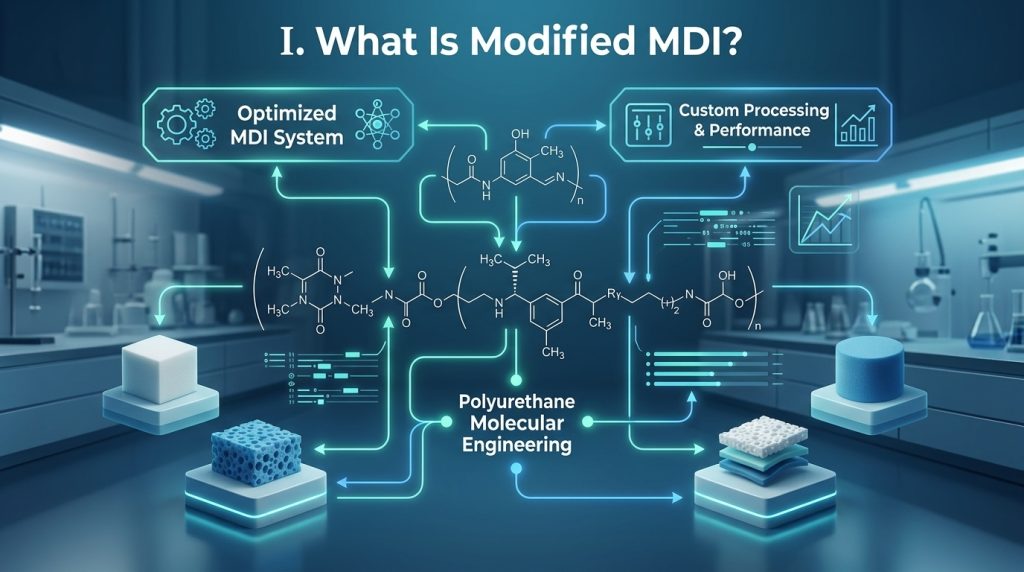
Modified MDI refers to MDI that has been chemically modified or formulated to provide specific processing or performance characteristics.
Compared with conventional MDI, modified MDI can be designed to offer different properties such as:
- Improved fluidity and processability
- Adjusted reactivity
- Better compatibility with polyols
- Controlled viscosity
- Improved flexibility or elasticity
- Specific mechanical performance
The exact characteristics depend on the modification technology and the intended application.
In simple terms:
Modified MDI is not simply another grade of MDI—it is an MDI system optimized for a specific formulation or processing requirement.
Why Do We Need Modified MDI?
Different polyurethane applications have different requirements.
A standard MDI system may work well for one application but create processing or performance challenges in another.
Modified MDI can help manufacturers achieve a better balance between processing behavior and final product performance.
It can be useful when manufacturers need:
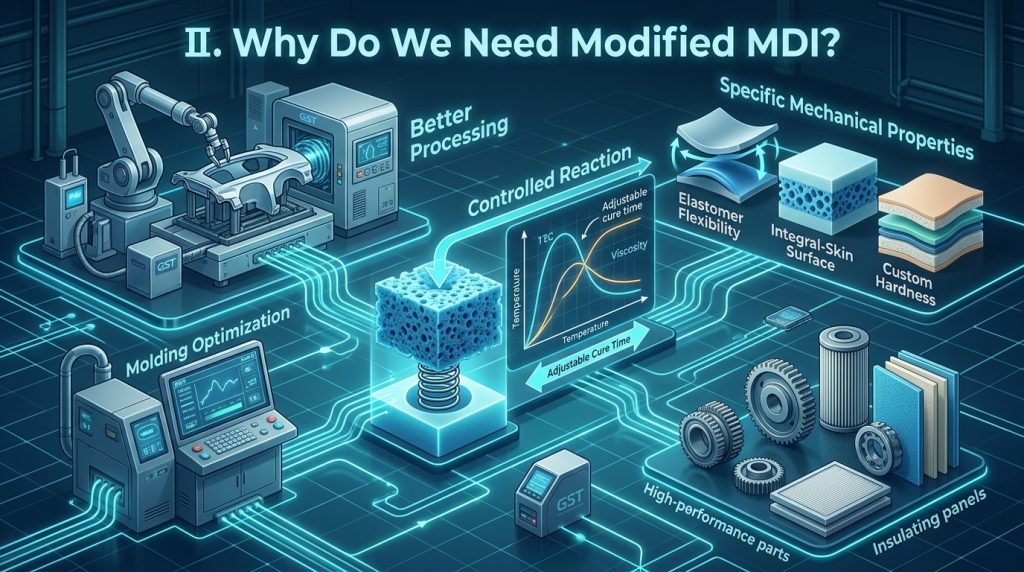
Better Processing
Suitable viscosity and flow behavior can make mixing, metering, and molding easier.
Controlled Reaction
The reaction profile can be adjusted to match the polyol system and production process.
Specific Mechanical Properties
Depending on the formulation, modified MDI can contribute to the desired hardness, flexibility, resilience, strength, or durability.
Application Flexibility
Modified MDI systems are used in various polyurethane applications, including molded foam, elastomers, integral-skin products, and other specialized PU systems.
How Does Modified MDI Work?
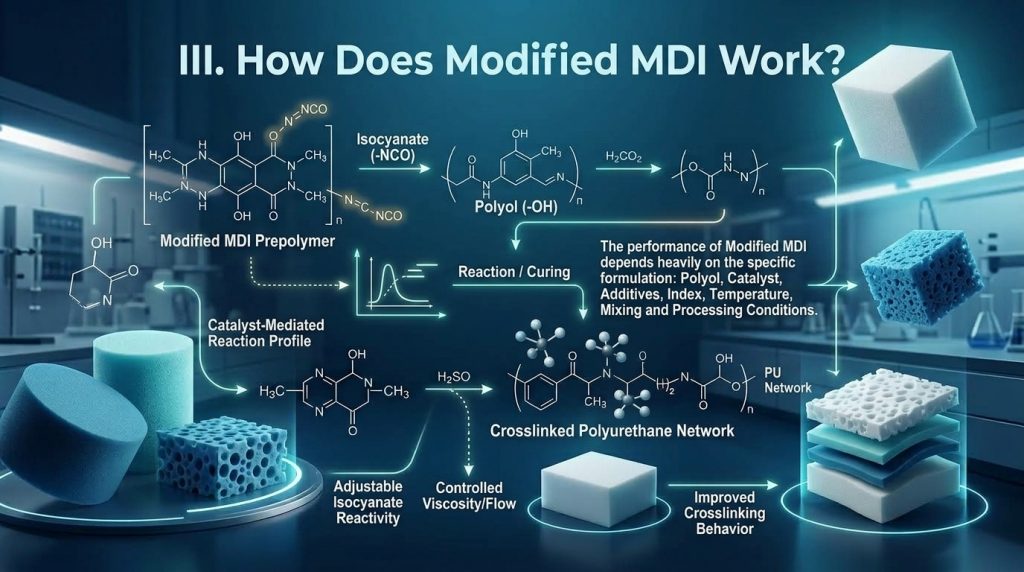
Like conventional MDI, modified MDI contains reactive isocyanate groups (-NCO).
These groups react with hydroxyl-containing components such as polyols to form polyurethane structures.
The important difference is that modification changes the chemical or physical characteristics of the MDI system.
This can influence:
- Reaction kinetics
- Viscosity
- Crosslinking behavior
- Compatibility
- Processing window
- Final polymer structure
However, Modified MDI cannot be evaluated independently.
Its performance depends heavily on the polyol, catalyst, additives, isocyanate index, temperature, mixing conditions, and processing method.
That’s why replacing a conventional MDI with a modified grade without rechecking the formulation may not produce the expected result.
Common Problems When Using Modified MDI
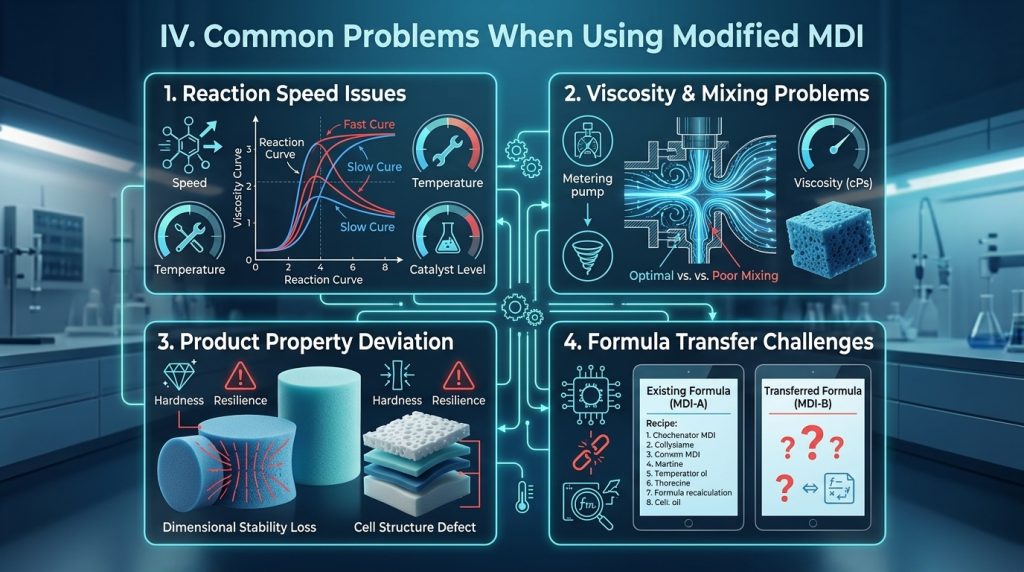
1. Reaction Is Too Fast or Too Slow
A modified MDI system may have a different reaction profile from the original isocyanate.
Solution: Review the catalyst system, polyol reactivity, temperature, and isocyanate index together rather than adjusting one parameter blindly.
2. Viscosity or Mixing Problems
Differences in viscosity can affect metering, mixing, and material flow.
Solution: Check the compatibility between Modified MDI and the polyol system and optimize processing temperature and mixing conditions where appropriate.
3. Foam or Product Properties Are Not as Expected
Changing the isocyanate can change hardness, resilience, cell structure, dimensional stability, or mechanical properties.
Solution: Rebalance the complete formulation and validate it through laboratory and production trials.
4. Existing Formula Cannot Be Directly Transferred
A formula developed for one MDI grade may not perform identically with another.
Solution: Establish a new formulation window based on the specific Modified MDI grade and target application.
How Can GST Help?
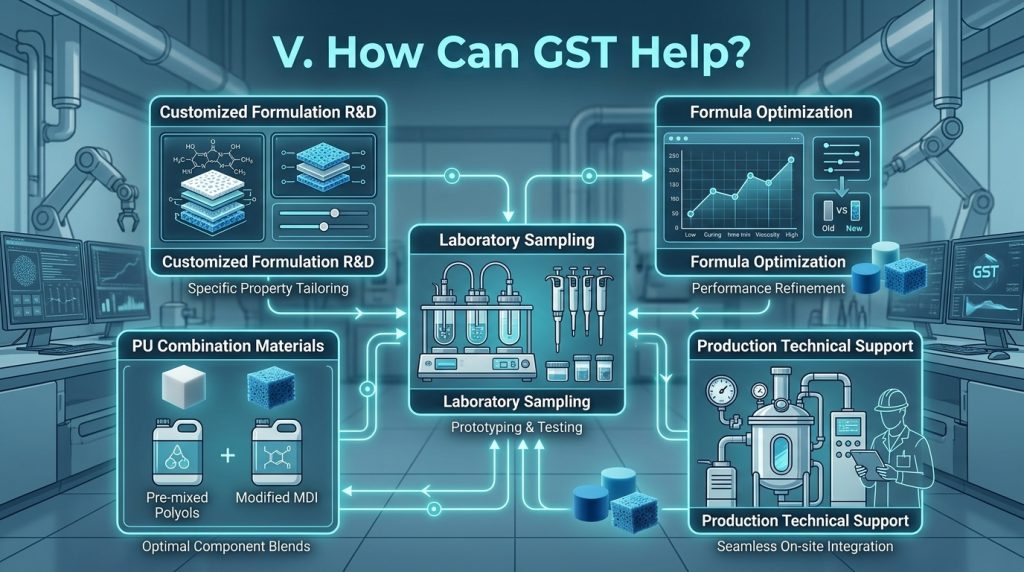
At GST, we look at Modified MDI as part of a complete polyurethane system—not as an isolated raw material.
Our R&D team can help manufacturers evaluate the relationship between Modified MDI, polyol, catalysts, surfactants, additives, and processing conditions.
PU Combination Materials
GST can provide application-oriented polyurethane combination materials designed around specific foam and product requirements.
Customized Formulation Development
We can adjust the formulation according to target hardness, density, resilience, flexibility, reaction time, mechanical properties, and processing requirements.
Laboratory Sampling
Before moving into mass production, GST can conduct laboratory trials to evaluate reaction behavior and physical properties.
Formula Optimization
If you are switching from conventional MDI to Modified MDI, or experiencing problems with an existing formulation, GST can help identify the key variables and optimize the system.
Production Technical Support
From laboratory formulation to production trials, GST can provide technical guidance to help manufacturers achieve more stable processing and consistent product quality.
Modified MDI Is a Tool—Not a Universal Solution
Modified MDI can provide valuable advantages, but there is no single Modified MDI that is suitable for every polyurethane application.
The right choice depends on the polyol system, target properties, processing equipment, temperature, formulation design, and end-use application.
The real question is not simply:
“Which Modified MDI should I use?”
It is:
“Which Modified MDI + polyol + formulation system can reliably deliver my target performance?”
That’s where GST can make a difference.
With PU combination materials, formulation R&D, laboratory testing, and production technical support, GST helps manufacturers move from individual raw-material selection toward a complete, application-specific polyurethane solution.
Need to optimize a Modified MDI formulation? Contact GST for a sample system and technical evaluation.
PREVIOUS:MDI vs TDI: What’s the Difference?
CATEGORIES
LATEST NEWS
- Aromatic vs Aliphatic Isocy...
- What Is Modified MDI?
- MDI vs TDI: What’s th...
- TDI 80/20 vs TDI 65/35
- What Is TDI?
- What Is Polymeric MDI (pMDI)?
- What Is MDI?
- What Is Isocyanate?
- How to Select the Right Pol...
- How Does Polyol Affect Foam...
CONTACT US
Tel:+86 18688691634
Email:sam@1688pu.com
Add:No. 91 Central East Rd, Luxi Village, Gaobu Town, Dongguan 523283, China.