Aromatic vs Aliphatic Isocyanates
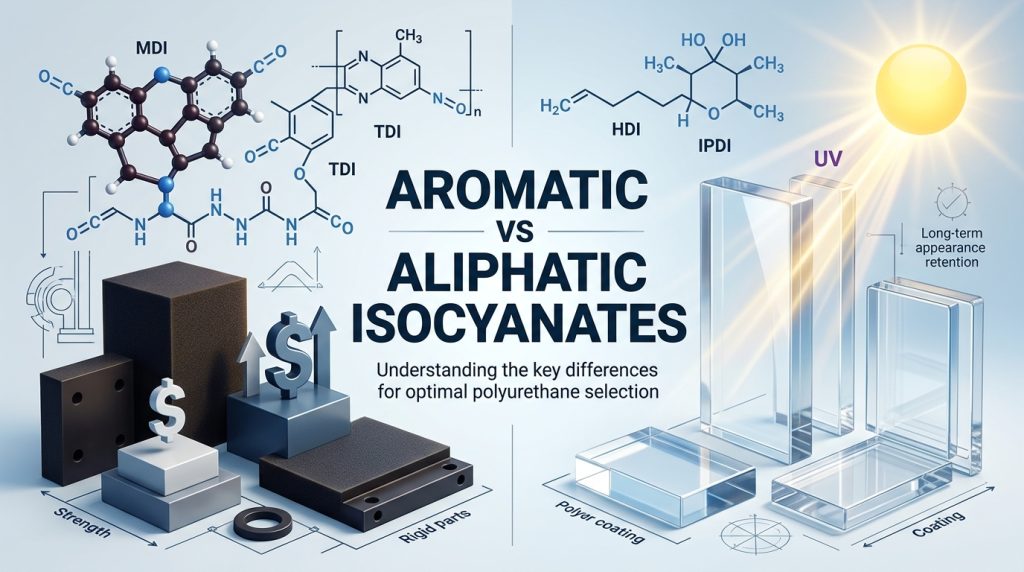
When selecting an isocyanate for a polyurethane system, one question often comes up:
Should you use an aromatic or aliphatic isocyanate?
The answer depends on the application. The two types have different chemical structures, performance characteristics, and typical use cases.
Understanding the difference can help manufacturers choose a more suitable PU formulation.
What Are Aromatic and Aliphatic Isocyanates?
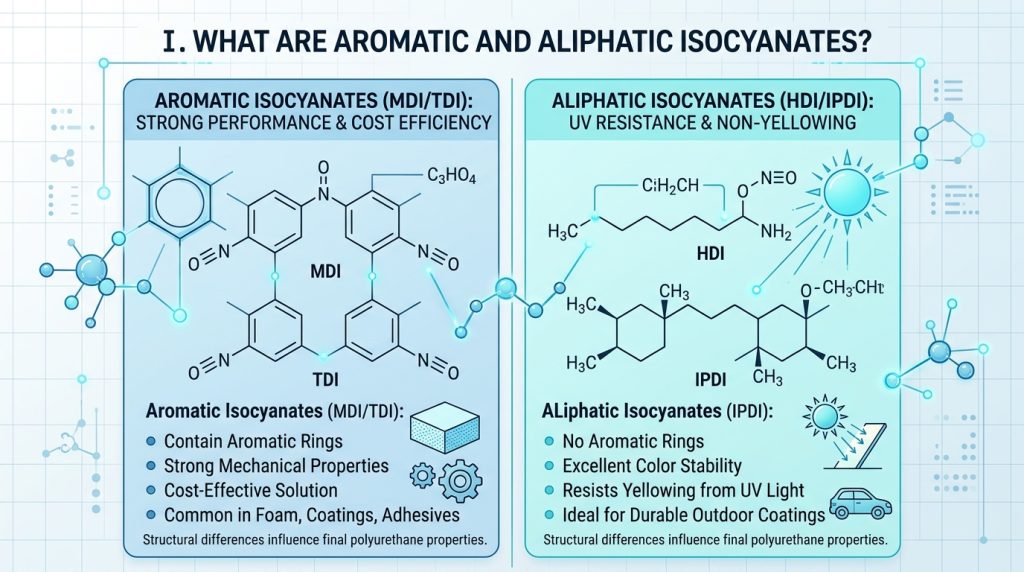
The main difference is their molecular structure.
Aromatic isocyanates contain aromatic rings in their molecular structure. Common examples include MDI and TDI.
Aliphatic isocyanates do not contain aromatic rings. Common examples include HDI, IPDI, and H12MDI.
This structural difference can strongly influence the final polyurethane’s properties.
In simple terms:
Aromatic isocyanates → strong performance and cost efficiency
Aliphatic isocyanates → better color stability and UV resistance
These are general characteristics, and actual performance depends on the specific grade and formulation.
Why Does the Choice Matter?
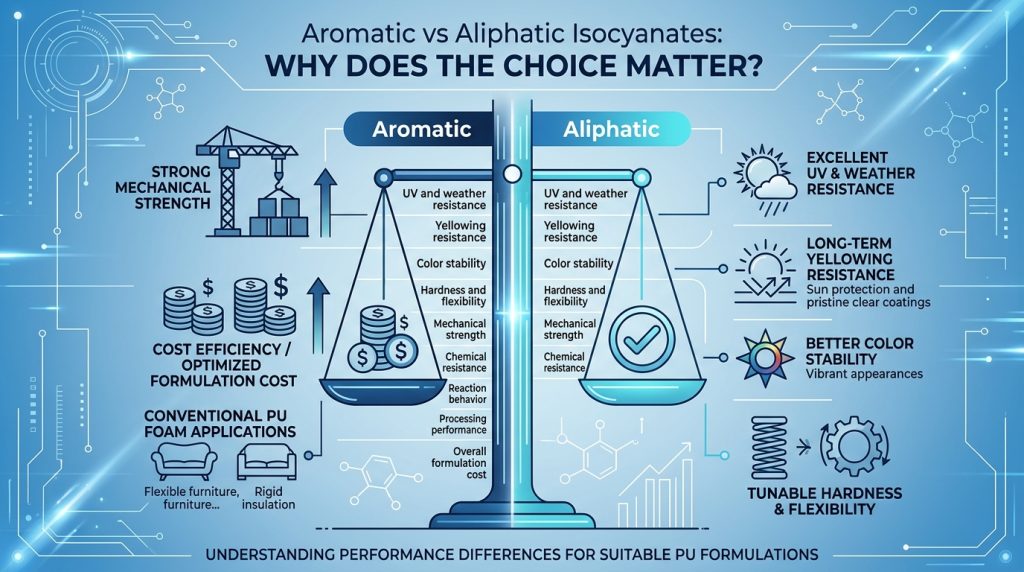
The choice of isocyanate can affect:
- UV and weather resistance
- Yellowing resistance
- Color stability
- Hardness and flexibility
- Mechanical strength
- Chemical resistance
- Reaction behavior
- Processing performance
- Overall formulation cost
For applications exposed to sunlight or where long-term color stability is critical, aliphatic isocyanates may be preferred.
For many conventional PU foam applications where mechanical performance and cost efficiency are important, aromatic isocyanates are widely used.
How Do They Work?
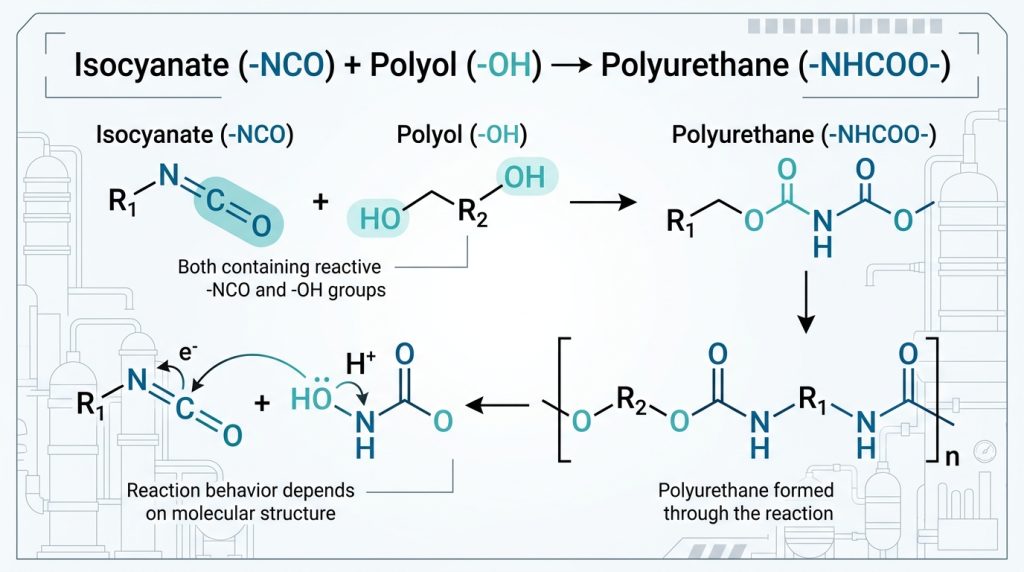
Both aromatic and aliphatic isocyanates contain reactive –NCO groups.
These groups react with hydroxyl groups in polyols to form polyurethane.
The difference in molecular structure affects the properties of the resulting polymer.
Aromatic isocyanates generally provide strong mechanical performance and are widely used in flexible and rigid polyurethane systems.
Aliphatic isocyanates are particularly valuable when UV stability, non-yellowing performance, and appearance retention are important.
However, the isocyanate cannot be evaluated alone.
Polyol type, catalyst, crosslinking, isocyanate index, additives, processing temperature, and curing conditions all influence the final result.
The right performance comes from the complete formulation—not from one raw material.
Common Problems and How to Solve Them
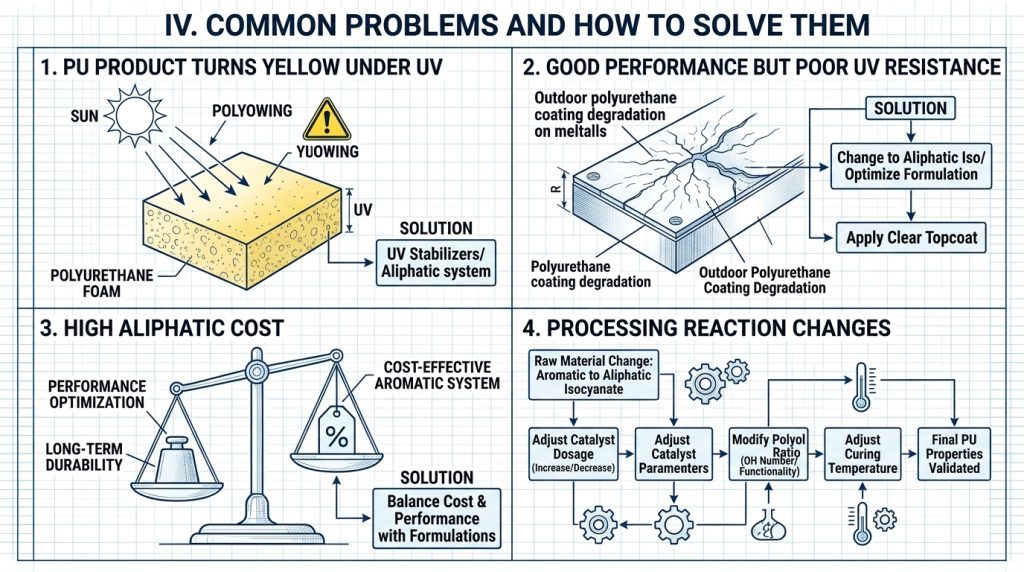
1. PU Product Turns Yellow
This is a common concern when aromatic polyurethane systems are exposed to UV light.
Solution: If long-term color stability is critical, consider an aliphatic isocyanate system or develop a formulation with suitable UV stabilizers and additives.
2. Performance Is Good but UV Resistance Is Poor
A formulation may have excellent mechanical properties but still show color or surface changes after outdoor exposure.
Solution: Evaluate the complete system and consider whether an aliphatic isocyanate is more appropriate for the application.
3. Aliphatic System Is Too Expensive
Aliphatic isocyanates can increase formulation cost compared with conventional aromatic systems.
Solution: Select the isocyanate according to the actual performance requirement rather than automatically using the more expensive option. A hybrid or optimized formulation may sometimes provide a better cost-performance balance.
4. Reaction or Processing Changes After Switching Isocyanates
Replacing an aromatic isocyanate with an aliphatic one can change reaction behavior and processing conditions.
Solution: Re-evaluate the polyol, catalyst, isocyanate index, additives, temperature, and curing conditions rather than directly transferring the original formula.
How Can GST Help?
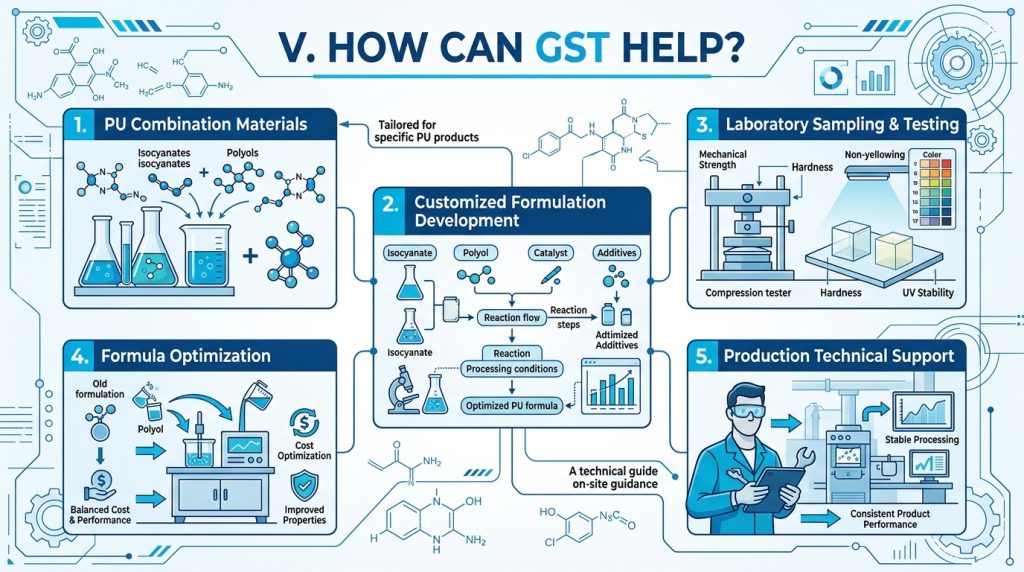
At GST, we don’t simply recommend an isocyanate based on its name or price.
We look at the complete application and formulation requirements.
PU Combination Materials
GST can provide application-specific PU combination materials for different polyurethane products and performance requirements.
Customized Formulation Development
Our R&D team can evaluate the compatibility between different isocyanates and polyols and optimize catalysts, additives, crosslinking, and isocyanate index.
Laboratory Sampling & Testing
We can compare formulations based on target properties such as hardness, resilience, mechanical strength, color stability, and processing behavior.
Formula Optimization
If you are switching from an aromatic to an aliphatic system, or trying to improve UV resistance and color stability, GST can help optimize the formulation instead of simply replacing one raw material.
Production Technical Support
From laboratory trials to production validation, GST can provide technical guidance to help manufacturers achieve stable processing and consistent product performance.
Aromatic or Aliphatic—Which Is Better?
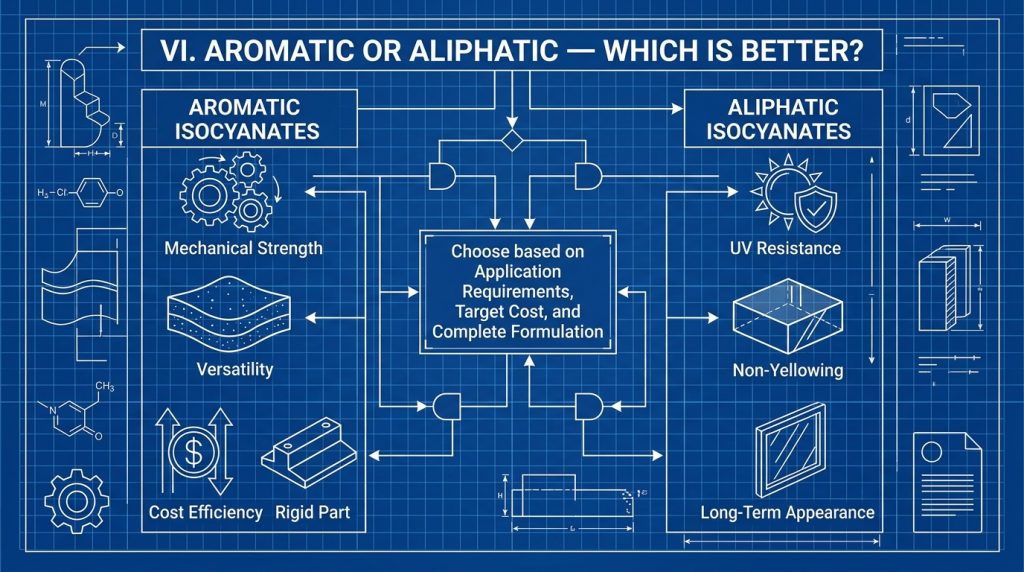
There is no universal winner.
Aromatic isocyanates are often selected for their mechanical performance, versatility, and cost efficiency.
Aliphatic isocyanates are especially valuable when UV resistance, non-yellowing performance, and long-term appearance are critical.
The best choice depends on the application, required performance, production process, and target cost.
The real question is not:
“Which isocyanate is better?”
It is:
“Which isocyanate and formulation can deliver the performance my application actually needs?”
That’s where GST can help.
With PU combination materials, formulation R&D, laboratory testing, and technical support, GST helps manufacturers develop practical polyurethane solutions based on real application requirements.
Need help choosing the right isocyanate system? Contact GST for formulation evaluation and sample development.
PREVIOUS:What Is Modified MDI?
CATEGORIES
LATEST NEWS
- Aromatic vs Aliphatic Isocy...
- What Is Modified MDI?
- MDI vs TDI: What’s th...
- TDI 80/20 vs TDI 65/35
- What Is TDI?
- What Is Polymeric MDI (pMDI)?
- What Is MDI?
- What Is Isocyanate?
- How to Select the Right Pol...
- How Does Polyol Affect Foam...
CONTACT US
Tel:+86 18688691634
Email:sam@1688pu.com
Add:No. 91 Central East Rd, Luxi Village, Gaobu Town, Dongguan 523283, China.