How to Choose the Right Isocyanate?
Choosing an isocyanate is one of the first—and most important—decisions in polyurethane formulation.
But with options such as TDI, MDI, Modified MDI, and aliphatic isocyanates, how do you know which one is right for your application?
The answer is not simply based on price or chemical name.
The right isocyanate is the one that works with your polyol system, processing conditions, and target product performance.
What Is an Isocyanate?
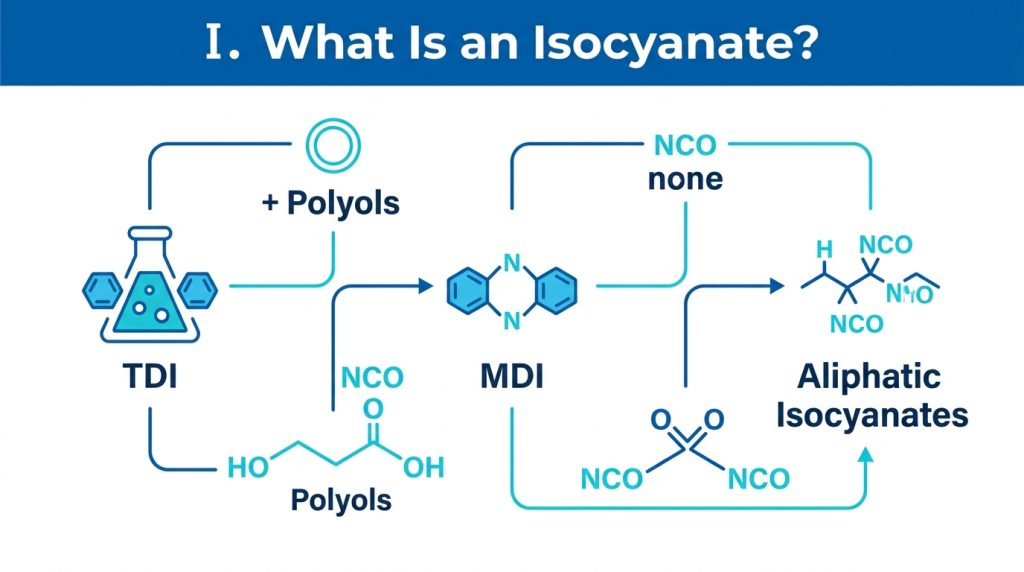
Isocyanates are highly reactive components used to produce polyurethane.
They react with polyols and other active-hydrogen-containing components to form the polyurethane polymer structure.
Common polyurethane isocyanates include:
- TDI – widely used in flexible foam
- MDI – widely used in rigid foam and various molded PU applications
- Modified MDI – designed for specific processing and performance requirements
- Aliphatic Isocyanates – often selected when UV resistance and color stability are important
Each type has different chemical characteristics, so selecting the right one is critical.
Why Does Isocyanate Selection Matter?
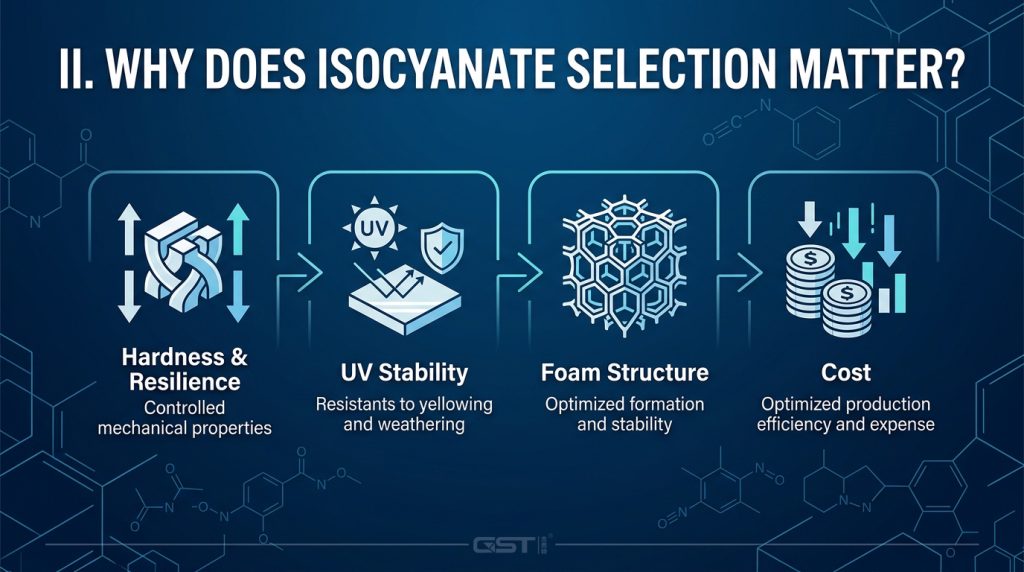
The isocyanate affects much more than the chemical reaction.
It can influence:
- Hardness and resilience
- Reaction speed
- Foam rise and stability
- Cell structure
- Mechanical strength
- Dimensional stability
- UV and yellowing resistance
- Processing window
- Production cost
For example, a flexible foam formulation may require a different isocyanate system from a rigid insulation foam or a UV-resistant PU coating.
One isocyanate cannot be the best solution for every application.
How Does Isocyanate Work?
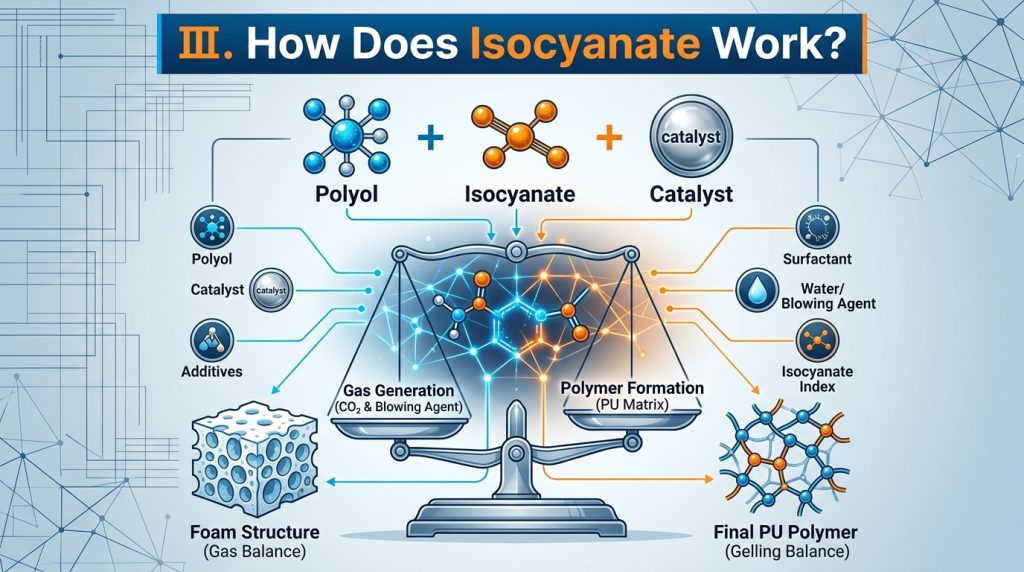
During polyurethane production, the –NCO groups in the isocyanate react with hydroxyl groups in polyols to form polyurethane.
In foam systems, isocyanate also interacts with water and other formulation components, contributing to the balance between gas generation, polymer formation, and foam stabilization.
This means the isocyanate must be matched with:
Polyol + Catalyst + Surfactant + Water/Blowing Agent + Additives + Isocyanate Index
Changing one component can change the behavior of the entire system.
That’s why choosing an isocyanate should always be considered as part of formulation design, rather than as an isolated raw-material decision.
How Do You Choose the Right Isocyanate?
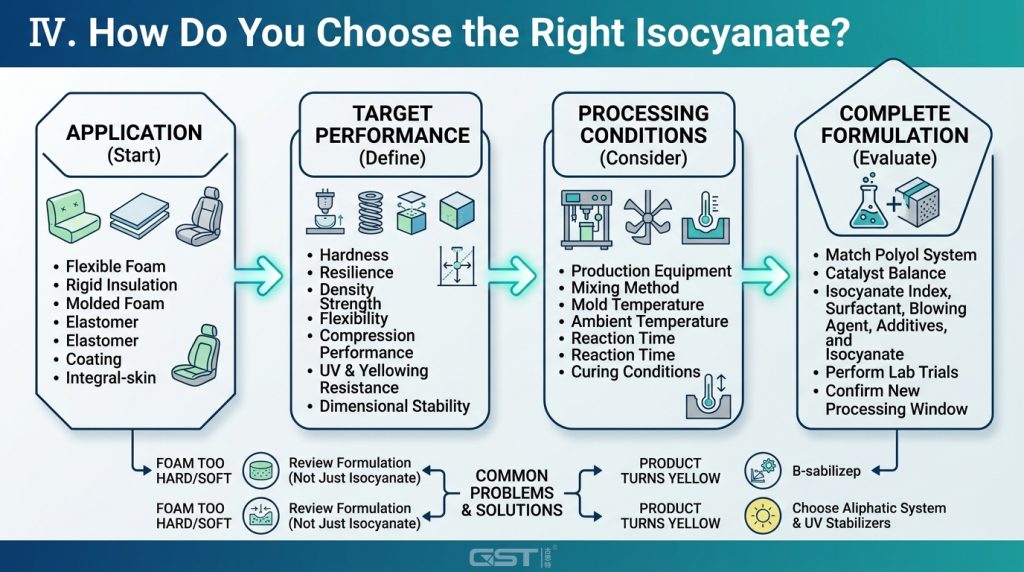
1. Start With the Application
Ask what you are making.
Flexible foam?
Rigid insulation?
Molded foam?
Elastomer?
Coating?
Integral-skin product?
The application determines the performance requirements and narrows down the suitable isocyanate systems.
2. Define the Target Performance
Consider the required:
- Hardness
- Resilience
- Density
- Strength
- Flexibility
- Compression performance
- UV resistance
- Color stability
- Dimensional stability
The isocyanate should be selected according to the required final properties—not simply what is easiest to purchase.
3. Consider Processing Conditions
Production equipment, mixing method, mold temperature, ambient temperature, reaction time, and curing conditions can all affect isocyanate selection.
A material that works well in the laboratory may require further adjustment before it performs consistently in mass production.
4. Evaluate the Complete Formulation
The right isocyanate still needs the right polyol and additives.
For example, changing from TDI to MDI, or from an aromatic to an aliphatic isocyanate, may require adjustments to the polyol system, catalyst balance, isocyanate index, and processing conditions.
Never assume that an existing formula can simply be transferred to another isocyanate.
Common Problems and How to Solve Them
Foam Is Too Hard or Too Soft
Possible causes include the isocyanate index, polyol characteristics, density, or crosslinking balance.
Solution: Review the complete formulation instead of changing the isocyanate alone.
Foam Rises Too Fast or Collapses
An imbalance between blowing and gelling reactions can lead to unstable foam.
Solution: Optimize the isocyanate, polyol, catalyst, water, surfactant, and processing conditions together.
Product Turns Yellow
This can be a concern in applications exposed to UV light, particularly with aromatic polyurethane systems.
Solution: Consider an appropriate aliphatic isocyanate system or optimize UV stabilizers and the overall formulation.
Production Becomes Unstable After Changing Isocyanate
Different isocyanates can have different reaction and processing characteristics.
Solution: Conduct laboratory trials and establish a new formulation and processing window before full-scale production.
How Can GST Help?
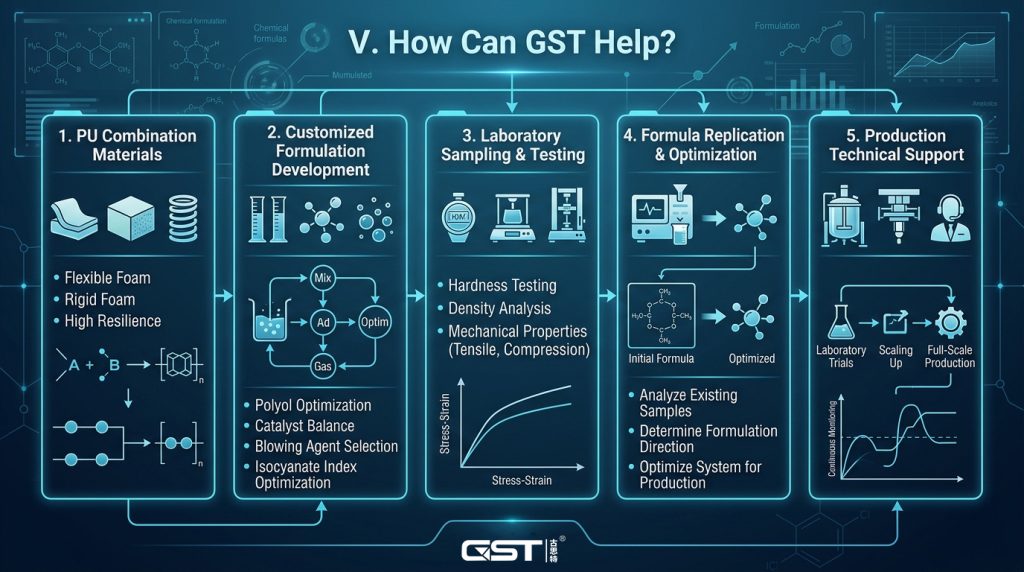
At GST, we believe selecting an isocyanate is only the beginning.
Our R&D team focuses on matching the isocyanate + polyol + additives + processing conditions to the customer’s actual application.
PU Combination Materials
GST can provide application-specific PU combination materials for flexible foam, high-resilience foam, rigid foam, molded products, and other polyurethane applications.
Customized Formulation Development
We can optimize polyol systems, isocyanate selection, catalysts, surfactants, blowing agents, additives, and isocyanate index according to the target performance.
Laboratory Sampling & Testing
We can develop and test samples based on requirements such as hardness, density, resilience, cell structure, mechanical properties, and processing behavior.
Formula Replication & Optimization
If you already have an existing foam or product sample, GST can help identify the formulation direction and optimize the system for your production requirements.
Production Technical Support
From laboratory development to production trials, GST can provide technical guidance to help manufacturers achieve more stable processing and consistent product quality.
The Right Isocyanate Is Part of the Right System
There is no universal “best” isocyanate.
TDI, MDI, Modified MDI, and aliphatic isocyanates all have their own advantages and application areas.
The better question is:
Which isocyanate can work with my formulation and production process to deliver the performance I need?
That’s where formulation expertise becomes important.
GST combines PU combination materials, formulation R&D, laboratory testing, and technical support to help manufacturers move from raw-material selection to a complete polyurethane solution.
Not sure which isocyanate is right for your application? Contact GST for formulation evaluation and sample development.
PREVIOUS:Aromatic vs Aliphatic Isocyanates
CATEGORIES
LATEST NEWS
- What Is a Polyurethane Cata...
- What Is Isocyanate Index?
- How to Choose the Right Iso...
- Aromatic vs Aliphatic Isocy...
- What Is Modified MDI?
- MDI vs TDI: What’s th...
- TDI 80/20 vs TDI 65/35
- What Is TDI?
- What Is Polymeric MDI (pMDI)?
- What Is MDI?
CONTACT US
Tel:+86 18688691634
Email:sam@1688pu.com
Add:No. 91 Central East Rd, Luxi Village, Gaobu Town, Dongguan 523283, China.