What Is Isocyanate Index?
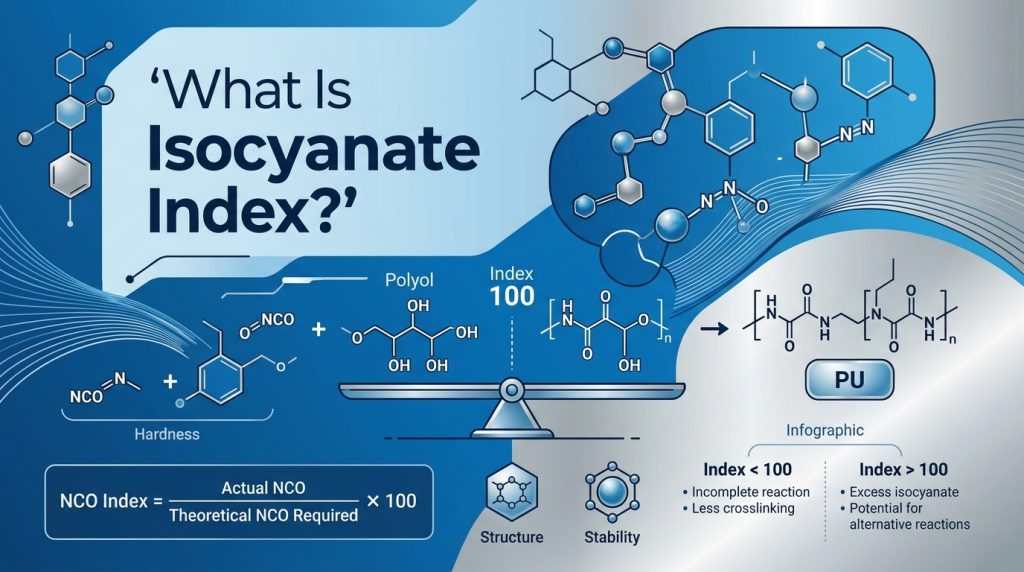
In polyurethane (PU) foam production, small formulation adjustments can lead to significant changes in foam performance. One important parameter is the Isocyanate Index, also known as the NCO Index. It helps determine the balance between isocyanate and the active hydrogen compounds in a formulation, directly influencing foam properties and processing stability.
What Is Isocyanate Index?
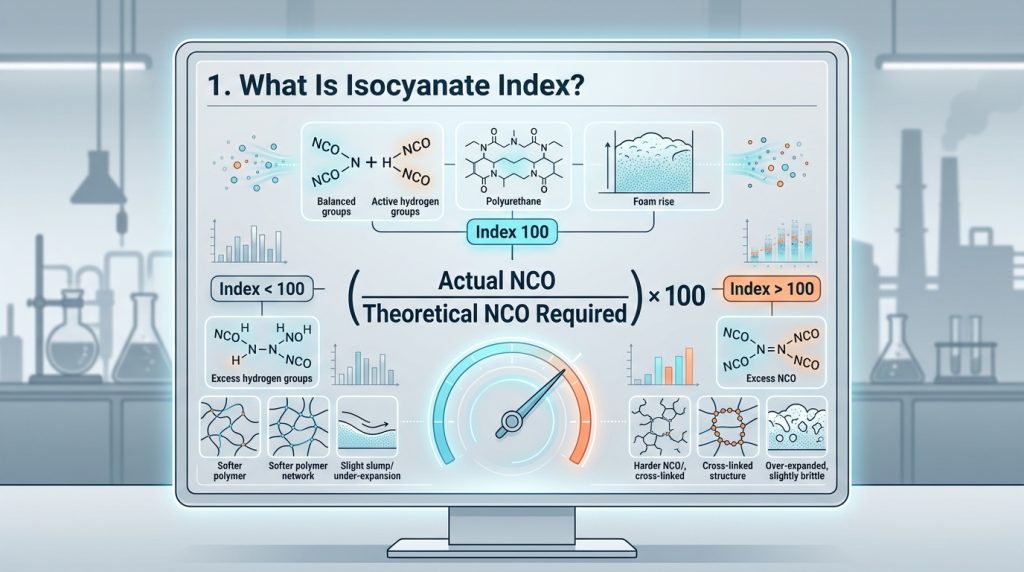
The Isocyanate Index is the ratio of the actual amount of isocyanate used to the theoretical amount required to react with all relevant active hydrogen groups, multiplied by 100.
Formula:
NCO Index = (Actual NCO / Theoretical NCO Required) × 100
- Index 100: The stoichiometric amount of isocyanate is supplied for the calculated reaction requirements.
- Index below 100: Less isocyanate is used than the theoretical requirement.
- Index above 100: More isocyanate is used than the theoretical requirement.
An index of 100 does not automatically guarantee the best foam. The optimal value depends on the formulation, foam type, target properties, and processing conditions.
Why Is the NCO Index Important?
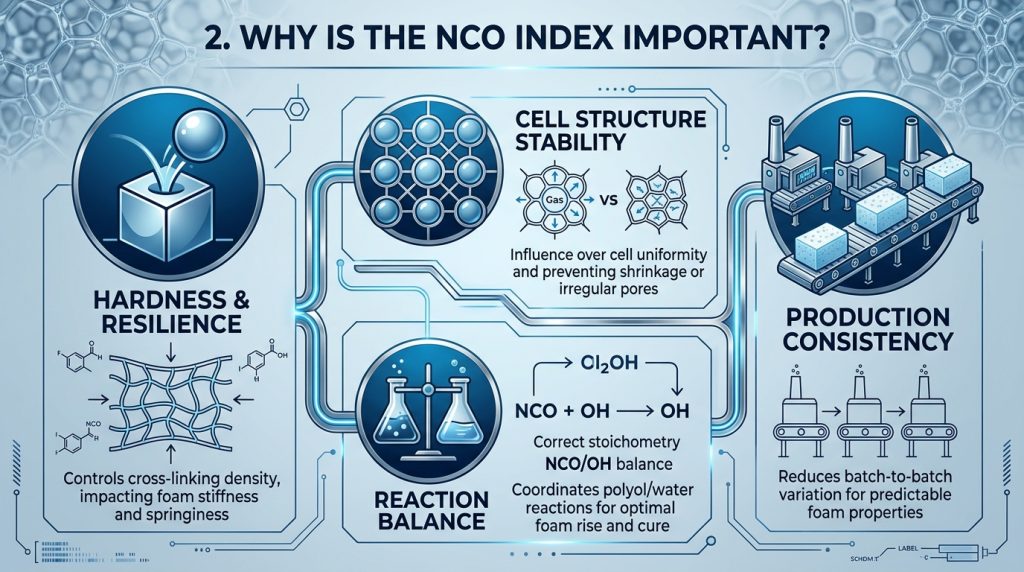
The NCO Index affects the chemical structure formed during polyurethane reactions. It can influence:
- Hardness and resilience: The balance of reactants affects the polymer network and the foam’s mechanical properties.
- Cell structure and dimensional stability: An unsuitable index may contribute to irregular cells, shrinkage, or other processing defects.
- Reaction balance: Isocyanate levels interact with polyols, water, catalysts, and other ingredients, affecting foam rise and curing.
- Production consistency: Correct index control helps reduce batch-to-batch variation when raw materials and processing conditions are also controlled.
The goal is not simply to increase or decrease the index, but to find the appropriate balance for the target application.
How Does the NCO Index Work?
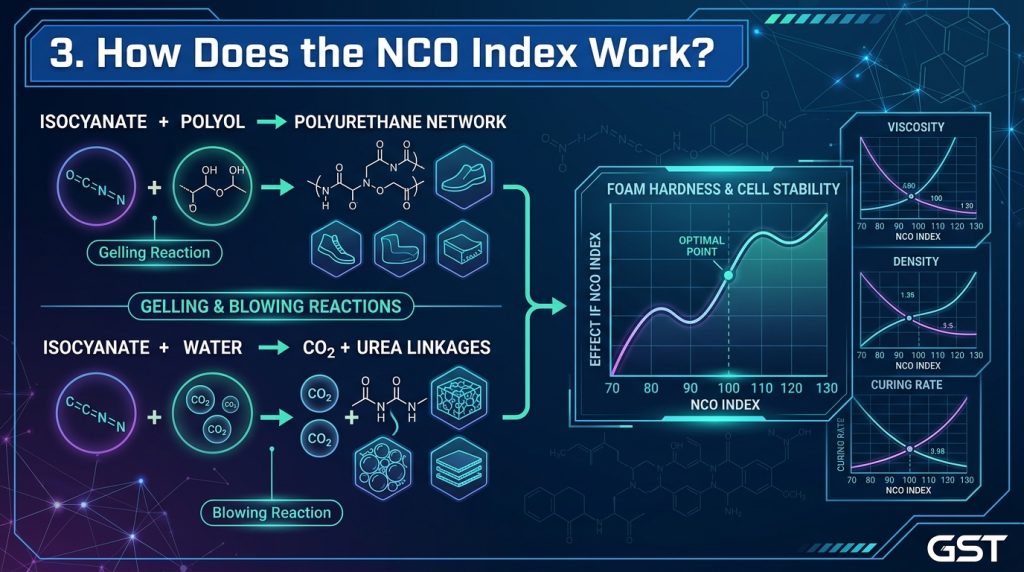
During PU foaming, isocyanate reacts with polyols to form the polyurethane structure. When water is used as a chemical blowing agent, it also reacts with isocyanate, generating carbon dioxide and forming urea linkages.
These reactions influence both foam formation and the final polymer network. Changing the NCO Index can therefore affect hardness, strength, cell stability, and curing behavior.
However, the relationship is not always linear. The result also depends on polyol hydroxyl value, water content, isocyanate functionality, catalyst balance, surfactants, and processing conditions.
Common NCO Index Problems and Solutions
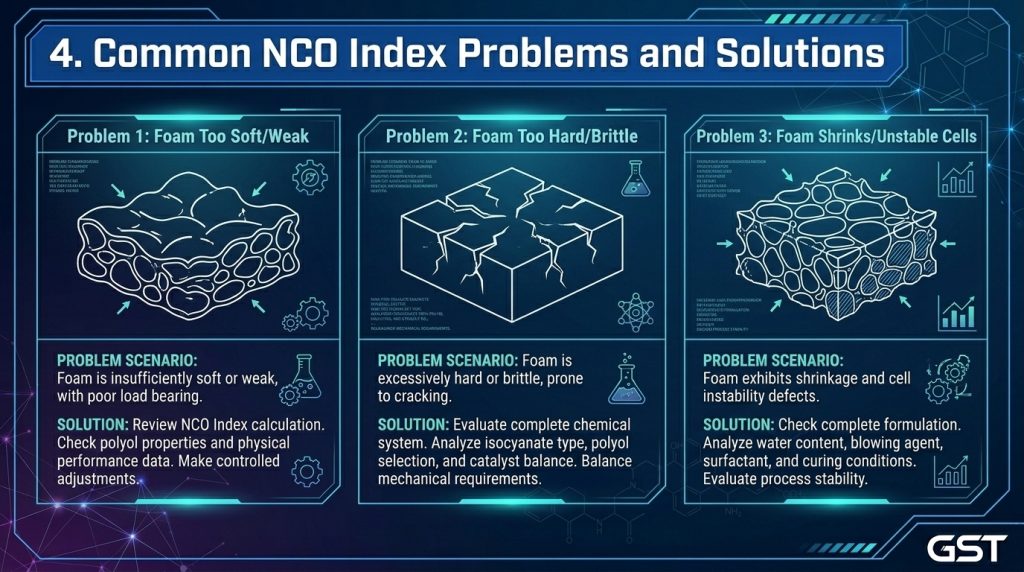
Problem 1: Foam is too soft or has insufficient strength
An index that is too low may contribute to an insufficiently developed polymer network. However, low crosslinking, unsuitable polyols, or other formulation issues may also be responsible.
Solution: Review the index calculation, polyol properties, and target physical performance before making controlled adjustments.
Problem 2: Foam is too hard or brittle
An excessively high index may contribute to a stiffer structure or brittleness in some formulations. The effect depends on the complete chemical system.
Solution: Evaluate the index alongside isocyanate type, polyol selection, catalyst balance, and the required mechanical properties.
Problem 3: Foam shrinks or has unstable cells
These defects are not necessarily caused by the NCO Index alone. Blowing and gelling reactions, water content, surfactant selection, and curing conditions can all contribute.
Solution: Check the complete formulation and foaming process rather than changing the index in isolation.
How Can GST Help Optimize the NCO Index?
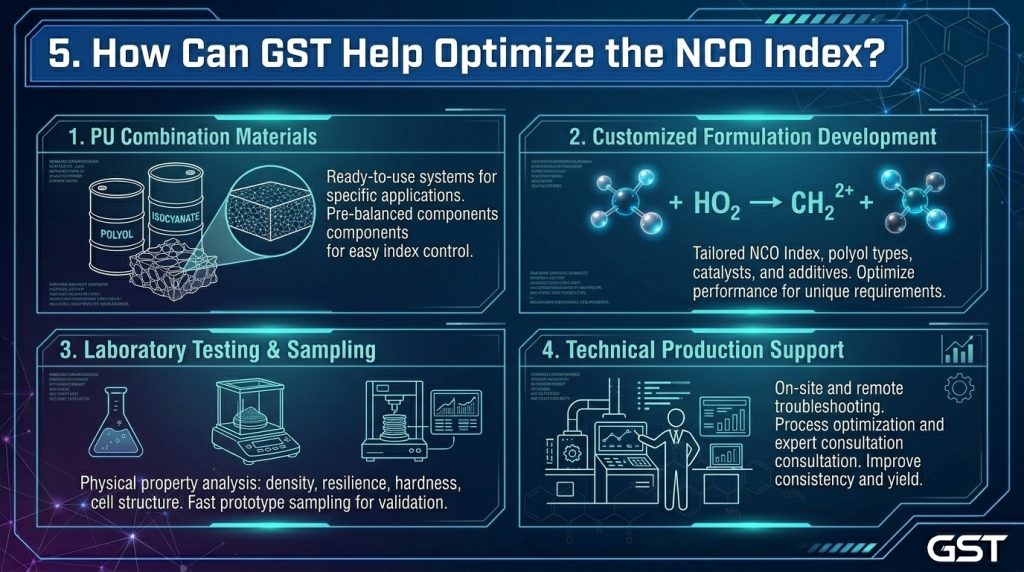
At GST, we understand that stable polyurethane foam requires more than a single parameter adjustment. It requires a formulation designed around the raw materials, target application, and production process.
As a polyurethane system supplier, GST provides:
- PU combination materials: Formulated systems designed for specific foam applications and performance requirements.
- Customized formulation development: Adjustment of the NCO Index, polyol selection, catalyst balance, and other formulation variables.
- Laboratory testing and sampling: Support for evaluating foam rise, cell structure, density, resilience, and other relevant properties.
- Technical production support: Guidance on troubleshooting foam defects, optimizing processing conditions, and improving production consistency.
Whether you manufacture flexible foam cushions, memory foam products, or rigid polyurethane foam, GST can help evaluate the formulation as a complete system.
Conclusion
The Isocyanate Index is a key parameter in polyurethane formulation, but the right NCO Index is the one that works with the entire formulation and production process.
Instead of adjusting isocyanate content by trial and error, work with a formulation partner who understands material compatibility, reaction balance, and application requirements.
Looking for reliable PU combination materials or help optimizing your NCO Index? Contact GST for formulation development, laboratory samples, and technical support.
PREVIOUS:How to Choose the Right Isocyanate?
CATEGORIES
LATEST NEWS
- What Is a Polyurethane Cata...
- What Is Isocyanate Index?
- How to Choose the Right Iso...
- Aromatic vs Aliphatic Isocy...
- What Is Modified MDI?
- MDI vs TDI: What’s th...
- TDI 80/20 vs TDI 65/35
- What Is TDI?
- What Is Polymeric MDI (pMDI)?
- What Is MDI?
CONTACT US
Tel:+86 18688691634
Email:sam@1688pu.com
Add:No. 91 Central East Rd, Luxi Village, Gaobu Town, Dongguan 523283, China.