BASF Ludwigshafen Incident: What Could It Mean for the Global Polyurethane Market?
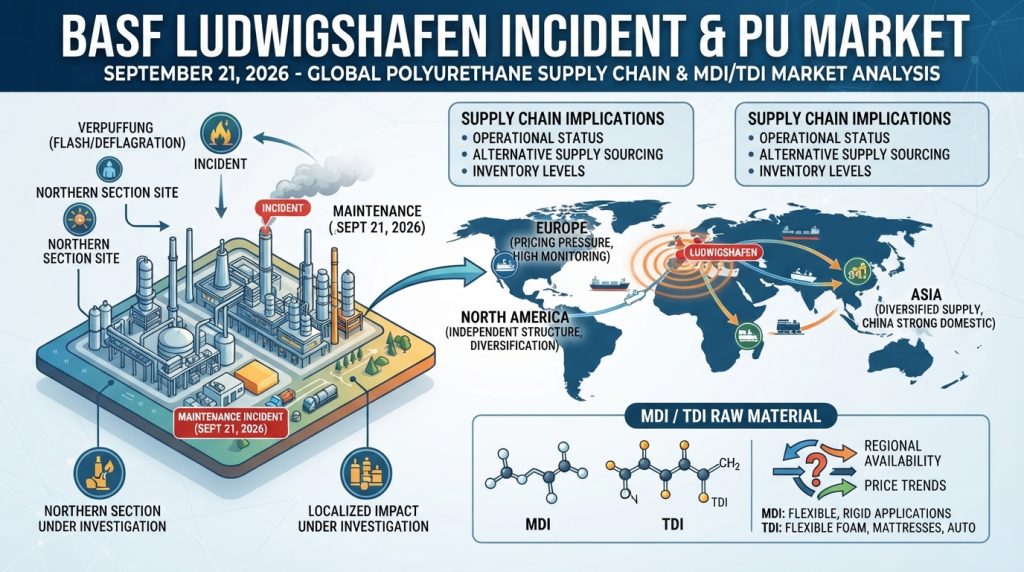
On September 21, 2026, an incident occurred at the BASF Ludwigshafen site in Germany during maintenance work. According to BASF, a Verpuffung, generally referring to a flash or deflagration-type event, occurred at a production facility in the northern section of the site at approximately 8:30 a.m.
Two employees of an external company sustained burn injuries and were taken to a nearby hospital for further treatment. BASF also reported that its environmental monitoring vehicle detected no elevated readings. The cause of the incident remains under investigation.
Because Ludwigshafen is one of the world’s largest integrated chemical production sites, the incident has attracted attention from chemical and polyurethane industry participants. However, it is important to distinguish between the confirmed incident and assumptions about its potential impact on global polyurethane raw material supply.
What Happened at BASF Ludwigshafen?
BASF’s official information currently confirms that the incident occurred during maintenance work at a facility in the northern section of its Ludwigshafen site.
At this stage, BASF has not announced that the incident has caused a global disruption to polyurethane raw material supply.
This distinction is important.
Ludwigshafen is a highly integrated chemical production complex, with numerous interconnected production units and raw-material streams. BASF’s Verbund system is designed to connect different production processes and improve the flexibility and efficiency of its manufacturing network.
Therefore, the potential market impact depends largely on which production unit was affected, whether production was interrupted, how long any interruption may last, and whether alternative production capacity can compensate for the affected supply.
Why Is the Incident Relevant to the Polyurethane Industry?
The polyurethane industry relies on a complex network of raw materials.
Among the most important are:
- MDI (Methylene Diphenyl Diisocyanate)
- TDI (Toluene Diisocyanate)
- Polyether polyols
- Propylene oxide
- Catalysts
- Silicone surfactants
- Other additives and specialty chemicals
BASF’s Monomers business identifies MDI and TDI as important isocyanates for polyurethane applications. MDI is used across flexible, semi-rigid and rigid polyurethane applications, while TDI is primarily associated with flexible foam products such as mattresses, furniture cushions and automotive seating. BASF also identifies propylene oxide as a major raw material for polyether polyols.
This means that any prolonged disruption involving a relevant upstream production unit could potentially affect downstream polyurethane manufacturers.
However, the occurrence of an incident at a major chemical site does not automatically mean that all polyurethane raw materials from that site are affected.
A Key Point: The Ludwigshafen TDI Complex Was Already Closed
One important fact should be considered when evaluating the current situation.
BASF closed its TDI complex at Ludwigshafen in 2023 as part of its restructuring of the site. BASF stated that European customers would continue to be supplied with TDI through its global production network, including production sites in Geismar, Louisiana; Yeosu, South Korea; and Shanghai, China.
Therefore, it would be inaccurate to interpret the September 2026 incident simply as a direct shutdown of a major Ludwigshafen TDI production line.
The actual impact on the polyurethane market will depend on the specific facility involved and any subsequent operational announcements from BASF.
Regional Impact on the Polyurethane Market
Europe: The Region to Watch Closely
Europe is likely to receive the most immediate market attention because Ludwigshafen is a strategically important chemical production hub.
At the same time, the European polyurethane raw material market was already experiencing price pressure before the incident.
Recent market analysis indicates that MDI and TDI prices had been moving higher in September, with producers citing factors including raw material, energy, transportation and supply-chain costs.
BASF itself announced on September 11 that it would increase prices for its Lupranate® MDI and TDI basic products by US$250 per metric ton in ASEAN and South Asia, citing increases in raw material, transportation and energy costs.
This means the Ludwigshafen incident should be viewed within a broader market environment rather than as an isolated cause of price movements.
For European polyurethane manufacturers, the key factors to monitor are:
- The operational status of the affected BASF facility
- Any announced production interruptions
- MDI and TDI availability
- Polyether polyol supply
- Energy costs
- Logistics and transportation conditions
- Inventory levels among distributors and downstream manufacturers
If a key production unit remains operational or alternative supply is available, the market impact may remain limited.
If a prolonged shutdown affects an important upstream material, however, European buyers could become more cautious about inventory and alternative sourcing.
China and Greater Asia: More Diversified Supply Options
The impact on China and other Asian markets may be different.
Asia has several major polyurethane raw material producers and production bases, creating a relatively diversified supply structure.
BASF’s global production network includes facilities in Asia as well as North America and Europe. The company has previously stated that its global network can support customers when individual regional production structures change.
China also has a strong domestic polyurethane raw material industry, with major producers serving both domestic and export markets.
Therefore, a localized incident in Germany does not automatically indicate a shortage of MDI, TDI or polyols in China.
Nevertheless, Asian prices can still be influenced indirectly if European buyers increase purchases from other regions or if global suppliers adjust their allocation strategies.
North America: Relatively Independent Supply Structure
North America has its own significant polyurethane raw material production capacity.
BASF’s Monomers business, for example, includes an MDI production expansion in Geismar, Louisiana.
This regional production structure provides an additional layer of supply diversification.
As a result, the immediate impact of a localized Ludwigshafen incident on North American polyurethane manufacturers is likely to depend more on global trade flows, supplier allocation and market pricing than on direct physical supply interruption.
India and South Asia: Increasing Strategic Importance
South Asia is becoming increasingly important in the global polyurethane supply chain.
On September 21, 2026, BASF announced that it is evaluating a potential MDI production complex in Dahej, Gujarat, India, in response to growing regional demand.
This development highlights a broader industry trend:
Polyurethane raw material production is becoming increasingly regionalized.
More production capacity closer to end-use markets can help reduce the dependence of individual regions on long-distance supply chains.
What Could Happen to PU Raw Material Prices?
It is too early to conclude that the Ludwigshafen incident itself will cause a significant global increase in polyurethane raw material prices.
Several variables need to be considered.
Scenario 1: Limited Operational Impact
If the affected facility resumes normal operations without significant disruption, the direct impact on global PU raw material supply could remain limited.
Market pricing would then continue to be driven primarily by:
- Raw material costs
- Energy prices
- Demand
- Production utilization
- Inventory
- Transportation costs
- Regional supply and demand balances
Scenario 2: Temporary Production Disruption
If an important upstream unit is temporarily affected, regional supply could tighten.
In this situation, buyers may increase inventory or look for alternative suppliers, potentially creating short-term price pressure.
Scenario 3: Prolonged Disruption
A prolonged shutdown of a strategically important production unit would have a greater potential to affect regional supply and international trade flows.
In such a situation, buyers could increasingly evaluate:
- Alternative suppliers
- Different production regions
- Dual sourcing
- Longer-term supply agreements
- Reformulation or material substitution where technically feasible
At present, it is too early to determine which scenario will develop.
What Does This Mean for PU Combination Material Manufacturers?
For polyurethane system suppliers and foam manufacturers, the event highlights an issue that is broader than one individual company or production site:
Supply-chain resilience matters.
A PU combination material is not simply a mixture of raw materials. Its performance depends on the interaction between polyols, isocyanates, catalysts, surfactants, blowing agents and other formulation components.
When raw material specifications or supply sources change, manufacturers may need to evaluate:
- Cream time
- Rise time
- Gel time
- Density
- Cell structure
- Hardness
- Resilience
- Compression performance
- Dimensional stability
- Processing window
Therefore, switching raw material suppliers should not be treated as a simple purchasing decision.
It may require formulation evaluation and process validation.
GST’s Perspective: Stability Through Formulation and Technical Support
As a polyurethane combination material supplier, GST believes that market uncertainty should be addressed through technical evaluation rather than speculation.
For PU manufacturers, maintaining stable production requires more than monitoring raw material prices.
It also requires:
Reliable raw material sourcing + formulation expertise + application testing + technical support.
GST provides polyurethane combination materials and formulation support for a range of applications, including:
- Flexible polyurethane foam
- High-resilience foam
- Memory foam
- Rigid polyurethane foam
- Spray insulation systems
- Gel systems
- Customized polyurethane applications
When raw material conditions change, formulation performance should be evaluated according to the specific application rather than based solely on a single raw material price.
For manufacturers facing changing material costs or supply conditions, technical discussions with experienced PU formulation suppliers can help identify practical options while maintaining the required foam performance.
What Should PU Buyers Monitor Next?
The most important information to watch over the coming days is not simply the headline of the incident, but the subsequent operational information.
PU manufacturers and buyers should monitor:
- BASF’s updates regarding the affected Ludwigshafen facility
- Any confirmed production interruption or restart information
- MDI and TDI price movements in Europe and Asia
- Polyether polyol availability and pricing
- Energy and logistics costs
- Inventory levels and lead times
- Alternative regional supply options
These indicators will provide a more accurate picture of the market than short-term speculation.
Conclusion
The September 21 incident at BASF’s Ludwigshafen site is an important development for the chemical industry because of the strategic importance of the site.
However, based on the information currently available, it is not appropriate to conclude that the incident has caused a global polyurethane raw material shortage or that it will automatically lead to a significant worldwide price increase.
The potential impact will depend on the specific production unit involved, the duration of any operational interruption, the availability of alternative supply and the broader balance between polyurethane supply and demand.
For the global PU industry, the event is a reminder of the importance of supply-chain diversification, formulation flexibility and technical support.
GST will continue to monitor developments in the polyurethane raw material market and provide technical and market information to help PU manufacturers make informed production and sourcing decisions.
Disclaimer: This article is an industry analysis based on publicly available information as of September 22, 2026. Market conditions may change as additional information becomes available. The analysis does not represent BASF’s official position and should not be interpreted as a prediction of future polyurethane raw material prices.
Tags: Polyurethane
PREVIOUS:China’s Dimethylthiotoluenediamine (DMTDA) Project Successfully Begins Trial Production
CATEGORIES
LATEST NEWS
- BASF Ludwigshafen Incident:...
- What Is Polyol Molecular We...
- What Is Polymer Polyol?
- Polyether Polyol vs Polyest...
- What Is Polyester Polyol?
- What Is Polyether Polyol?
- What Is Polyol?
- Why Is Reaction Balance Cri...
- Blowing Reaction vs Gelling...
- How Molecular Structure Det...
CONTACT US
Tel:+86 18688691634
Email:sam@1688pu.com
Add:No. 91 Central East Rd, Luxi Village, Gaobu Town, Dongguan 523283, China.