What Happens When Isocyanate Reacts With Water?
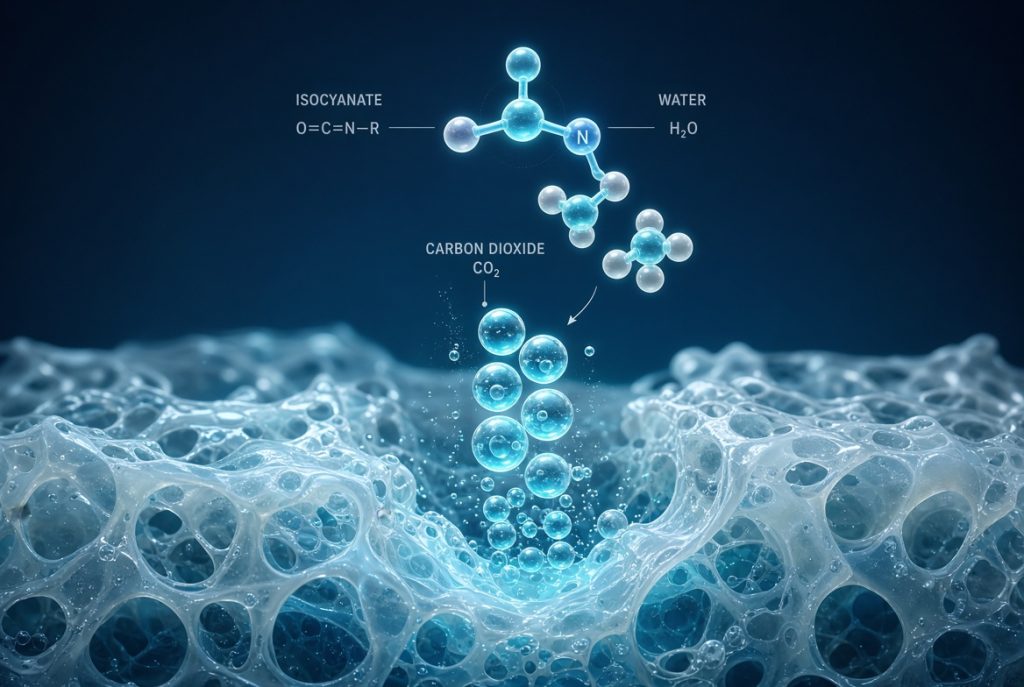
If you work with polyurethane (PU), you have probably heard that isocyanate and water react strongly. But what actually happens when they meet?
The answer is more interesting than simply “they react.” This reaction is one of the key mechanisms behind polyurethane foam formation, and controlling it is essential for achieving the right density, cell structure, curing speed, and final performance.
1. What Happens When Isocyanate Meets Water?
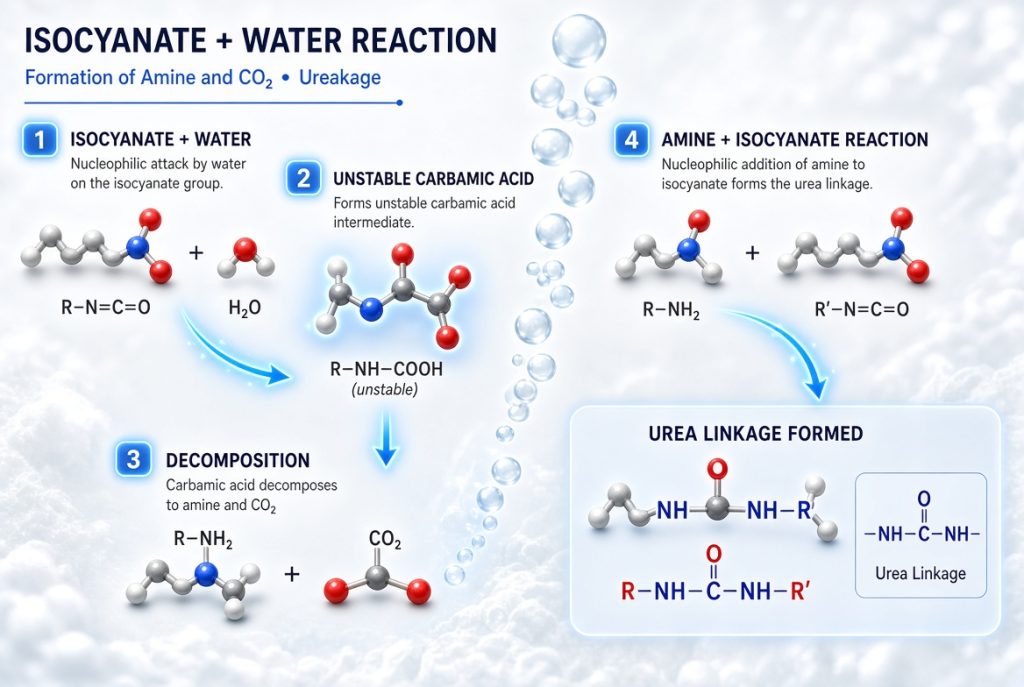
When an isocyanate group reacts with water, it first forms an unstable carbamic acid intermediate, which quickly decomposes into an amine and carbon dioxide (CO₂).
The amine then reacts with another isocyanate group to form a urea linkage.
In simplified form:
Isocyanate + Water → Amine + CO₂
Amine + Isocyanate → Urea
The generated CO₂ gas creates bubbles, while the chemical reaction contributes to the formation of the polymer network.
This is why water can act as a chemical blowing agent in polyurethane foam systems.
2. Why Is This Reaction Important?
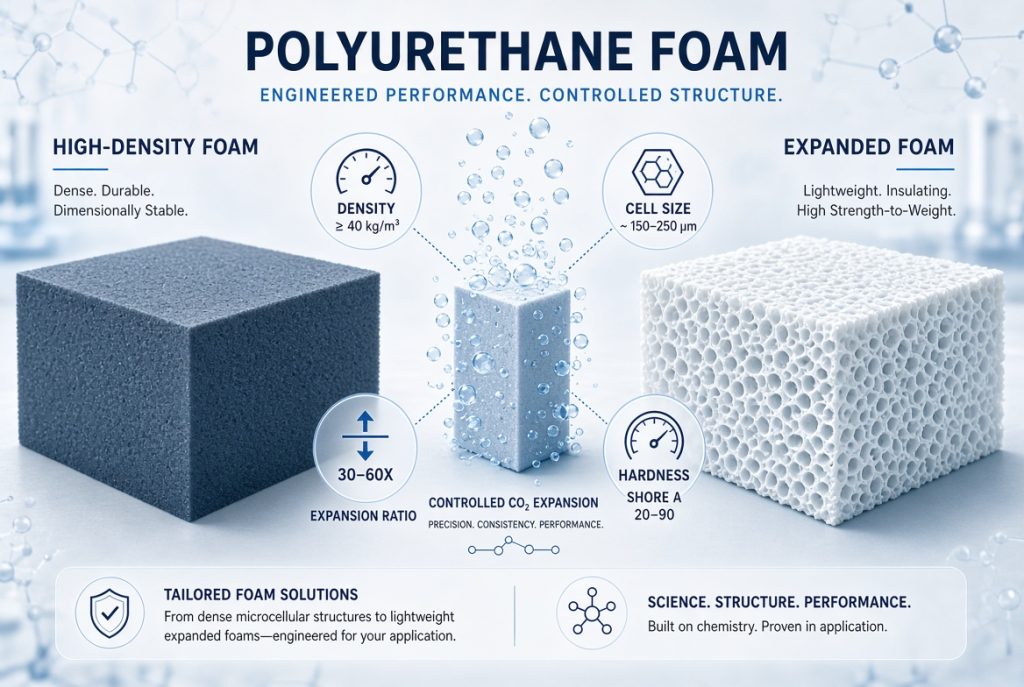
In polyurethane foam production, the reaction between isocyanate and water is not simply something to avoid—it can be something to control and use.
The amount of water can influence:
- Foam density
- Cell size and structure
- Expansion ratio
- Cream and rise time
- Foam hardness
- Dimensional stability
- Final mechanical properties
Too little water may result in insufficient gas generation and higher foam density.
Too much water can generate excessive CO₂, increase urea content, disturb the cell structure, and potentially cause shrinkage, cracking, or poor surface quality.
So the real question is not:
“Should isocyanate react with water?”
It is:
“How can we control the reaction to achieve the target foam performance?”
3. How Does It Work in PU Foam?
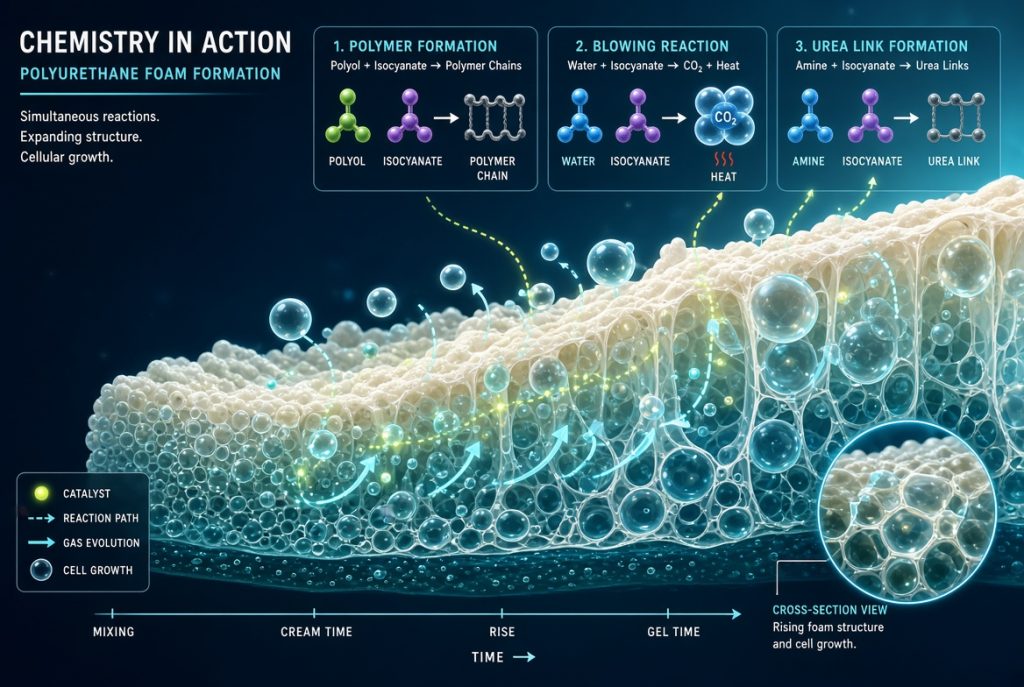
A typical polyurethane foam system involves several reactions happening almost simultaneously.
Polyol + Isocyanate → Polyurethane
Isocyanate + Water → CO₂ + Amine
Amine + Isocyanate → Urea
At the same time, catalysts can accelerate different reaction pathways.
This creates a delicate balance between polymer formation, gas generation, cell growth, and curing.
If the gas is generated too quickly but the polymer network is not strong enough, cells may become unstable.
If the polymerization is too fast, the foam may not expand sufficiently.
That is why polyurethane formulation is more than simply mixing two chemicals—it is about reaction balance.
4. Common Problems Caused by Moisture
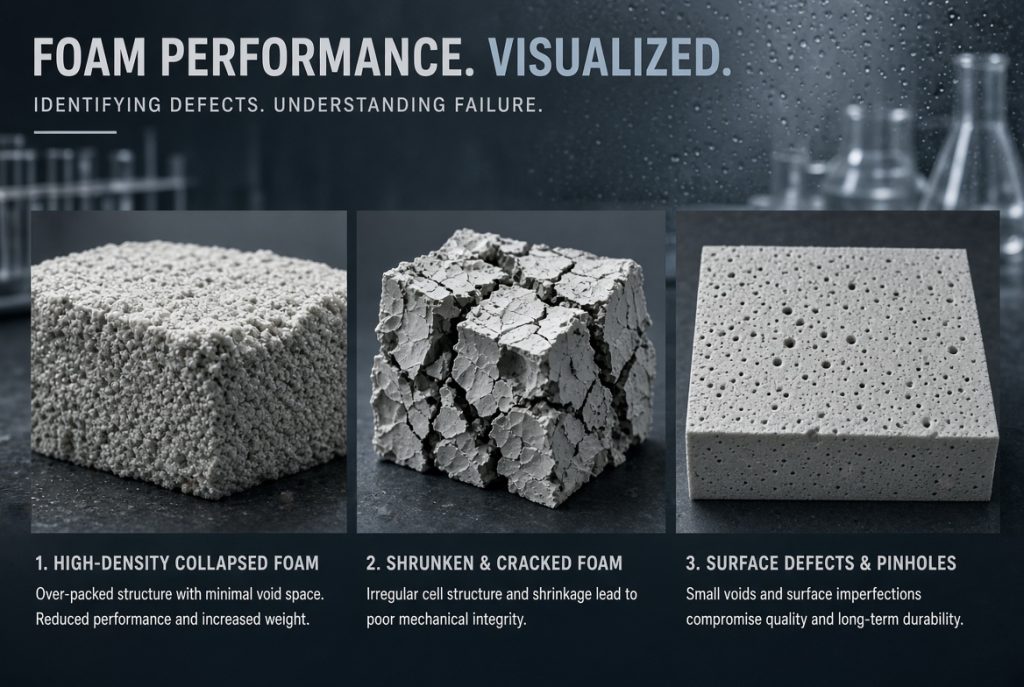
Water is not always intentionally added to a formulation. Moisture can also come from raw materials, equipment, molds, storage tanks, or even humid air.
Common problems include:
Foam Density Is Too High
Possible causes include insufficient chemical blowing reaction, incorrect water level, or poor processing conditions.
Foam Shrinkage
Excessive gas generation, weak cell walls, or an imbalance between blowing and polymerization reactions can contribute to shrinkage.
Irregular or Large Cells
Poor mixing, excessive moisture, unsuitable catalysts, or an unbalanced formulation may lead to unstable cell structures.
Surface Defects
Moisture contamination can affect reaction kinetics and may result in pinholes, cracks, poor skin formation, or uneven surfaces.
Inconsistent Production
Even a small change in moisture content can alter the reaction profile, especially in sensitive PU systems.
5. How Can These Problems Be Solved?
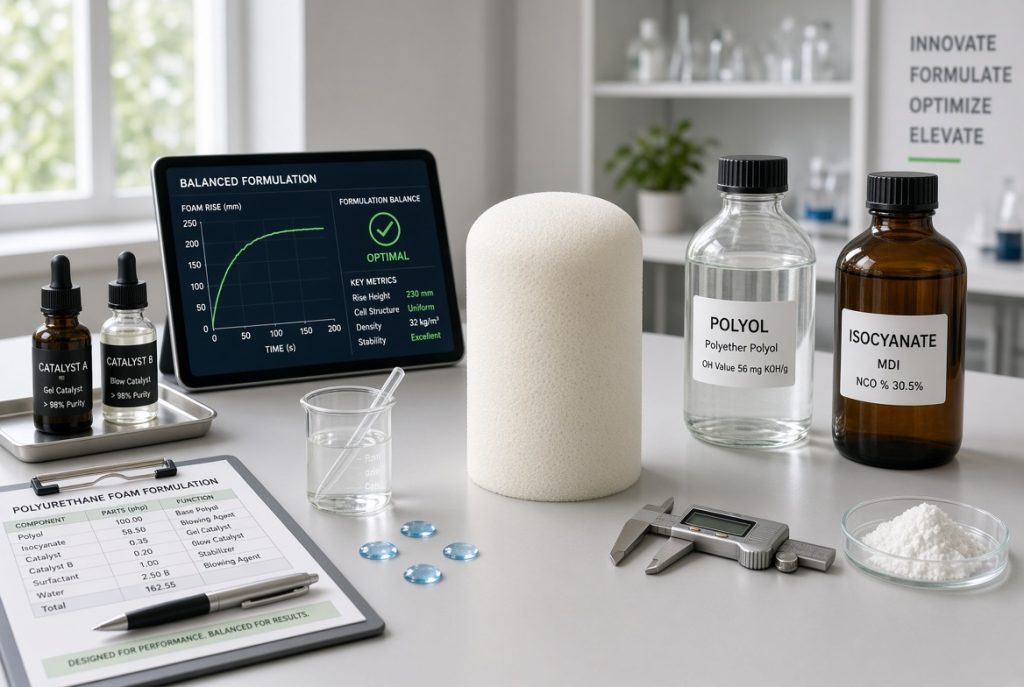
The key is formulation control + raw material control + process control.
A professional PU formulation normally needs to consider:
- Water content
- Isocyanate index
- Polyol characteristics
- Catalyst package
- Surfactant selection
- Blowing-agent system
- Mixing ratio
- Mold or substrate temperature
- Ambient humidity
- Processing equipment
Instead of adjusting only one ingredient, formulators need to understand how these factors interact.
For example, changing the water level may require corresponding adjustments to the catalyst package, surfactant, isocyanate index, or processing conditions.
That is where formulation expertise becomes valuable.
6. How Can GST Help?

At GST, we understand polyurethane from both the chemical reaction and the application perspective.
We provide more than standard polyurethane raw materials. Our GST polyurethane systems and combination materials are developed around specific applications and processing requirements.
Our technical solutions can include:
✓ Customized PU combination materials
For flexible foam, rigid foam, memory foam, high-resilience foam, self-skinning systems, and other applications.
✓ Formula development and optimization
Adjusting water, catalysts, surfactants, polyols, isocyanate index, and other components according to the target density and performance.
✓ Sample testing and application verification
From laboratory formulation to machine trials and production validation.
✓ Troubleshooting support
Helping identify problems such as shrinkage, poor cell structure, slow or fast reaction, insufficient expansion, surface defects, and inconsistent foam quality.
✓ Application-based technical solutions
Because the best formulation is not necessarily the one with the lowest cost—it is the one that delivers stable processing and reliable final performance.
7. The Bottom Line
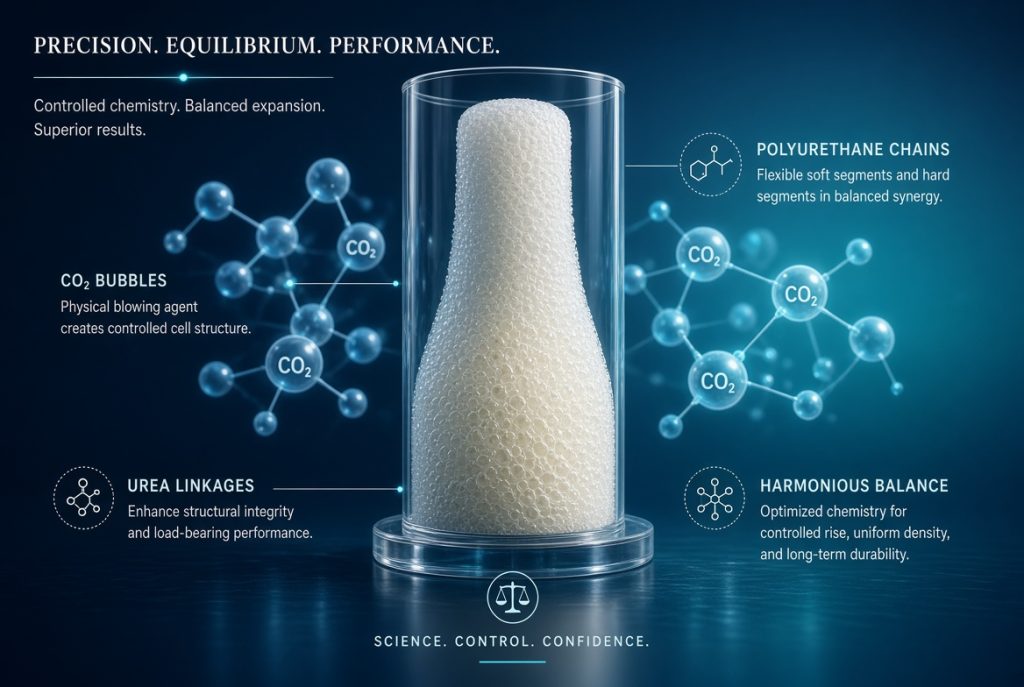
When isocyanate reacts with water, it produces CO₂ and amines, and this reaction plays a fundamental role in polyurethane foam formation.
But in PU manufacturing, more reaction does not always mean better foam.
The real goal is to balance blowing, polymerization, cell stabilization, and curing.
That balance is where formulation technology makes the difference.
Need a polyurethane combination material or a customized PU formulation?
GST can help turn your application requirements into a practical polyurethane solution—from formula development and laboratory testing to production support.
Contact GST for your polyurethane project.
CATEGORIES
LATEST NEWS
- Aromatic vs Aliphatic Isocy...
- What Is Modified MDI?
- MDI vs TDI: What’s th...
- TDI 80/20 vs TDI 65/35
- What Is TDI?
- What Is Polymeric MDI (pMDI)?
- What Is MDI?
- What Is Isocyanate?
- How to Select the Right Pol...
- How Does Polyol Affect Foam...
CONTACT US
Tel:+86 18688691634
Email:sam@1688pu.com
Add:No. 91 Central East Rd, Luxi Village, Gaobu Town, Dongguan 523283, China.