What Is Polyol Functionality?
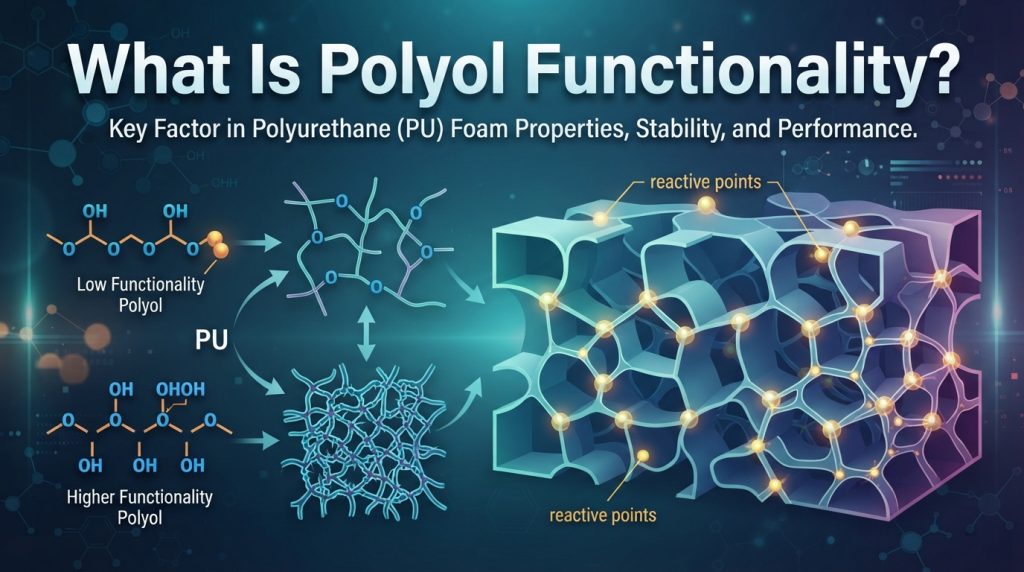
In polyurethane (PU) foaming, polyol functionality is one of the key factors that determines how a foam forms, how stable its structure is, and what properties the final product can achieve.
But what exactly is polyol functionality—and why does it matter?
Ⅰ,What Is Polyol Functionality?
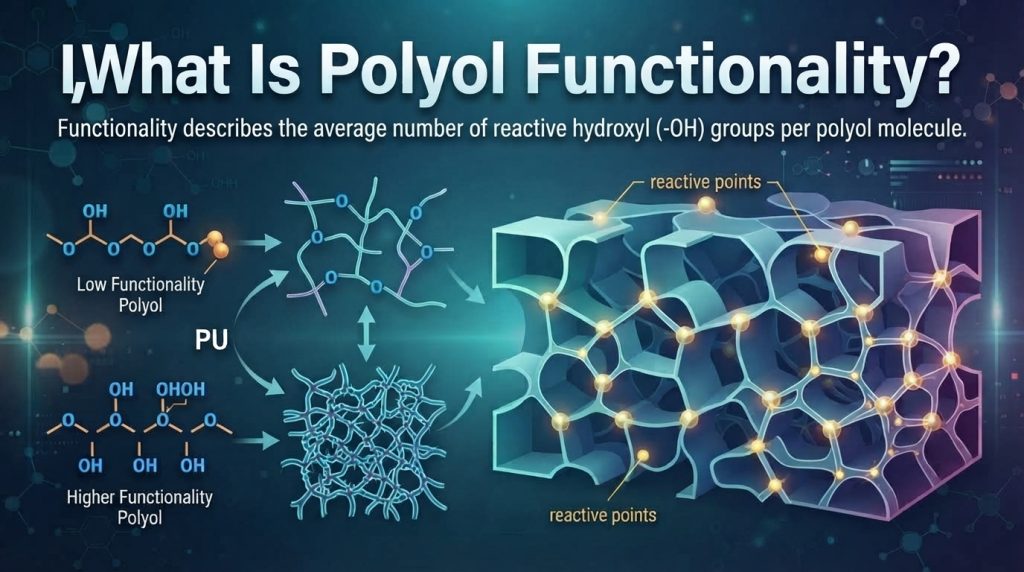
Polyol functionality refers to the average number of reactive hydroxyl (-OH) groups per polyol molecule.
Simply put, it describes how many reaction points a polyol molecule has when it reacts with an isocyanate such as MDI or TDI.
For example:
- Low-functionality polyol → fewer reaction points → more linear polymer structures
- Higher-functionality polyol → more reaction points → more branching and crosslinking
This molecular characteristic has a direct influence on foam structure, hardness, dimensional stability, resilience, and other physical properties.
Ⅱ,Why Is Polyol Functionality Important?
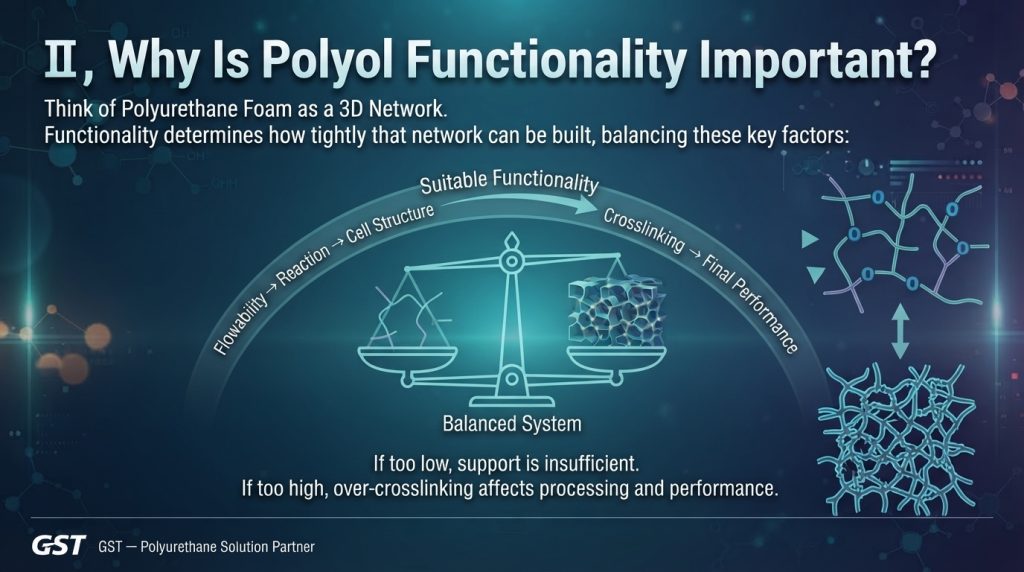
Think of polyurethane foam as a three-dimensional network.
Functionality helps determine how tightly that network can be built.
A suitable functionality can help balance:
Flowability → Reaction → Cell Structure → Crosslinking → Final Performance
If the functionality is too low, the polymer network may not provide enough structural support.
If it is too high, the reaction can become excessively crosslinked, potentially affecting processing, flow, cell structure, flexibility, and other properties.
That is why functionality should not be considered separately from other formulation parameters.
Ⅲ,How Does Polyol Functionality Work?
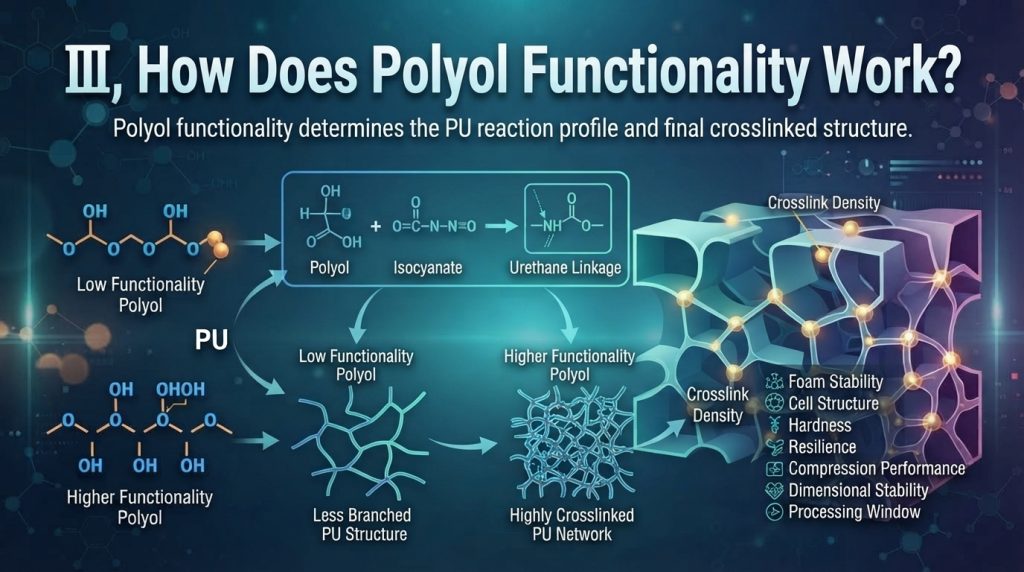
During PU production, polyol reacts with isocyanate to form polyurethane.
When polyol molecules have multiple reactive groups, they can react at several points, creating branched or crosslinked structures.
This affects important factors such as:
- Foam stability
- Cell structure
- Hardness
- Resilience
- Compression performance
- Dimensional stability
- Processing window
However, polyol functionality alone does not determine the final foam performance.
Equivalent weight, hydroxyl value, molecular weight, polymer polyol content, catalyst system, silicone surfactant, blowing agent, isocyanate index, water level, and processing conditions all interact with functionality.
Ⅳ,Common Problems Caused by Incorrect Functionality
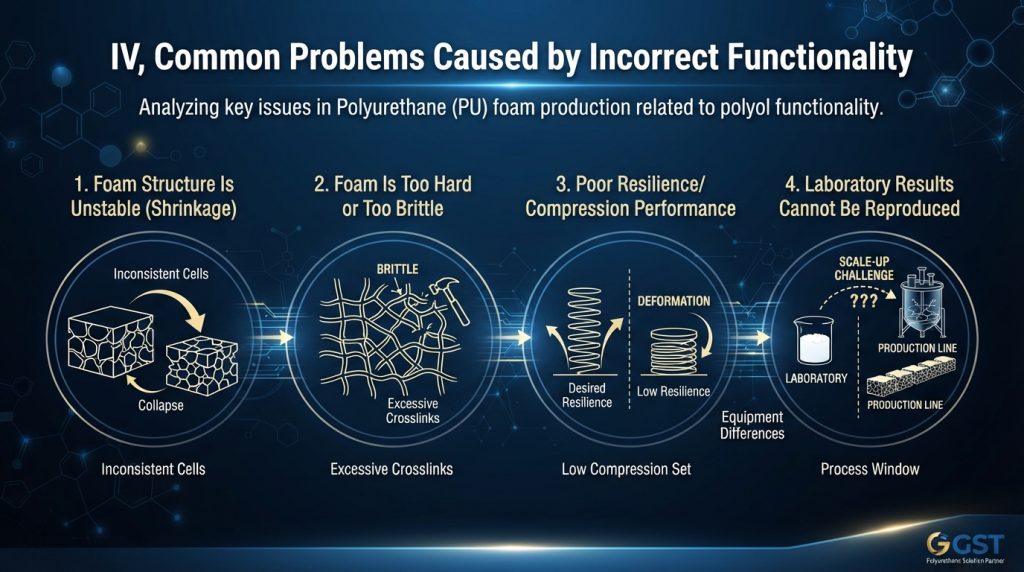
1. Foam Structure Is Unstable
The foam may shrink, collapse, or show inconsistent cell structures.
Possible solution:
Review polyol functionality together with catalyst balance, surfactant selection, blowing level, and isocyanate index.
2. Foam Is Too Hard or Too Brittle
Excessive crosslinking can influence flexibility and resilience.
Possible solution:
Adjust the polyol blend and overall crosslink density instead of simply changing one raw material.
3. Poor Resilience or Compression Performance
The problem may come from an unsuitable combination of functionality, molecular weight, polymer polyol, and formulation balance.
Possible solution:
Optimize the complete formulation according to the target density, hardness, resilience, and application requirements.
4. Laboratory Results Cannot Be Reproduced in Production
A formula that works in the laboratory may behave differently on a production line because of differences in temperature, mixing, equipment, mold conditions, and raw-material batches.
Possible solution:
Evaluate the formulation together with actual production conditions and establish a suitable processing window.
Ⅴ,How Can GST Help?
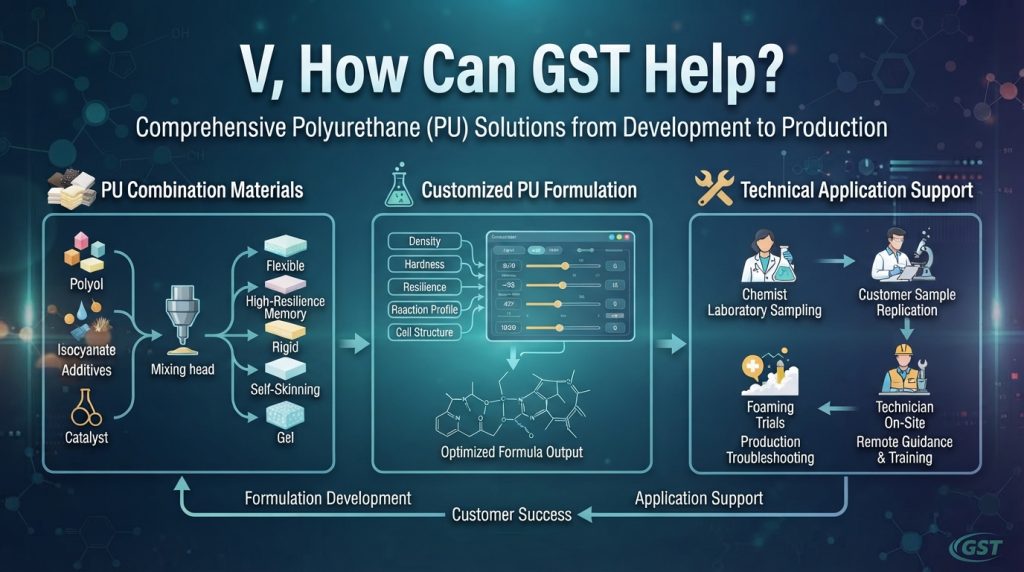
At GST, we understand that PU formulation is not simply about selecting a high- or low-functionality polyol.
The real challenge is finding the right formulation balance.
GST provides:
PU Combination Materials
We can develop PU combination materials for different applications, including:
- Flexible foam
- High-resilience foam
- Memory foam
- Rigid foam
- Self-skinning foam
- Gel systems
- Other customized PU applications
Customized PU Formulation
Based on the customer’s target requirements, GST can optimize:
Polyol + Polymer Polyol + Catalyst + Silicone + Blowing Agent + Additives + Isocyanate
The formulation can be adjusted according to density, hardness, resilience, reaction profile, cell structure, processing conditions, and final product requirements.
Technical Application Support
GST can also provide:
- Laboratory sampling
- Formula development
- Customer sample replication
- Raw-material recommendation
- Foaming trials
- Reaction-time adjustment
- Production troubleshooting
- Remote technical guidance
- Technician training
From Raw Materials to the Final Product
The right polyol functionality is only one piece of the PU formulation puzzle.
The goal is not simply to choose a polyol with a specific functionality.
The goal is to build a balanced reaction system that delivers stable processing and consistent final performance.
That is where formulation development makes the difference.
GST — PU Combination Material & Formulation Solution Provider
From raw-material selection and formula development to foaming trials and production support, GST works with customers to develop practical polyurethane solutions for real manufacturing conditions.
If you are facing problems with foam density, hardness, resilience, shrinkage, cell structure, reaction speed, or production stability, contact GST for a customized PU formulation and technical solution.
PREVIOUS:What Is Polyol Molecular Weight?
CATEGORIES
LATEST NEWS
- What Is TDI?
- What Is Polymeric MDI (pMDI)?
- What Is MDI?
- What Is Isocyanate?
- How to Select the Right Pol...
- How Does Polyol Affect Foam...
- What Is Hydroxyl Value (OH ...
- What Is Polyol Functionality?
- BASF Ludwigshafen Incident:...
- What Is Polyol Molecular We...
CONTACT US
Tel:+86 18688691634
Email:sam@1688pu.com
Add:No. 91 Central East Rd, Luxi Village, Gaobu Town, Dongguan 523283, China.