What Is PU Foam?
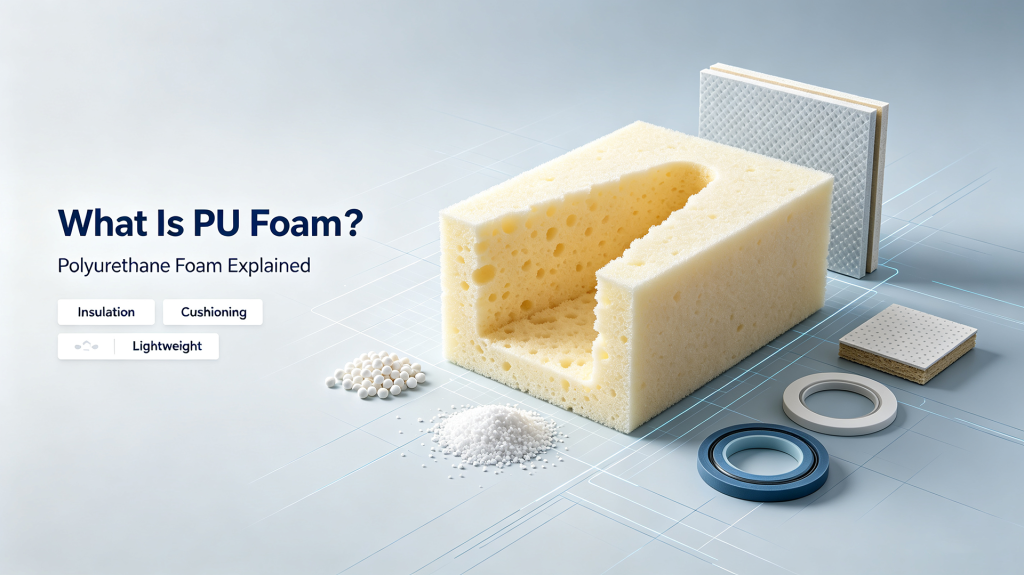
If you have ever sat on a soft sofa, rested your head on a memory pillow, opened a refrigerator, insulated a building, or used protective packaging, there is a good chance you have encountered PU foam.
PU foam, short for polyurethane foam, is one of the most versatile polymeric foam materials in modern manufacturing. By adjusting its chemistry, density, hardness, resilience, cell structure, flame resistance, and processing conditions, PU foam can be engineered for applications ranging from comfortable furniture to high-performance insulation.
But what exactly is PU foam? Why is it so widely used? How does it actually form? And why do manufacturers sometimes struggle with issues such as poor cell structure, shrinkage, low resilience, or inconsistent density?
More importantly, how can a professional polyurethane system supplier help turn these challenges into a stable production solution?
This guide explains PU foam from the basics to practical application.
1. What Is PU Foam?
PU foam is a cellular material formed through a polyurethane chemical reaction that creates a polymer network while generating gas to produce a foam structure.
The word “polyurethane” comes from the chemical structure formed during the reaction of isocyanates with compounds containing reactive hydrogen groups, mainly polyols.
In practical PU foam production, the formulation normally contains several components, such as:
- Polyols
- Isocyanates
- Blowing agents
- Catalysts
- Surfactants
- Crosslinkers or chain extenders
- Flame retardants when required
- Other functional additives
When these components are mixed under controlled conditions, chemical reactions begin almost immediately.
One reaction forms the polyurethane polymer network, while another can generate gas that expands the reacting material. At the same time, surfactants help stabilize the growing cells.
The result is a material containing numerous gas-filled cells—PU foam.
PU foam is not just one material
This is one of the most important things beginners should understand.
“PU foam” is a broad category rather than a single fixed product.
Depending on the formulation and production process, PU foam can be designed as:
- Flexible PU foam
- High-resilience foam
- Memory foam / slow-rebound foam
- Rigid PU foam
- Semi-rigid foam
- Self-skinning PU foam
- Integral skin foam
- Spray polyurethane foam
- Microcellular polyurethane foam
The chemistry is related, but the formulation and processing requirements can be dramatically different.
For example, a memory pillow requires a very different formulation strategy from a refrigerator insulation panel. A motorcycle seat needs different mechanical properties from a rigid insulation board.
That is why simply saying “we need PU foam” is usually not enough to determine the correct formulation.
2. Why Do We Need PU Foam?
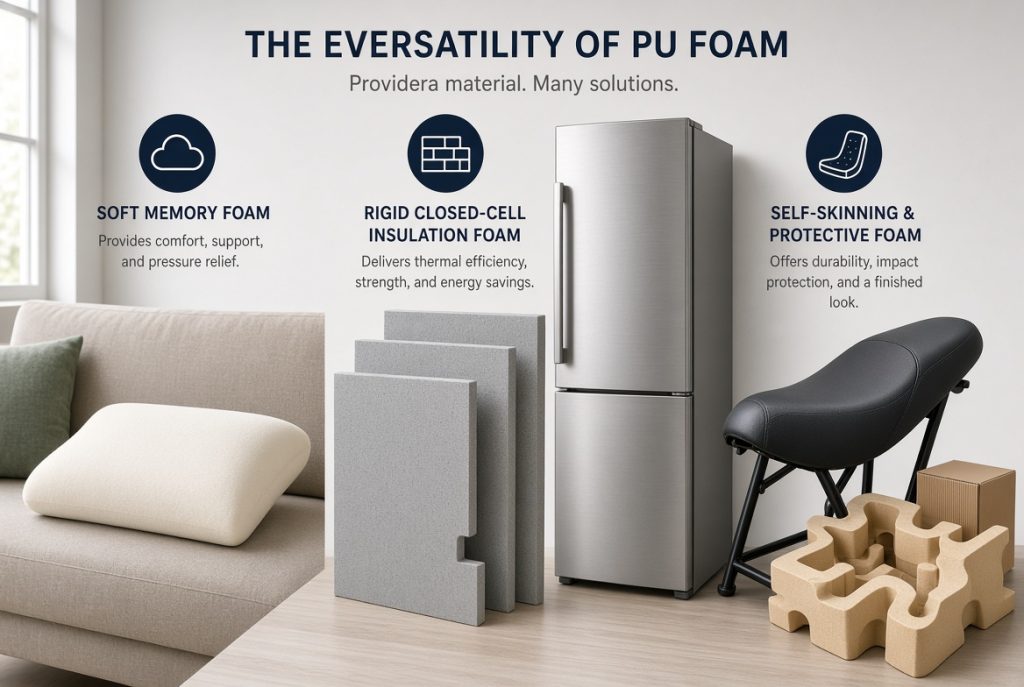
The popularity of PU foam comes from one major advantage:
Its properties can be engineered.
Unlike many conventional materials that have relatively fixed characteristics, polyurethane foam can be formulated to achieve a wide range of performance requirements.
Comfort
Flexible PU foam can provide:
- Softness
- Elasticity
- Resilience
- Pressure distribution
- Shock absorption
- Different firmness levels
This makes it suitable for:
- Sofas
- Mattresses
- Pillows
- Cushions
- Car seats
- Motorcycle seats
- E-bike seats
- Headrests
For example, a memory foam pillow is not simply “soft foam.” Its formulation needs to balance density, hardness, recovery speed, cell structure, temperature sensitivity, and long-term durability.
Lightweighting
Foam contains a large amount of gas within its cellular structure.
This allows manufacturers to achieve useful mechanical or thermal properties with relatively low weight.
For transportation, furniture, packaging, and many consumer products, reducing weight can reduce:
- Material consumption
- Transportation costs
- Product weight
- Energy consumption
Thermal insulation
Rigid PU foam is particularly valuable because its closed-cell structure can provide excellent thermal insulation.
This is why PU foam is widely used in:
- Refrigerators and freezers
- Cold-storage facilities
- Insulated panels
- Building insulation
- Pipes
- Tanks
- Roofing systems
- Industrial thermal insulation
Impact absorption
Certain PU foam formulations can absorb and dissipate mechanical energy.
This makes them useful for:
- Protective packaging
- Helmets
- Automotive components
- Sports equipment
- Protective products
The key is that different applications require different foam structures and mechanical responses.
3. How Does PU Foam Work?
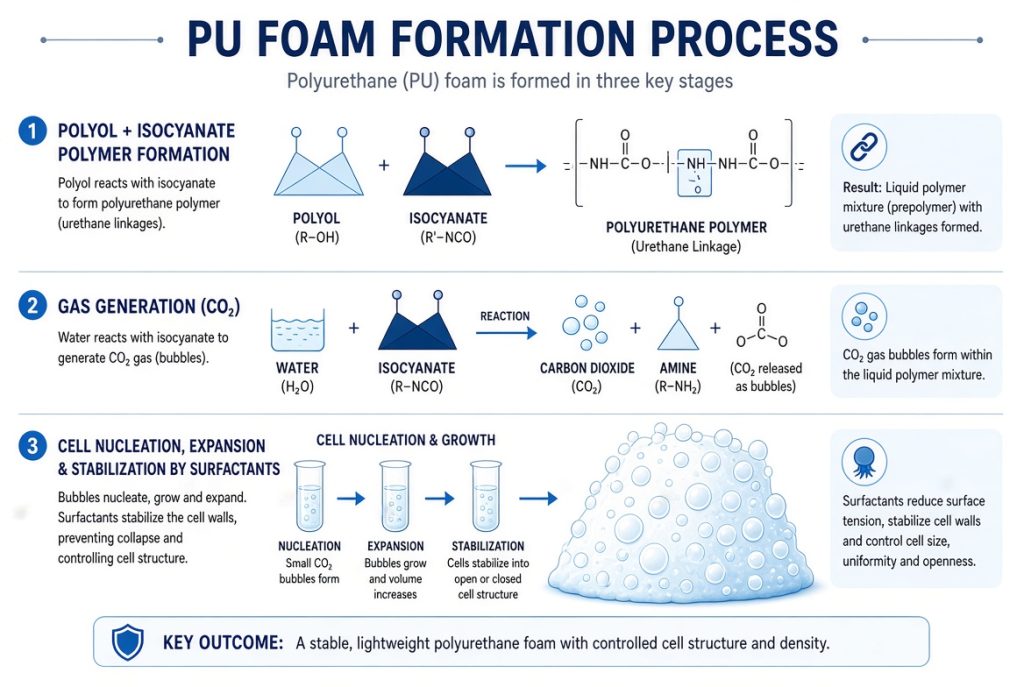
To understand PU foam, it helps to think of the process as polymer formation + gas generation + cell stabilization.
These three processes happen together and must remain balanced.
3.1 Polyurethane polymer formation
The basic polyurethane reaction occurs between an isocyanate and a polyol.
The resulting polymer creates the structural framework of the foam.
In simplified terms:
Polyol + Isocyanate → Polyurethane
However, real industrial formulations are considerably more complicated.
Different polyols, isocyanates, catalysts, chain extenders, crosslinkers, and additives influence:
- Reaction speed
- Crosslink density
- Hardness
- Flexibility
- Resilience
- Tensile strength
- Tear strength
- Compression behavior
This is why formulation design is much more than simply mixing two raw materials.
3.2 Gas generation and foaming
Foam needs gas.
Depending on the formulation, physical or chemical blowing mechanisms can be used.
One important chemical reaction involves isocyanate reacting with water:
Isocyanate + Water → CO₂ + Urea-related structures
The generated carbon dioxide can act as a blowing gas, creating bubbles inside the reacting polymer.
As the reaction proceeds, these bubbles expand.
Imagine thousands—or even millions—of tiny balloons growing inside a liquid polymer system.
That is essentially the beginning of the foam structure.
3.3 Cell formation and stabilization
Generating gas is not enough.
If the bubbles grow uncontrollably, the foam may collapse, develop large voids, or form an unstable cell structure.
This is where silicone surfactants and other formulation components become extremely important.
They help control:
- Cell nucleation
- Cell size
- Cell opening
- Cell stability
- Foam rise
- Surface quality
The final foam structure is therefore determined by the interaction between chemistry, gas generation, surfactant behavior, and processing conditions.
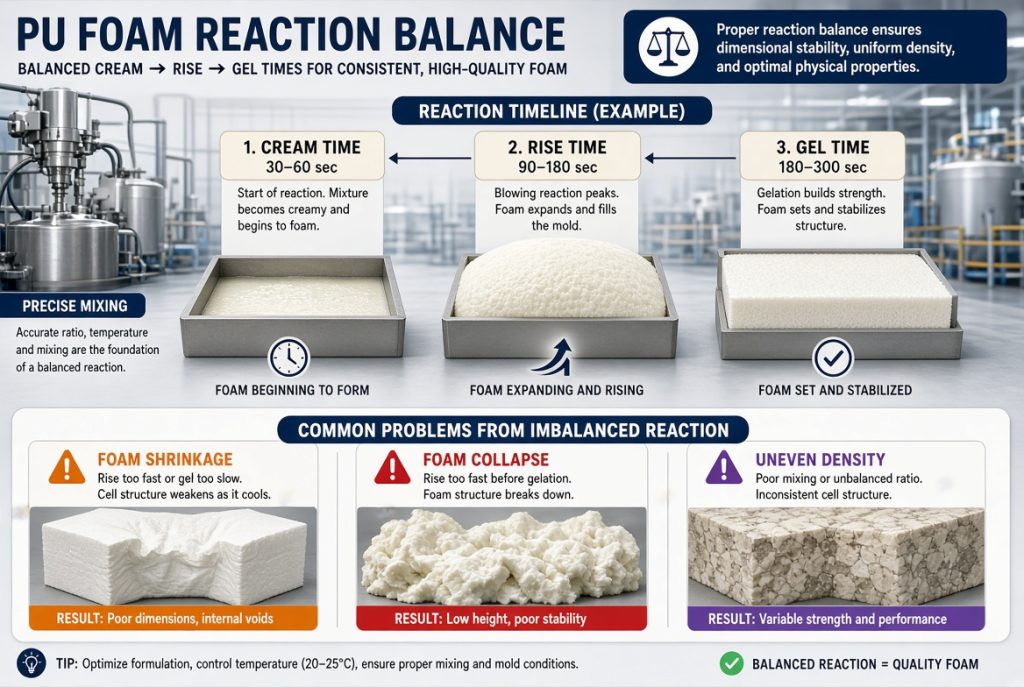
4. The Most Important Factor: Reaction Balance
One of the biggest mistakes beginners make is thinking:
“If the foam is not good, just add more catalyst.”
In reality, PU foam is a balance between several competing reactions.
Two useful concepts are:
Cream time
The period when the mixed material begins to visibly expand.
Rise time
The time required for the foam to reach its maximum rise or near-final expansion.
There are also other critical parameters such as:
- Gel time
- Tack-free time
- Demold time
- Density
- Rise profile
- Internal temperature
- Cell structure
If the reaction is too fast, the foam may rise before the polymer network has developed enough strength.
If the reaction is too slow, the foam may have:
- Poor productivity
- Insufficient dimensional stability
- Surface problems
- Collapse
- Incomplete curing
Therefore, good PU foam formulation is essentially a process of balancing chemical reaction rates with physical expansion.
5. Common PU Foam Problems
In real production, even a formulation that works well in the laboratory can behave differently on a production line.
Here are some of the most common problems.
Problem 1: Foam Shrinkage
The foam initially looks good but later contracts.
Possible causes include:
- Cell structure instability
- Excessive open-cell formation
- Insufficient polymer strength
- Incorrect surfactant balance
- Excessive blowing
- Incorrect catalyst balance
- Temperature problems
How to solve it
Instead of changing one ingredient randomly, manufacturers should systematically evaluate:
- Density
- Cell structure
- Cream/gel/rise profile
- Polyol system
- Surfactant level
- Catalyst balance
- Water/blowing level
- Mold and environmental temperature
Problem 2: Uneven Density
A product may have acceptable average density but large density differences from one area to another.
Possible causes include:
- Poor mixing
- Incorrect machine parameters
- Material temperature variation
- Mold temperature variation
- Uneven filling
- Formulation imbalance
Solution
The solution may require both formula optimization and equipment/process adjustment.
This is why a professional PU system supplier should not only provide a chemical formulation but also understand the customer’s production process.
Problem 3: Foam Collapse
The foam rises but cannot maintain its structure.
This can happen when the foam expands faster than the polymer network develops sufficient strength.
Potential causes include:
- Gel reaction too slow
- Excessive blowing
- Poor cell stabilization
- Incorrect surfactant
- Insufficient crosslinking
- Improper catalyst balance
The correct solution is usually to adjust the relationship between blowing, gelling, and cell stabilization, rather than simply increasing one catalyst.
Problem 4: Poor Resilience
For high-resilience foam, customers may find that the finished product feels too “dead” or lacks rebound.
Possible causes include:
- Incorrect polyol structure
- Incorrect crosslink density
- Poor cell structure
- Incorrect catalyst balance
- Incorrect density
- Processing temperature problems
For applications such as automotive seats and high-resilience cushions, the formulation must be designed around the required mechanical performance rather than simply targeting a specific density.
Problem 5: Memory Foam Rebounds Too Quickly—or Too Slowly
Slow-rebound foam is particularly sensitive to formulation design.
If the recovery is too fast, the product may not provide the expected memory effect.
If it is too slow, the foam may feel uncomfortable or fail production requirements.
Factors include:
- Polyol selection
- Polymer architecture
- Density
- Cell structure
- Catalyst system
- Crosslinking
- Additives
- Environmental temperature
For example, producing a 5-second memory pillow requires more than simply adding a “slow-rebound additive.” The entire formulation needs to be designed around the target recovery behavior.
6. Why PU Foam Formulation Is Difficult
A PU foam formulation can contain relatively few components, but each component can influence multiple properties simultaneously.
Changing one ingredient can affect:
Density → Cell structure → Hardness → Resilience → Reaction profile → Dimensional stability
This creates a classic formulation challenge.
For example:
Increase water → more gas → lower density
But the story does not end there.
More gas generation can also change cell size, reaction balance, foam stability, shrinkage tendency, and mechanical properties.
Similarly:
Increase catalyst → faster reaction
But faster reaction may also change rise profile, cell opening, curing behavior, surface quality, and processing window.
Therefore, professional PU foam development requires system-level formulation thinking.
7. PU Foam vs. PU System / Combination Material
This distinction is especially important for manufacturers.
A PU foam product is the final material.
A PU system or combination material is the customized chemical package designed to produce that final material.
In many industrial applications, customers do not want to independently purchase dozens of raw materials and develop the chemistry from scratch.
Instead, they need a system that can provide:
- Stable processing
- Consistent foam quality
- Target density
- Target hardness
- Required resilience
- Suitable reaction profile
- Production efficiency
- Application-specific performance
This is where a professional polyurethane system supplier becomes valuable.
8. How GST Can Provide PU Foam Solutions
For manufacturers looking for more than a standard raw material supply, GST can provide a combination of PU system, formulation development, application testing, and technical support.
The goal is not simply to sell a drum of chemicals.
The goal is to help the customer achieve a repeatable production result.
8.1 Customized PU Combination Materials
GST can develop customized polyurethane combination materials according to the customer’s application requirements.
Potential target applications include:
- Flexible foam
- High-resilience foam
- Memory foam
- Rigid foam
- Self-skinning foam
- Packaging foam
- Automotive seating
- Furniture cushions
- Motorcycle seats
- E-bike seats
- Memory pillows
- Insulation
- Cold storage
- Refrigerator insulation
- Protective products
Instead of starting with:
“Which formula do you sell?”
A better approach is:
“What properties does your final product need?”
The formulation can then be designed around the target performance.
8.2 Formula R&D
Different customers may require completely different formulations even for the same application.
For example, two memory pillow manufacturers may both produce “memory foam pillows,” but their requirements could be different:
- 3-second rebound
- 5-second rebound
- 8-second rebound
- Higher density
- Lower density
- Softer feel
- Firmer feel
- Better temperature response
- Different mold-filling behavior
GST’s formulation development approach can focus on these specific targets rather than offering a one-size-fits-all formula.
8.3 Laboratory Sampling and Machine Trials
A successful laboratory sample is only the beginning.
The real test is whether the formulation can run consistently on the customer’s production equipment.
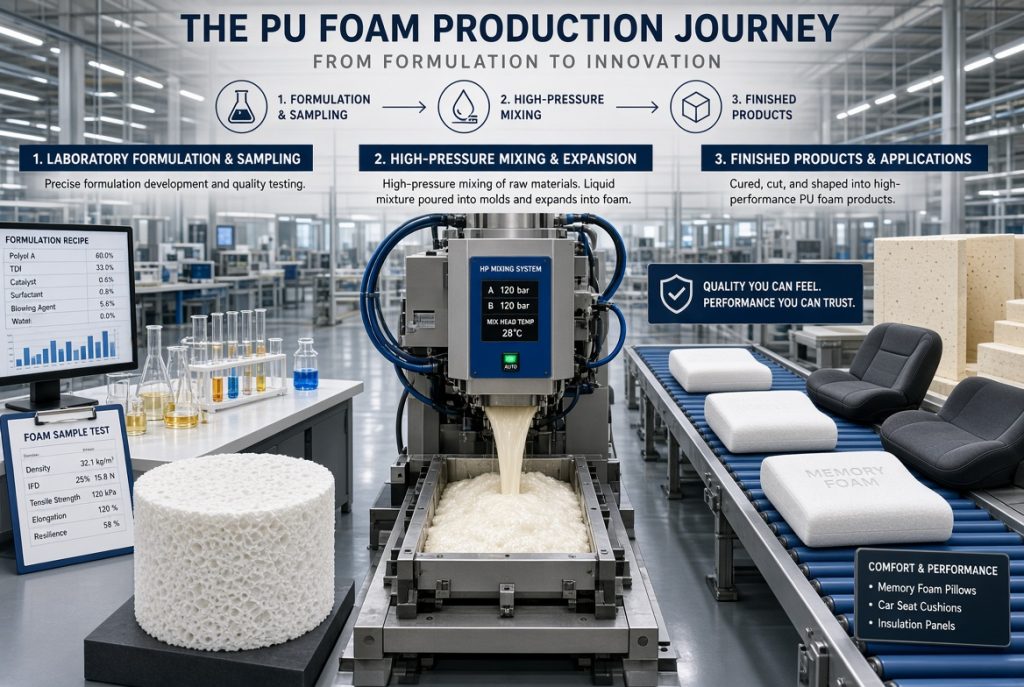
Therefore, a complete technical solution should consider:
Laboratory formulation → sample production → machine trial → parameter adjustment → mass production
During machine trials, factors such as:
- Mixing ratio
- Material temperature
- Machine pressure
- Pouring quantity
- Mold temperature
- Mold design
- Mixing efficiency
- Demolding time
may need to be optimized together.
8.4 Troubleshooting Existing Production Problems
GST can also support customers who already have a PU foam formula but are experiencing production problems.
For example:
“The foam shrinks after 24 hours.”
“The density is unstable.”
“The foam surface has defects.”
“The memory effect is not consistent.”
“The foam collapses after rising.”
“The production line works differently in winter and summer.”
These are not simply raw-material problems.
They are formulation + equipment + process + environment problems.
A professional technical team can analyze the complete production system and identify the most likely causes before adjusting the formulation.
9. From Formula to Production: What Really Matters?
A good PU foam solution should answer five questions:
1. What is the target product?
Memory pillow? Sofa cushion? Motorcycle seat? Refrigerator insulation? Packaging?
2. What properties are required?
Density? Hardness? Resilience? Rebound time? Flame resistance? Thermal conductivity?
3. What equipment is being used?
Low-pressure machine? High-pressure machine? Manual mixing? Continuous production?
4. What are the production conditions?
Material temperature, mold temperature, mixing ratio, ambient temperature, humidity, and cycle time can all influence the final foam.
5. What does mass production require?
A formula that works once is not necessarily a good industrial formula.
The real goal is:
Stable formula + stable process + stable quality + efficient production.
10. The Future of PU Foam
PU foam continues to evolve as manufacturers demand:
- Lower density
- Higher performance
- Better energy efficiency
- Improved comfort
- Better durability
- Flame-retardant performance
- Lower emissions
- More sustainable material solutions
- More precise processing
At the same time, customers increasingly expect polyurethane suppliers to provide more than chemicals.
They need application knowledge, formulation development, troubleshooting, testing, and technical support.
That is why the future of polyurethane is moving from simply selling raw materials toward providing complete application solutions.
11. Conclusion: PU Foam Is a System, Not Just a Foam
So, what is PU foam?
At the simplest level, it is a cellular polyurethane material.
But from an industrial perspective, PU foam is much more than that.
It is the result of a carefully balanced system involving:
Raw materials + chemical reactions + catalysts + surfactants + blowing + equipment + processing conditions + formulation design.
That is why achieving consistent PU foam quality can be challenging—and why professional formulation support can make a significant difference.
For manufacturers, the right question is not simply:
“Which PU foam should I buy?”
It is:
“What PU system can reliably help me manufacture the product I need?”
GST: Your PU Foam Combination Material & Application Solution Partner
GST focuses on polyurethane combination materials and application solutions, helping manufacturers move from idea → formulation → laboratory sample → machine trial → mass production.
Whether you are developing flexible foam, high-resilience foam, memory foam, rigid foam, self-skinning foam, packaging foam, insulation products, automotive components, furniture, or other PU applications, the right combination material and formulation strategy can make your production more stable and your final product more competitive.
Need a customized PU foam formulation or combination material?
Talk to GST about your target density, hardness, rebound, foam structure, processing conditions, and application requirements—and build the formulation around your actual production needs.
GST — Polyurethane Combination Materials & One-Stop Application Solutions.
CATEGORIES
LATEST NEWS
- Aromatic vs Aliphatic Isocy...
- What Is Modified MDI?
- MDI vs TDI: What’s th...
- TDI 80/20 vs TDI 65/35
- What Is TDI?
- What Is Polymeric MDI (pMDI)?
- What Is MDI?
- What Is Isocyanate?
- How to Select the Right Pol...
- How Does Polyol Affect Foam...
CONTACT US
Tel:+86 18688691634
Email:sam@1688pu.com
Add:No. 91 Central East Rd, Luxi Village, Gaobu Town, Dongguan 523283, China.