Why Is Polyurethane So Widely Used?
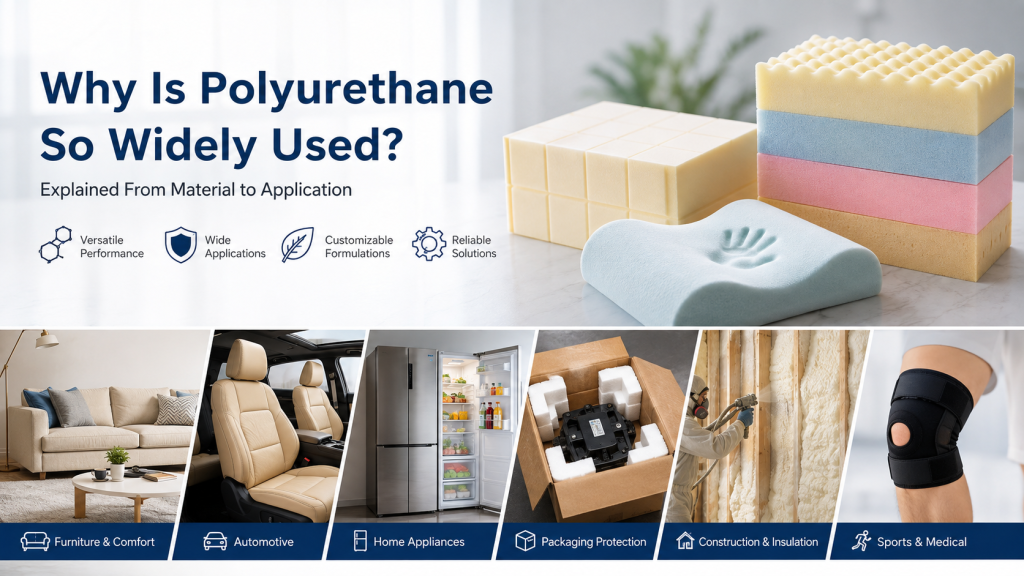
From soft, comfortable mattresses to durable automotive parts, from refrigerator insulation to protective packaging, polyurethane appears in more products than most people realize. Its popularity is not based on one single property—it comes from its ability to be engineered for very different performance requirements.
So, what makes polyurethane so widely used? Let’s break it down.
What Is Polyurethane?
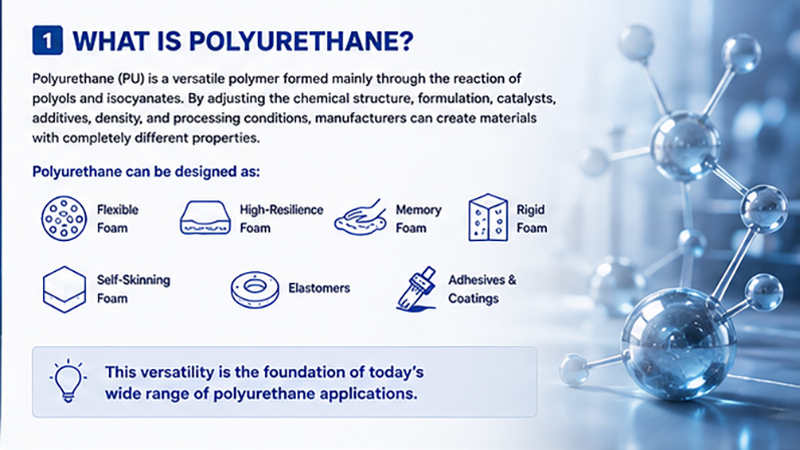
Polyurethane (PU) is a versatile polymer formed mainly through the reaction of polyols and isocyanates. By adjusting the chemical structure, formulation, catalysts, additives, density, and processing conditions, manufacturers can create materials with completely different properties.
Depending on the formulation, polyurethane can be designed as:
- Flexible foam
- High-resilience foam
- Memory foam
- Rigid foam
- Self-skinning foam
- Elastomers
- Adhesives and coatings
This versatility is the foundation of today’s wide range of polyurethane applications.
Why Do We Need Polyurethane?
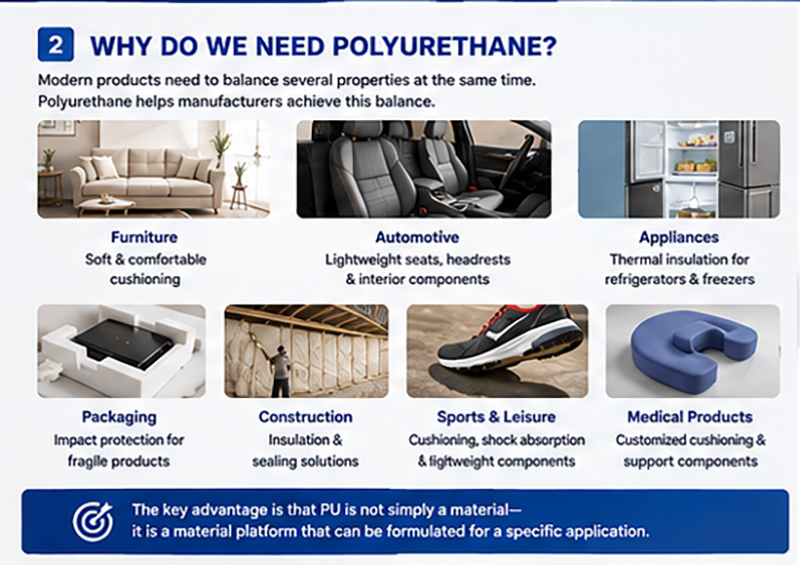
Modern products often need to balance several properties at the same time: comfort, strength, lightweight construction, insulation, durability, and cost.
Polyurethane can help manufacturers achieve this balance.
For example:
- Furniture: soft and comfortable cushioning
- Automotive: lightweight seats, headrests, and interior components
- Appliances: thermal insulation for refrigerators and freezers
- Packaging: impact protection for fragile products
- Construction: insulation and sealing solutions
- Sports & leisure: cushioning, shock absorption, and lightweight components
- Medical products: customized cushioning and support components
The key advantage is that PU is not simply a material—it is a material platform that can be formulated for a specific application.
How Does Polyurethane Work?
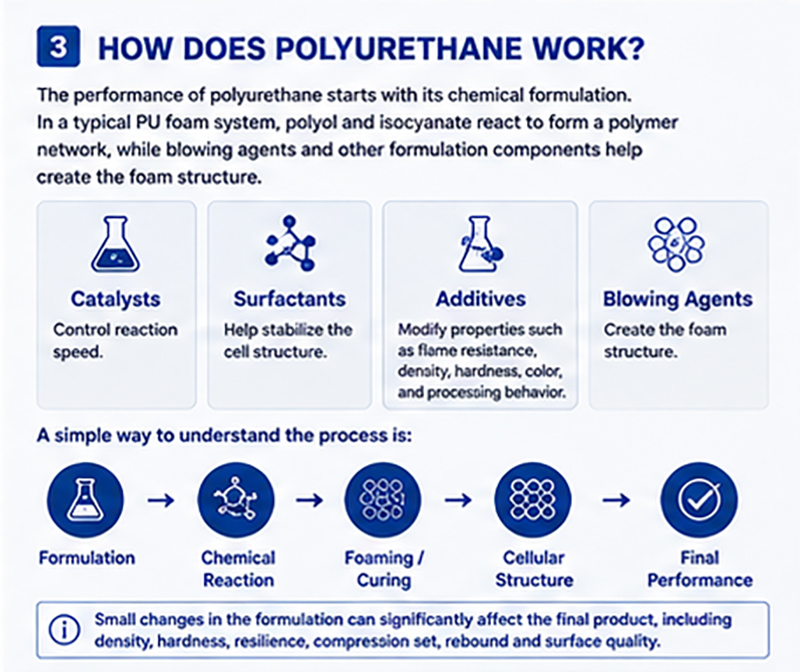
The performance of polyurethane starts with its chemical formulation.
In a typical PU foam system, polyol and isocyanate react to form a polymer network, while blowing agents and other formulation components help create the foam structure.
Catalysts control reaction speed, surfactants help stabilize the cell structure, and additives can modify properties such as flame resistance, density, hardness, color, and processing behavior.
A simple way to understand the process is:
Formulation → Chemical Reaction → Foaming/Curing → Cellular Structure → Final Performance
Small changes in the formulation can significantly affect the final product.
For example, adjusting the catalyst balance can influence cream time, rise time, demolding time, and surface quality. Changing the formulation can also affect density, hardness, resilience, compression set, and rebound characteristics.
That is why successful polyurethane production requires more than simply mixing raw materials.
Common Problems in Polyurethane Applications
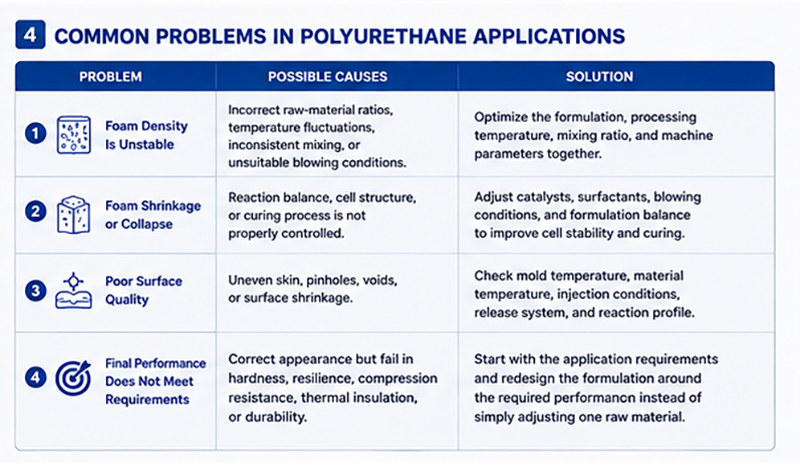
Although polyurethane is highly versatile, manufacturers may encounter problems during development or production.
1. Foam Density Is Unstable
Possible causes include incorrect raw-material ratios, temperature fluctuations, inconsistent mixing, or unsuitable blowing conditions.
Solution: Optimize the formulation, processing temperature, mixing ratio, and machine parameters together.
2. Foam Shrinkage or Collapse
This can occur when the reaction balance, cell structure, or curing process is not properly controlled.
Solution: Adjust catalysts, surfactants, blowing conditions, and formulation balance to improve cell stability and curing.
3. Poor Surface Quality
Defects such as uneven skin, pinholes, voids, or surface shrinkage may appear.
Solution: Check mold temperature, material temperature, injection conditions, release system, and reaction profile.
4. Final Performance Does Not Meet Requirements
A product may have the correct appearance but fail in hardness, resilience, compression resistance, thermal insulation, or durability.
Solution: Start with the application requirements and redesign the formulation around the required performance instead of simply adjusting one raw material.
How Can GST Help?
For polyurethane applications, choosing the right combination material and formulation is often more important than simply choosing a raw material supplier.
GST provides polyurethane combination materials and application-oriented technical solutions for different manufacturing requirements.
Our solutions can cover:
- Flexible foam systems
- High-resilience foam systems
- Memory foam systems
- Rigid foam systems
- Self-skinning PU systems
- Customized polyurethane formulations
- Formula optimization and technical support
- Laboratory testing and sample development
- Machine trial and production validation
More importantly, GST focuses on the complete process—from formulation development to production verification.
If a customer needs a memory pillow with a specific rebound time, a motorcycle seat with controlled resilience, rigid foam with specific insulation performance, or a customized PU component with particular density and hardness, the formulation can be developed around the actual application.
The Real Reason Polyurethane Is So Widely Used
The biggest strength of polyurethane is customization.
One material family can be transformed into soft, resilient, rigid, elastic, lightweight, insulating, or energy-absorbing products simply by changing its formulation and processing conditions.
That is why polyurethane continues to play an important role across furniture, automotive, appliances, construction, packaging, medical products, sports equipment, and many other industries.
Polyurethane is widely used not because it does everything—but because its performance can be engineered for what a specific application needs.
If you are looking for a polyurethane combination material, customized formulation, or technical solution, GST can help turn your product requirements into a practical PU application solution.
CATEGORIES
LATEST NEWS
- Aromatic vs Aliphatic Isocy...
- What Is Modified MDI?
- MDI vs TDI: What’s th...
- TDI 80/20 vs TDI 65/35
- What Is TDI?
- What Is Polymeric MDI (pMDI)?
- What Is MDI?
- What Is Isocyanate?
- How to Select the Right Pol...
- How Does Polyol Affect Foam...
CONTACT US
Tel:+86 18688691634
Email:sam@1688pu.com
Add:No. 91 Central East Rd, Luxi Village, Gaobu Town, Dongguan 523283, China.