What Is Polyurethane? A Complete Beginner’s Guide
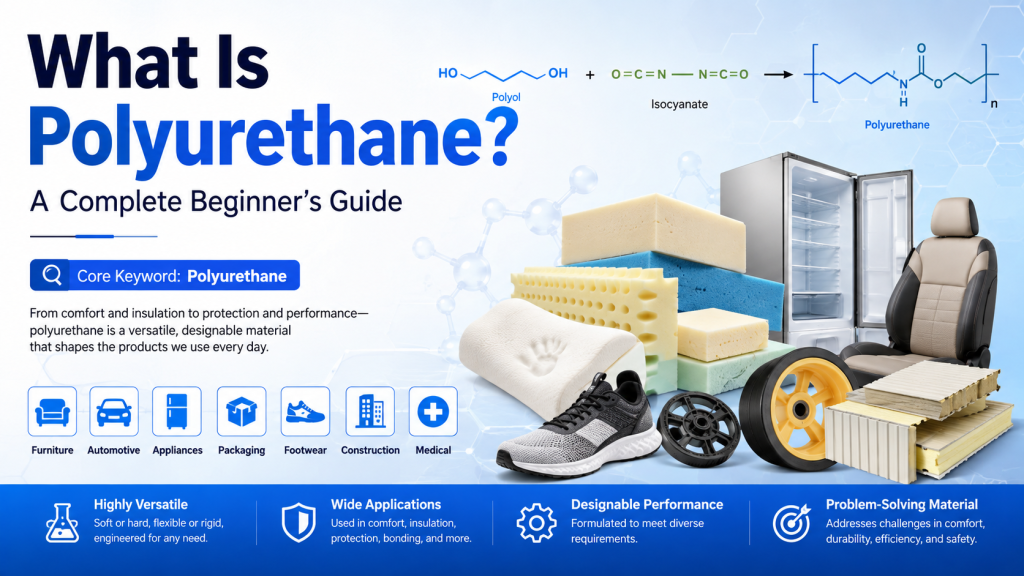
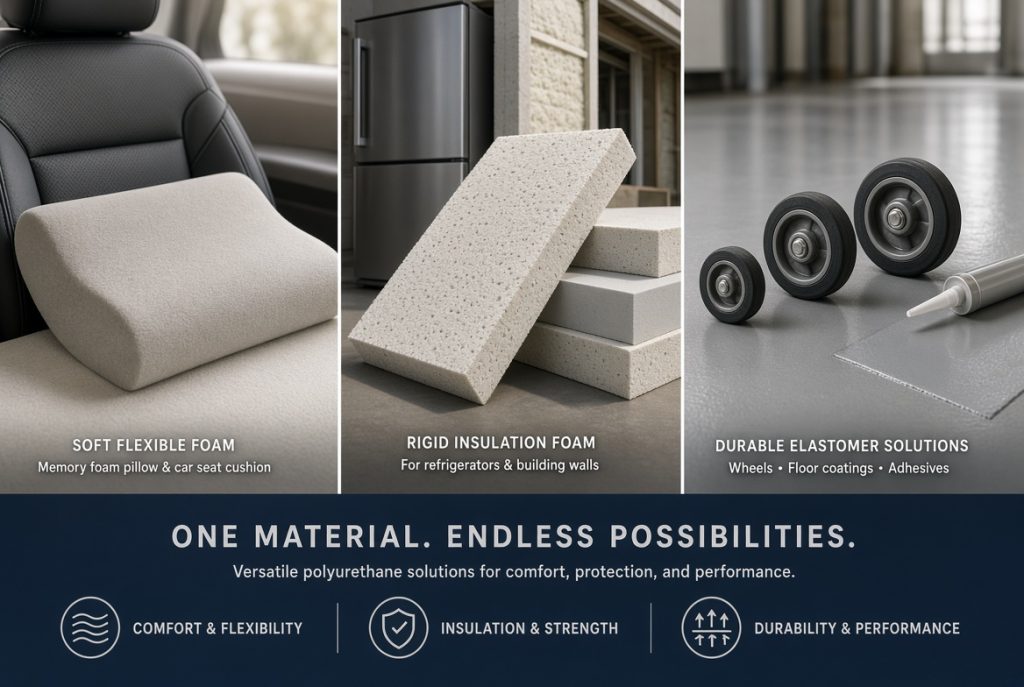
If you have ever used a memory foam pillow, sat on a car seat, opened a refrigerator, walked on a sports shoe, or handled protective packaging, there is a good chance you have already encountered polyurethane.
Polyurethane is not simply one material with one fixed set of properties. It is a broad family of polymers that can be engineered to be soft or hard, flexible or rigid, lightweight or highly durable, elastic or dimensionally stable. This versatility is one of the main reasons polyurethane has become an important material across furniture, automotive, appliances, construction, packaging, footwear, electronics, medical products, and many other industries.
But what exactly is polyurethane? Why do manufacturers choose it? How does polyurethane work? And when something goes wrong during production—such as poor foam rise, uneven density, slow curing, surface defects, or unstable hardness—how can the problem be solved?
This guide explains Polyurethane from a beginner-friendly perspective while keeping the technical details practical.
1. What Is Polyurethane?
At its most basic level, polyurethane is a polymer formed through a chemical reaction involving isocyanates and compounds containing reactive hydroxyl groups, commonly polyols.
In many polyurethane systems, the main reaction takes place between a polyol and an isocyanate. Depending on the selected raw materials, formulation, catalysts, additives, processing conditions, and production method, manufacturers can create materials with dramatically different properties.
A simplified way to understand the chemistry is:
Polyol + Isocyanate → Polyurethane
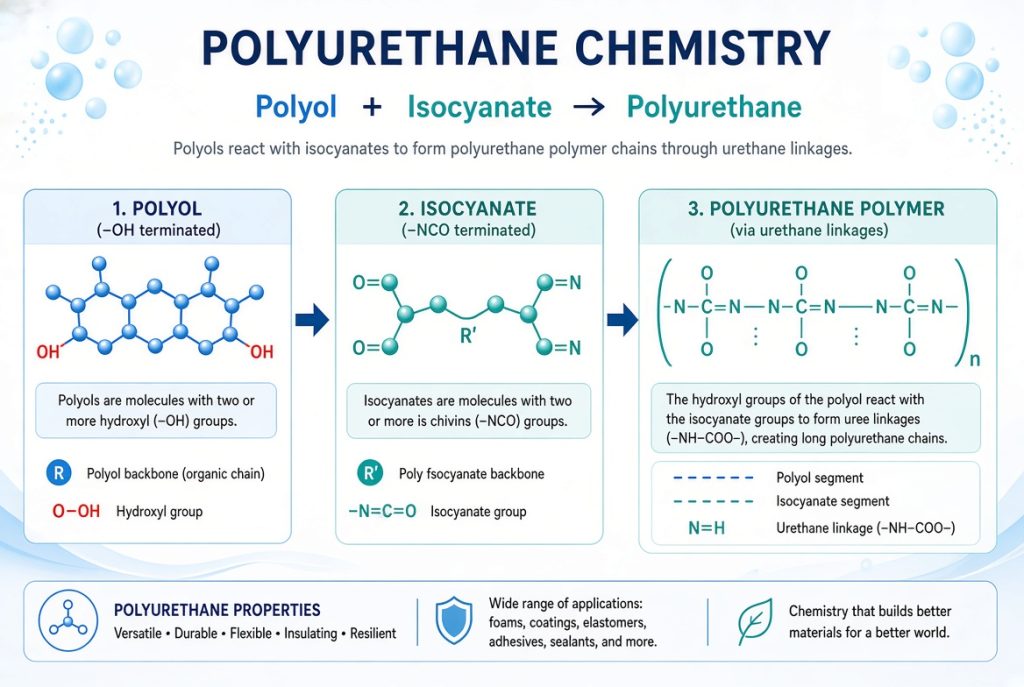
However, real-world polyurethane formulation is much more sophisticated than this simple equation suggests.
A typical system may involve:
- Polyether or polyester polyols
- MDI, TDI, or other isocyanates
- Catalysts
- Surfactants
- Blowing agents
- Chain extenders or crosslinkers
- Flame retardants
- Stabilizers
- Pigments and other functional additives
The combination and balance of these components determine the final performance of the polyurethane product. Industry training materials commonly divide polyurethane chemistry into areas such as rigid and flexible systems, 1K and 2K systems, waterborne systems, elastomers, coatings, adhesives, and foams.
Polyurethane is a “designable” material
This is perhaps the most important concept for beginners.
When people say polyurethane, they are not necessarily talking about the same material.
For example:
| Polyurethane Type | Typical Characteristics | Common Applications |
| Flexible PU Foam | Soft, resilient, cushioning | Mattresses, sofas, car seats |
| Memory Foam | Slow recovery, pressure distribution | Memory pillows, mattresses |
| High Resilience Foam | Elasticity, fast recovery | Automotive seats, furniture |
| Rigid PU Foam | Lightweight, thermal insulation | Refrigerators, cold storage, buildings |
| Self-Skinning Foam | Integrated outer skin + foam core | Armrests, motorcycle seats, handles |
| PU Elastomer | Wear resistance, elasticity | Wheels, rollers, seals |
| PU Coating | Protection and appearance | Floors, automotive, industrial surfaces |
| PU Adhesive/Sealant | Strong bonding and sealing | Construction, furniture, composite materials |
This broad range of possibilities is one reason polyurethane is considered one of the most versatile polymer material families.
2. Why Do We Need Polyurethane?

The better question is not simply “What is polyurethane?”
It is:
What problem does polyurethane solve?
Different industries have different problems.
A furniture manufacturer may need comfort and resilience.
A refrigerator manufacturer may need thermal insulation and dimensional stability.
An automotive manufacturer may need lightweight cushioning, durability, and controlled hardness.
A packaging company may need shock absorption and customized protection.
A construction company may need thermal insulation, adhesion, sealing, and durability.
Polyurethane can be formulated for many of these requirements.
2.1 Comfort
Flexible polyurethane foam can be engineered across a wide range of densities, hardness levels, resilience, and support characteristics.
That makes it useful for:
- Mattresses
- Sofas
- Office chairs
- Car seats
- Cushions
- Pillows
- Motorcycle seats
For example, a memory foam pillow needs a very different response profile from a high-resilience automotive seat. The chemistry and formulation therefore need to be designed around the application rather than simply selecting “one polyurethane material.”
2.2 Thermal Insulation
Rigid polyurethane foam is widely used for insulation because its cellular structure can provide strong resistance to heat transfer.
Typical applications include:
- Refrigerators and freezers
- Cold-storage rooms
- Insulated panels
- Roof insulation
- Wall insulation
- Pipe insulation
- Spray foam insulation
Rigid polyurethane and polyisocyanurate foams are recognized as important insulation materials for buildings and appliances.
For a refrigerator, for example, the foam is not merely “filling space.”
It becomes an important part of the thermal-management system.
2.3 Lightweight + Strength
Polyurethane can provide a useful balance between weight and mechanical performance.
This is particularly valuable in automotive, transportation, sporting goods, furniture, and industrial applications.
Instead of simply making a component thicker or heavier, engineers can use polyurethane chemistry and structural design to achieve the required performance with controlled density.
2.4 Energy Efficiency
Polyurethane insulation can help reduce unwanted heat transfer.
This is why polyurethane foam is frequently used in:
- Refrigeration
- Building insulation
- Cold-chain equipment
- Insulated doors
- Roof and wall systems
The benefit is not only material performance. Better insulation can contribute to lower energy consumption during the service life of a product or building.
2.5 Durability and Protection
Polyurethane can also be formulated for abrasion resistance, elasticity, adhesion, chemical resistance, weather resistance, and impact absorption.
This makes polyurethane useful in coatings, adhesives, sealants, elastomers, automotive components, industrial parts, and protective applications.
3. How Does Polyurethane Work?
To understand polyurethane processing, it helps to think about three stages:
Formulation → Reaction → Structure Formation
The final product is determined by what happens during all three stages.
3.1 Stage One: Formulation
Before production begins, formulators select the raw materials according to the target product.
For example:
Target: 5-second slow-rebound memory foam pillow
The formulation may need to balance:
- Density
- Hardness
- Resilience
- Recovery time
- Cell structure
- Air permeability
- Compression characteristics
- Processing window
- Surface quality
A completely different formulation would be needed for a rigid refrigerator insulation foam.
This is why polyurethane manufacturing is fundamentally a formulation engineering process, not simply a mixing process.
3.2 Stage Two: Chemical Reaction
Once the components are mixed, the polyurethane reaction begins.
The isocyanate reacts with reactive groups in the polyol system, creating polyurethane structures. Depending on the system, additional reactions can contribute to crosslinking, chain extension, or gas generation.
In a typical two-component system, the isocyanate side is often referred to as the A-side, while the polyol formulation is commonly referred to as the B-side. Curing begins after the components are mixed, with the reaction speed depending on formulation and processing conditions.
This is where catalysts become extremely important.
A catalyst can influence how quickly different reactions occur.
The goal is not simply:
“Make the reaction faster.”
The real goal is:
“Make the right reactions happen at the right speed.”
3.3 Stage Three: Foam Formation
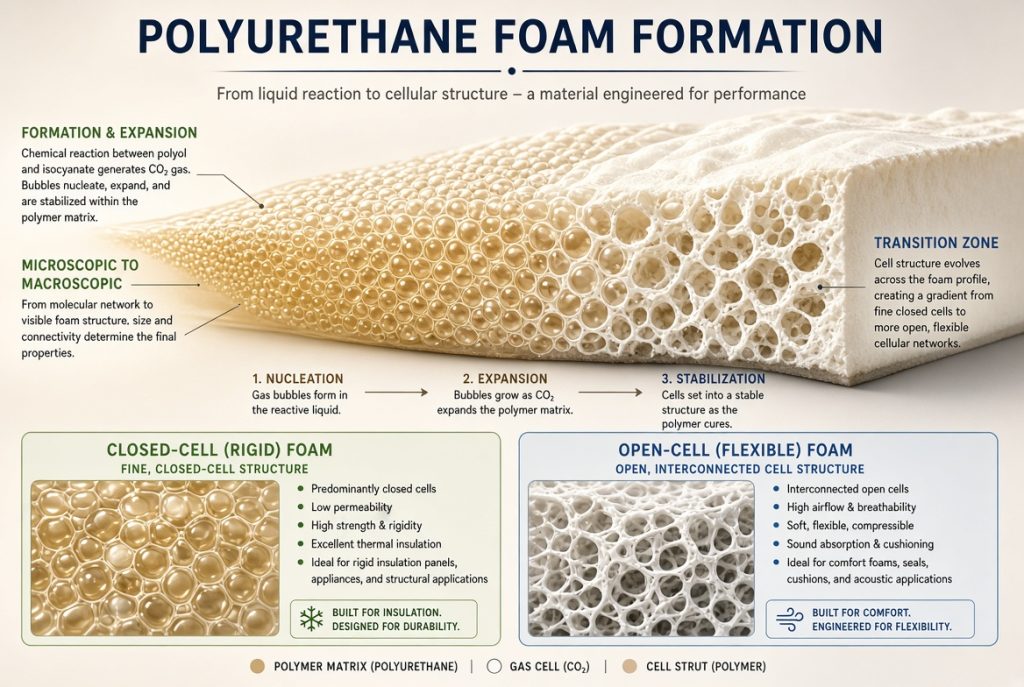
For polyurethane foam, the chemistry has another important dimension: cell formation.
Gas generated during the foaming process expands the reacting polymer system and creates cells.
The resulting cellular structure influences:
- Density
- Hardness
- Thermal insulation
- Compression behavior
- Resilience
- Airflow
- Surface appearance
- Dimensional stability
For rigid foam, a fine and stable closed-cell structure is particularly important for insulation performance.
For flexible foam, the balance between cell opening, polymer strength, airflow, resilience, and density becomes much more important.
Therefore, two foams can have the same density but completely different performance.
Density alone does not define polyurethane foam quality.
4. What Determines the Final Performance of Polyurethane?
Many beginners assume that the performance of polyurethane mainly depends on the polyol and isocyanate.
In reality, the formulation is a system.
Important variables include:
Raw Materials
Different polyols and isocyanates provide different molecular structures and reactivity.
For example:
- Polyether polyols
- Polyester polyols
- TDI
- MDI
- Polymeric MDI
Different combinations can produce different physical and processing characteristics.
Catalyst Balance
Catalysts influence reaction kinetics.
If the catalyst balance is incorrect, you may experience:
- Slow cream time
- Excessively fast rise
- Poor mold filling
- Incomplete curing
- Surface defects
- Shrinkage
- Poor cell structure
Surfactants
Surfactants help control cell formation and stabilization.
An inappropriate surfactant package can result in:
- Large cells
- Uneven cells
- Collapse
- Poor surface quality
- Dimensional instability
Blowing System
The blowing system determines how the foam expands and contributes significantly to density and cell structure.
Isocyanate Index
The ratio between reactive components is also critical.
Small formulation changes can affect:
- Hardness
- Density
- Strength
- Resilience
- Cure
- Dimensional stability
- Surface characteristics
This is why professional polyurethane formulation is a balance of chemistry, processing, equipment, and application requirements.
5. Common Polyurethane Problems — and How to Solve Them
In real production, polyurethane problems rarely have only one possible cause.
A good technical engineer does not simply ask:
“Which raw material is wrong?”
Instead, they look at the entire process.
Problem 1: Foam Density Is Too High or Too Low
Possible Causes
- Incorrect formulation
- Incorrect component ratio
- Incorrect blowing balance
- Material temperature variation
- Poor mixing
- Machine calibration problems
- Environmental temperature or humidity changes
Possible Solutions
First verify the basic parameters:
- Check A/B component ratio.
- Check raw-material temperature.
- Check material viscosity.
- Check machine calibration.
- Check mixing quality.
- Review the blowing system.
- Re-test density under controlled conditions.
The important principle is:
Do not change the formulation before confirming the process.
Otherwise, you may “solve” a machine problem by changing the chemistry—and create another problem later.
Problem 2: Foam Collapses After Rising
Foam collapse is a classic polyurethane processing problem.
Possible causes include:
- Insufficient polymer strength during rise
- Poor cell stabilization
- Incorrect catalyst balance
- Excessive blowing
- Incorrect surfactant selection
- Material temperature problems
- Excess moisture or formulation imbalance
Solution
A systematic troubleshooting approach should compare:
Cream Time → Rise Time → Gel Time → Tack-Free Time → Final Density → Cell Structure
The relationship between these parameters often reveals where the formulation is out of balance.
Problem 3: Foam Shrinkage
Shrinkage can occur when the internal cell pressure and polymer structure are not properly balanced.
Possible causes include:
- Poor cell structure
- Excessive open-cell or closed-cell imbalance
- Insufficient curing
- Incorrect blowing conditions
- Temperature problems
- Demolding too early
- Formulation imbalance
The solution may involve adjusting the catalyst package, surfactant system, blowing balance, polymer structure, or processing conditions.
Problem 4: Hardness Is Not Stable
Suppose a customer wants:
30 kg/m³ density + specific hardness + specific resilience.
But the production result changes from batch to batch.
Possible reasons include:
- Raw-material batch variation
- Component ratio variation
- Material temperature fluctuations
- Catalyst concentration changes
- Mixing problems
- Mold temperature differences
- Inconsistent curing conditions
The solution is not always “add more catalyst.”
A professional approach is to establish a controlled processing window and define measurable specifications for each important parameter.
Problem 5: Surface Defects
Common surface problems include:
- Pinholes
- Voids
- Poor skin
- Uneven surface
- Bubbles
- Flow marks
- Mold-filling defects
Possible causes may come from:
- Mold temperature
- Release agent
- Material temperature
- Mixing
- Air entrapment
- Reaction profile
- Formulation
- Mold design
For self-skinning polyurethane, the relationship between skin formation and internal foam development is particularly important.
6. Why Is a Polyurethane “Combination Material” Important?
This is where polyurethane becomes particularly interesting for manufacturers.
Instead of purchasing and independently balancing every single component, manufacturers can use a polyurethane system / combination material.
A combination material typically integrates multiple formulation components into a controlled system designed for a particular application and processing method.
For example, a system may be designed specifically for:
- Memory foam pillows
- High-resilience automotive seats
- Motorcycle seats
- Self-skinning products
- Rigid insulation
- Packaging foam
- Shoe soles
- Industrial elastomers
The advantage is consistency and formulation control.
Rather than asking a factory operator to independently optimize ten or more variables, a professional system supplier can develop a formulation around the customer’s target requirements.
7. GST: From Polyurethane Raw Materials to Complete Application Solutions
For manufacturers, the biggest challenge is often not understanding what polyurethane is.
The real challenge is:
How do we make the polyurethane perform exactly as our product requires?
This is where GST can provide value beyond simply supplying polyurethane materials.
GST focuses on polyurethane combination materials, formulation development, and application technology, helping customers move from an initial product requirement to laboratory testing and production validation.
7.1 GST Polyurethane Combination Materials
GST can develop application-oriented polyurethane systems for different product requirements, including:
- Flexible foam
- High-resilience foam
- Slow-rebound / memory foam
- Self-skinning foam
- Rigid foam
- Packaging foam
- Other customized polyurethane systems
The purpose is not to sell a “one-formula-fits-all” product.
Instead, the formulation can be developed around the customer’s actual requirements.
7.2 Formula Development
Different customers may request completely different performance targets.
For example:
Memory Pillow
- Specific density
- 5-second recovery
- Soft touch
- Good support
- Stable cell structure
- Comfortable hand feel
Motorcycle Seat
- Specific hardness
- High resilience
- Compression performance
- Durability
- Surface quality
Refrigerator Insulation
- Low thermal conductivity
- Fine cell structure
- Dimensional stability
- Suitable processing time
- Strong adhesion
These are different technical problems.
Therefore, the formulation must be different.
GST’s role is to connect:
Customer Requirement → Material Selection → Formula Development → Laboratory Testing → Machine Trial → Production Validation
8. From Laboratory Sample to Mass Production
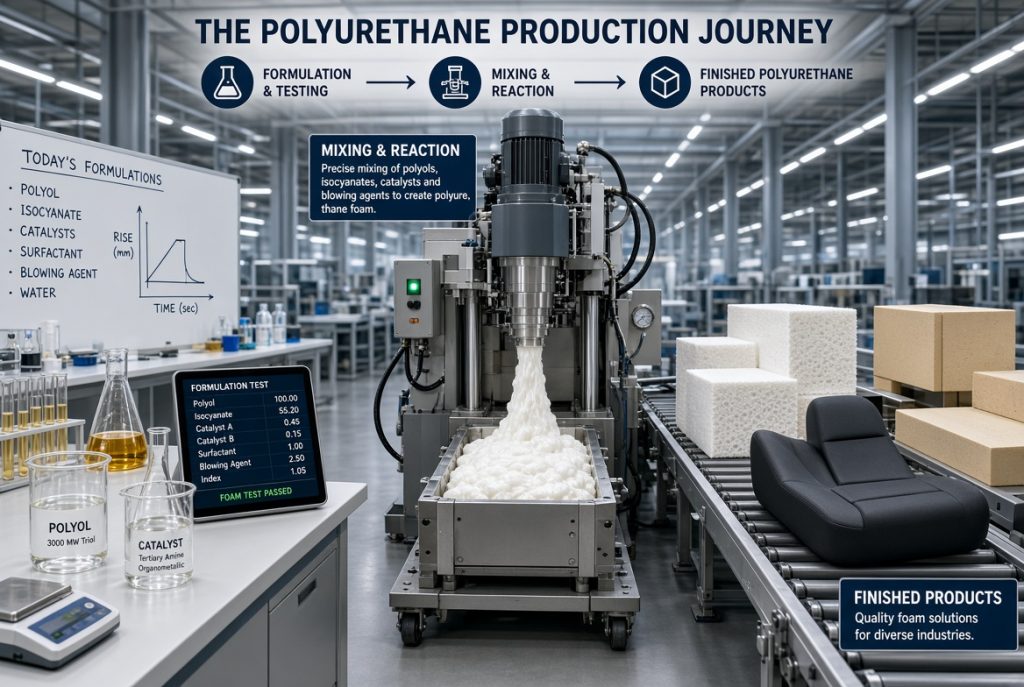
A successful polyurethane formula is not necessarily successful just because it works in a laboratory cup test.
This is a critical point for manufacturers.
Laboratory conditions and production conditions can be very different.
A formula must also be evaluated under actual:
- Machine parameters
- Mixing conditions
- Mold temperature
- Ambient temperature
- Material temperature
- Injection speed
- Mold filling
- Demolding conditions
- Production cycle
Therefore, a professional polyurethane solution should include both formulation development and processing support.
For example, GST can help customers move through a practical process:
Step 1 — Define the Target
What does the customer actually need?
Step 2 — Select the Chemistry
Choose suitable polyols, isocyanates, catalysts, surfactants, blowing systems, and other additives.
Step 3 — Laboratory Development
Perform small-scale formulation trials and evaluate physical properties.
Step 4 — Mold or Machine Trial
Move the formula onto the customer’s actual equipment.
Step 5 — Optimize the Processing Window
Adjust:
- Mixing ratio
- Material temperature
- Mold temperature
- Injection quantity
- Reaction profile
- Demolding time
Step 6 — Production Validation
Confirm that the formula remains stable under continuous production.
This is the difference between simply selling polyurethane chemicals and providing a polyurethane application solution.
9. Polyurethane Is a Chemistry — But Successful PU Production Is a System
A common misconception is:
“If the raw materials are good, the polyurethane product will automatically be good.”
Not necessarily.
A successful polyurethane product depends on the interaction between:
Raw Materials + Formula + Equipment + Process + Mold + Environment + Quality Control
A high-quality formulation can still produce poor results if the machine is incorrectly calibrated.
Likewise, excellent equipment cannot compensate for a poorly designed formulation.
That is why polyurethane development requires cooperation between material science and manufacturing technology.
10. Frequently Asked Questions About Polyurethane
Is polyurethane plastic?
Yes. Polyurethane is a polymer material and is generally classified as a versatile family of plastics/polymers. However, polyurethane can take many forms, including flexible foam, rigid foam, elastomers, coatings, adhesives, and sealants.
Is polyurethane always foam?
No.
Polyurethane can be produced as:
- Foam
- Elastomer
- Coating
- Adhesive
- Sealant
- Binder
- Thermoplastic polyurethane
Foam is only one major category of polyurethane products.
What is the difference between PU and polyurethane?
They normally refer to the same material family.
PU is simply the common abbreviation for polyurethane.
What is the difference between MDI and TDI?
Both are important aromatic diisocyanates used in polyurethane production.
TDI is widely associated with flexible foam applications, while MDI is extensively used in rigid foam and is also used in CASE applications and specialty foam systems.
Why does polyurethane foam need catalysts?
Catalysts influence reaction rates and help control the relationship between the various reactions taking place during processing.
The objective is to achieve the desired cream, rise, gel, cure, and final physical properties.
Why does the same polyurethane formula behave differently in different factories?
Because production conditions are not identical.
Differences in:
- Machine type
- Mixing efficiency
- Material temperature
- Mold temperature
- Ambient humidity
- Injection quantity
- Mold design
- Production cycle
can change the final result.
This is why formula adaptation and machine trials are important.
11. How to Choose the Right Polyurethane Solution
Before selecting a polyurethane system, manufacturers should clearly define the final product requirements.
A useful checklist includes:
Product Requirements
- What is the application?
- What density is required?
- What hardness is required?
- What resilience is required?
- What thermal performance is required?
- What durability is required?
- What surface appearance is required?
Production Requirements
- What machine is being used?
- What is the mixing ratio?
- What is the mold temperature?
- What is the production cycle?
- What is the expected output?
- What are the environmental conditions?
Quality Requirements
- Density
- Hardness
- Resilience
- Compression
- Tensile strength
- Elongation
- Thermal conductivity
- Dimensional stability
- Flame performance where applicable
- Aging performance
The clearer these requirements are, the easier it is for a polyurethane supplier to develop an appropriate system.
12. Why GST Can Be Your Polyurethane Technology Partner
At GST, polyurethane is viewed not simply as a chemical raw material, but as an application technology.
The goal is to help customers answer practical manufacturing questions:
How soft should the foam be?
How fast should it rebound?
How low can the density go while maintaining performance?
How can the foam fill the mold more evenly?
How can we improve surface quality?
How can we stabilize production?
How can a laboratory formula be transferred to mass production?
These questions require more than a product catalog.
They require:
Formula + Raw Materials + Testing + Equipment + Process + Technical Support
GST can provide polyurethane combination materials and customized formulation development for applications such as flexible foam, rigid foam, memory foam, high-resilience foam, self-skinning foam, packaging, automotive components, furniture, and other polyurethane products.
The ultimate objective is simple:
Make polyurethane easier to formulate, easier to process, and more reliable in real production.
Conclusion: Understanding Polyurethane Is the First Step
So, what is polyurethane?
In simple terms, polyurethane is a versatile polymer family created through carefully controlled chemical reactions, commonly involving polyols and isocyanates.
But that definition only tells part of the story.
The real power of polyurethane comes from its ability to be engineered.
By changing the raw materials, formulation, catalysts, blowing system, processing conditions, and structure, manufacturers can create materials ranging from soft memory foam to rigid insulation, from resilient automotive cushions to durable elastomers, coatings, adhesives, and sealants.
That is why polyurethane continues to play such an important role across modern manufacturing.
And for manufacturers, the most important question is often not:
“What is Polyurethane?”
It is:
“Which polyurethane formulation and processing solution is right for my product?”
That is exactly where a professional polyurethane system supplier such as GST can add value—from combination materials and formulation development to laboratory testing, machine trials, process optimization, and production support.
Need a customized polyurethane formulation or combination material for your application? GST can help turn your product requirements into a practical polyurethane solution.
NEXT:What Is PU Foam?
CATEGORIES
LATEST NEWS
- Aromatic vs Aliphatic Isocy...
- What Is Modified MDI?
- MDI vs TDI: What’s th...
- TDI 80/20 vs TDI 65/35
- What Is TDI?
- What Is Polymeric MDI (pMDI)?
- What Is MDI?
- What Is Isocyanate?
- How to Select the Right Pol...
- How Does Polyol Affect Foam...
CONTACT US
Tel:+86 18688691634
Email:sam@1688pu.com
Add:No. 91 Central East Rd, Luxi Village, Gaobu Town, Dongguan 523283, China.