How Is Polyurethane Made?
When you sit on a sofa, sleep on a memory foam pillow, open a refrigerator, or use insulated packaging, there is a good chance polyurethane (PU) is working behind the scenes.
But how is polyurethane made? Why can the same material be soft like a mattress, rigid like insulation, or strong enough for industrial applications?
The answer lies in polyurethane chemistry, formulation design, and processing technology.
1. What Is Polyurethane?
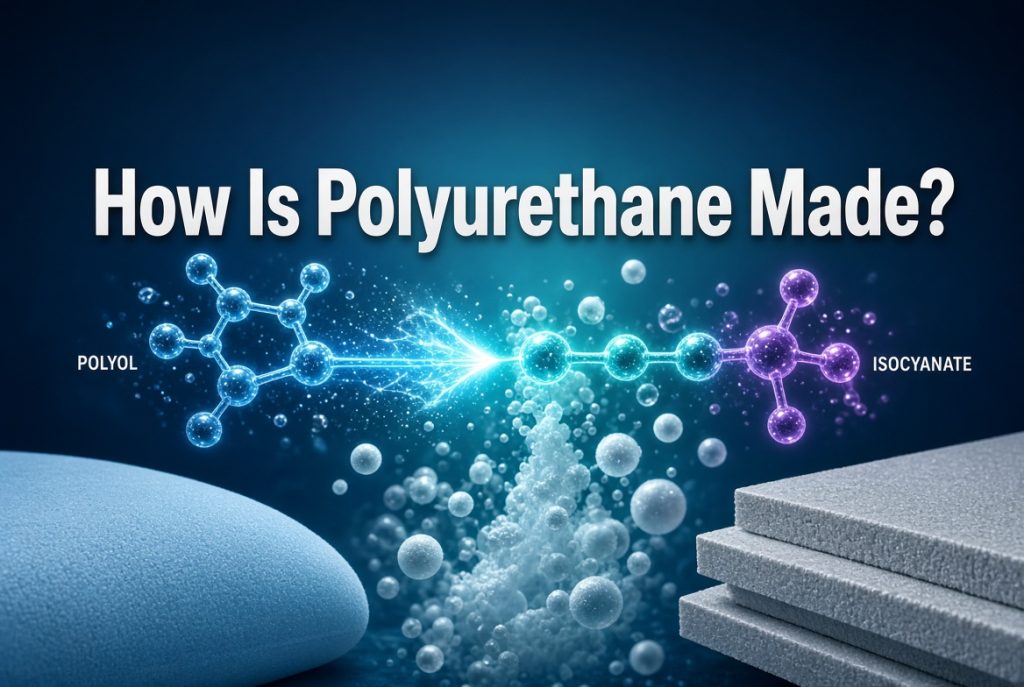
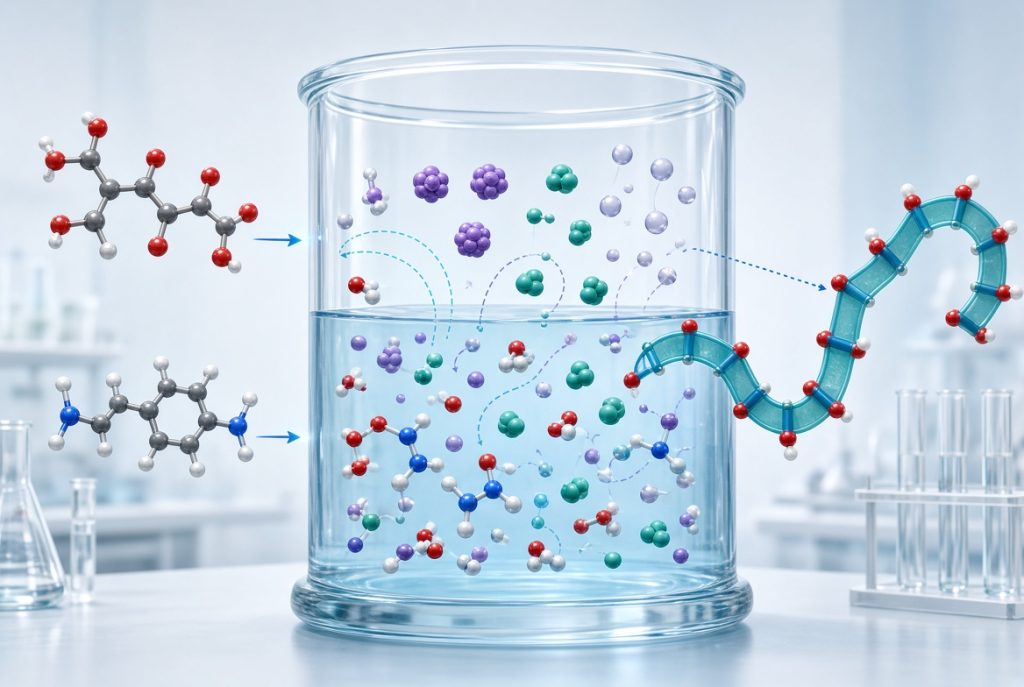
Polyurethane is a versatile polymer created mainly through a chemical reaction between polyols and isocyanates.
Unlike materials with only one fixed structure, polyurethane can be engineered into many different forms by adjusting its chemical structure and formulation.
Depending on the raw materials, additives, catalysts, blowing agents, and processing conditions, polyurethane can become:
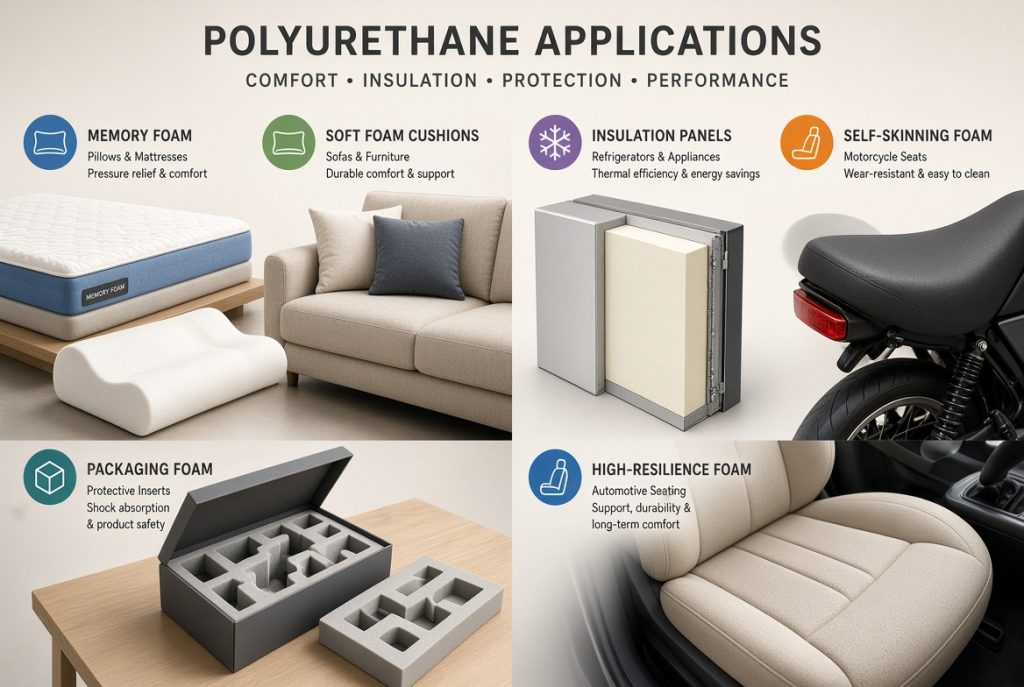
- Flexible foam for mattresses and sofas
- Memory foam for pillows and cushions
- High-resilience foam for automotive and furniture applications
- Rigid foam for thermal insulation
- Self-skinning foam for armrests and motorcycle seats
- Elastomers, adhesives, coatings, and other specialty materials
This flexibility is one of the main reasons polyurethane is used across so many industries.
2. Why Do We Need Polyurethane?
Modern products often require several properties at the same time: light weight, comfort, insulation, durability, flexibility, and energy efficiency.
Polyurethane can be formulated to meet very different performance requirements.
For example, rigid PU foam provides excellent thermal insulation while keeping weight relatively low. Flexible PU foam can provide cushioning and resilience. Memory foam can be designed to respond slowly to pressure and temperature.
In other words, polyurethane is not simply a material—it is a platform for material engineering.
3. How Is Polyurethane Made?
At its basic level, polyurethane production involves the reaction of polyol and isocyanate.
But commercial polyurethane production is much more than simply mixing two chemicals.
A typical formulation may include:
Polyol + Isocyanate + Catalysts + Silicone Surfactants + Blowing Agents + Other Additives → Polyurethane
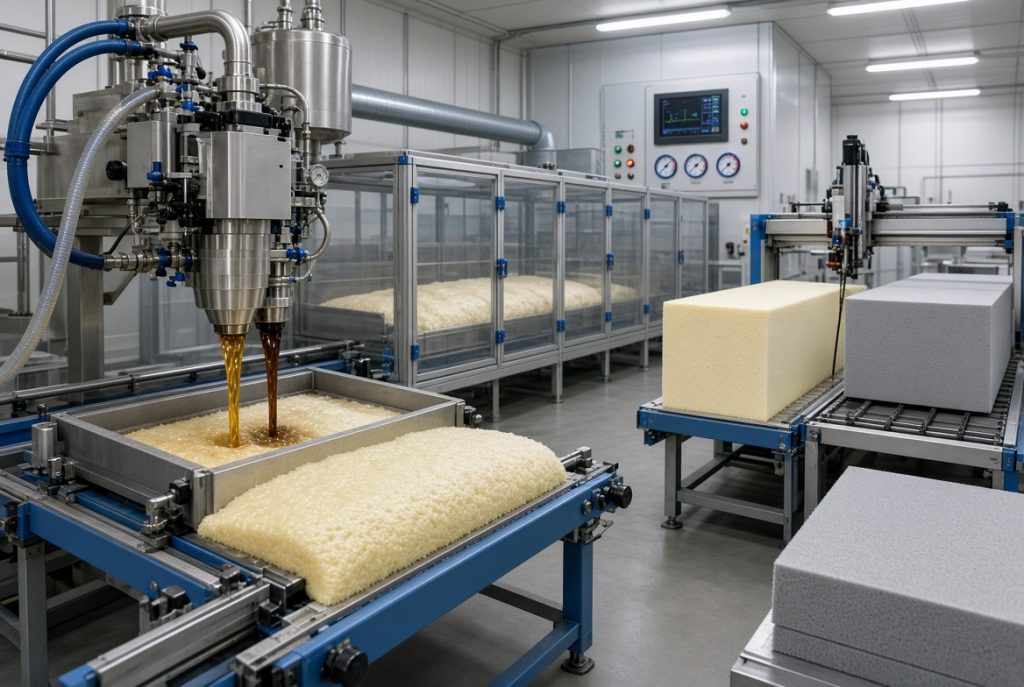
During processing, catalysts control the reaction speed, surfactants help stabilize the foam structure, and blowing agents generate the cellular structure in foam products.
The formulation determines important properties such as:
- Density
- Hardness
- Resilience
- Cell structure
- Rebound and recovery
- Compression set
- Thermal insulation
- Surface characteristics
- Curing and demolding behavior
This is why formulation technology is at the heart of polyurethane manufacturing.
4. How Does Polyurethane Foam Work?
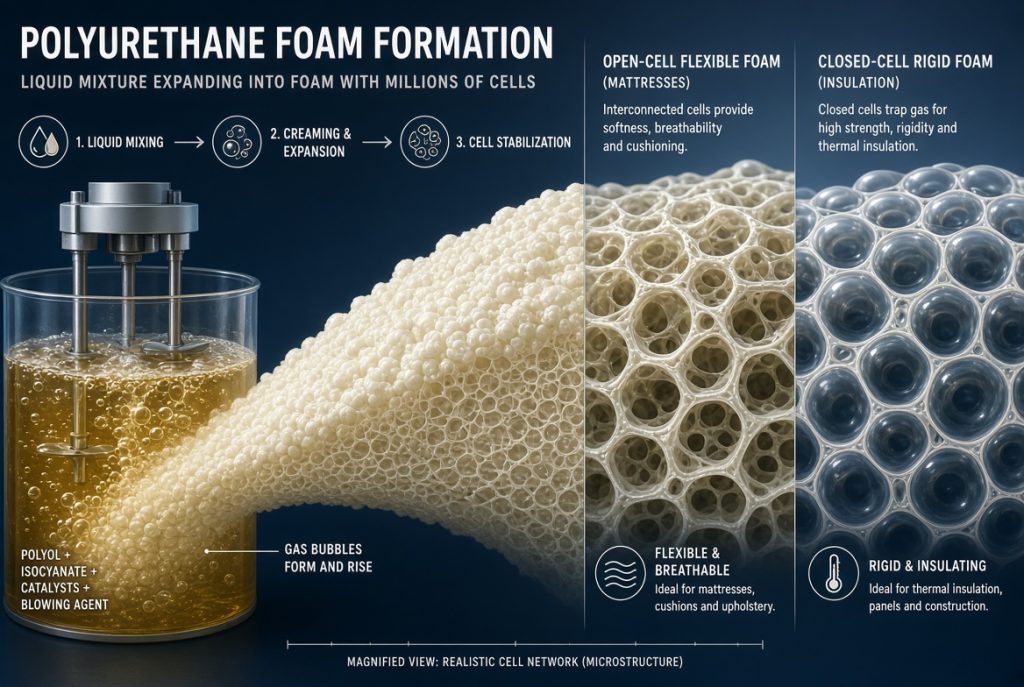
For polyurethane foam, two important reactions occur during the foaming process.
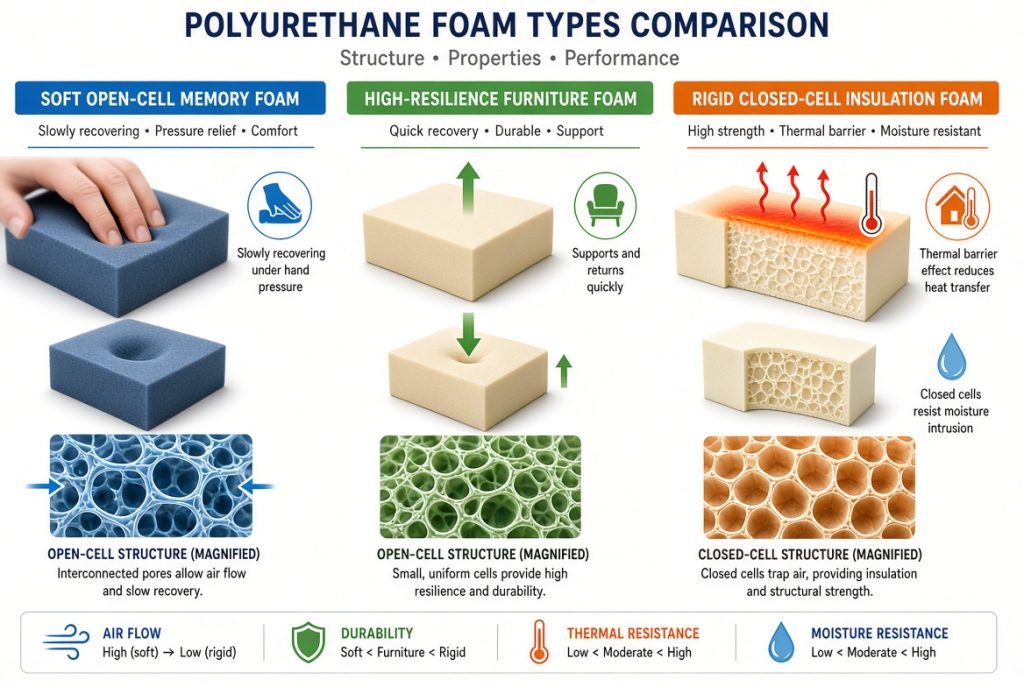
One reaction helps build the polymer network, while another generates gas that expands the material and creates millions of small cells.
The result is a cellular structure that can be precisely controlled through formulation and processing.
For example:
More open cell structure → softer, more breathable foam
More closed cell structure → better thermal insulation
Different polymer structures → different hardness, resilience, and durability
This is also why changing only one component of a formulation can significantly change the final foam performance.
5. Common Problems When Making Polyurethane
Polyurethane processing can look simple, but achieving stable production quality requires careful control.
Foam Density Is Unstable
Possible causes include incorrect raw-material ratios, temperature variations, poor mixing, or unstable blowing conditions.
Solution: Control raw-material temperature, mixing ratio, reaction profile, and processing parameters.
Foam Collapses or Shrinks
This can be related to an imbalance between the blowing and polymerization reactions, insufficient cell stabilization, or unsuitable catalyst levels.
Solution: Optimize catalysts, surfactants, blowing conditions, and the overall reaction balance.
Foam Has Large or Uneven Cells
Poor mixing, unsuitable surfactants, or incorrect processing conditions can affect cell structure.
Solution: Adjust the formulation and improve mixing and processing consistency.
The Product Does Not Meet the Required Hardness or Resilience
The issue may not come from one raw material alone. Polyol selection, isocyanate index, catalysts, additives, density, and processing conditions can all influence the final properties.
Solution: Optimize the complete formulation instead of changing only one ingredient.
6. Why Is Polyurethane Formulation So Important?
The same basic polyurethane chemistry can produce completely different products.
A memory pillow requires a different formulation from a refrigerator insulation panel. A motorcycle seat requires a different balance of resilience and durability than a packaging foam.
That is where polyurethane system formulation becomes critical.
A good formulation should consider:
Raw materials → Chemical reaction → Foaming behavior → Cell structure → Physical properties → Production process → Final application
The goal is not simply to make foam—it is to make the right foam for the right application.
7. How Can GST Help?
At GST, we focus on polyurethane combination materials, formulation development, and application solutions.
Instead of simply supplying individual raw materials, GST can provide combination materials and customized formulation solutions designed around specific product requirements.
Our solutions cover applications such as:
- Memory foam and slow-rebound products
- High-resilience flexible foam
- Rigid PU foam and insulation
- Self-skinning foam
- Automotive and motorcycle seating
- Furniture and cushioning
- Packaging
- Specialty polyurethane applications
More importantly, our technical team can work with customers on formula adjustment, sample development, process optimization, and production troubleshooting.
Whether you are developing a new polyurethane product or trying to solve an existing production problem, the right combination of material + formulation + process technology can make a major difference.
8. From Chemistry to Application
So, how is polyurethane made?
The short answer is: polyurethane is made through carefully controlled chemical reactions between polyols and isocyanates.
The more important answer is that high-quality polyurethane products are created through the combination of chemistry, formulation, equipment, processing, and application experience.
That is what turns basic raw materials into a memory pillow, comfortable seat, insulation panel, packaging material, or high-performance industrial product.
GST is committed to helping customers move from “Can we make it?” to “How can we make it better?”
If you are looking for polyurethane combination materials, customized formulations, sample development, or technical solutions, feel free to contact GST.
PREVIOUS:Why Is Polyurethane So Widely Used?
CATEGORIES
LATEST NEWS
- Aromatic vs Aliphatic Isocy...
- What Is Modified MDI?
- MDI vs TDI: What’s th...
- TDI 80/20 vs TDI 65/35
- What Is TDI?
- What Is Polymeric MDI (pMDI)?
- What Is MDI?
- What Is Isocyanate?
- How to Select the Right Pol...
- How Does Polyol Affect Foam...
CONTACT US
Tel:+86 18688691634
Email:sam@1688pu.com
Add:No. 91 Central East Rd, Luxi Village, Gaobu Town, Dongguan 523283, China.