Polyurethane Foam vs Rubber vs Plastic
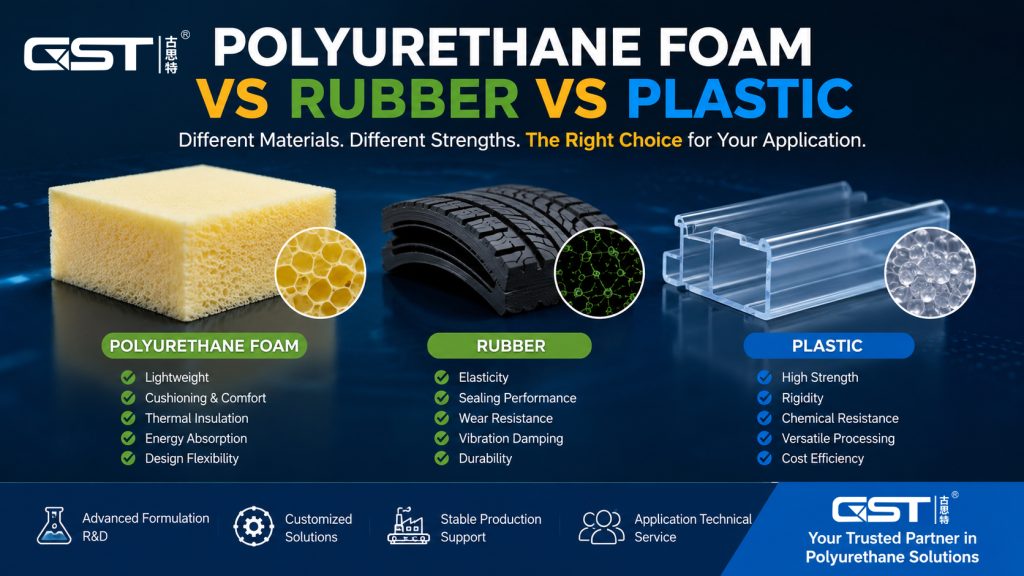
When choosing a material for insulation, cushioning, sealing, packaging, automotive parts, or industrial products, three materials often come into the conversation: polyurethane foam, rubber, and plastic.
They may look similar in some applications, but their structures, performance, and processing methods are quite different. So, which one is the right choice? And why is polyurethane foam becoming increasingly important?
1. What Are Polyurethane Foam, Rubber, and Plastic?
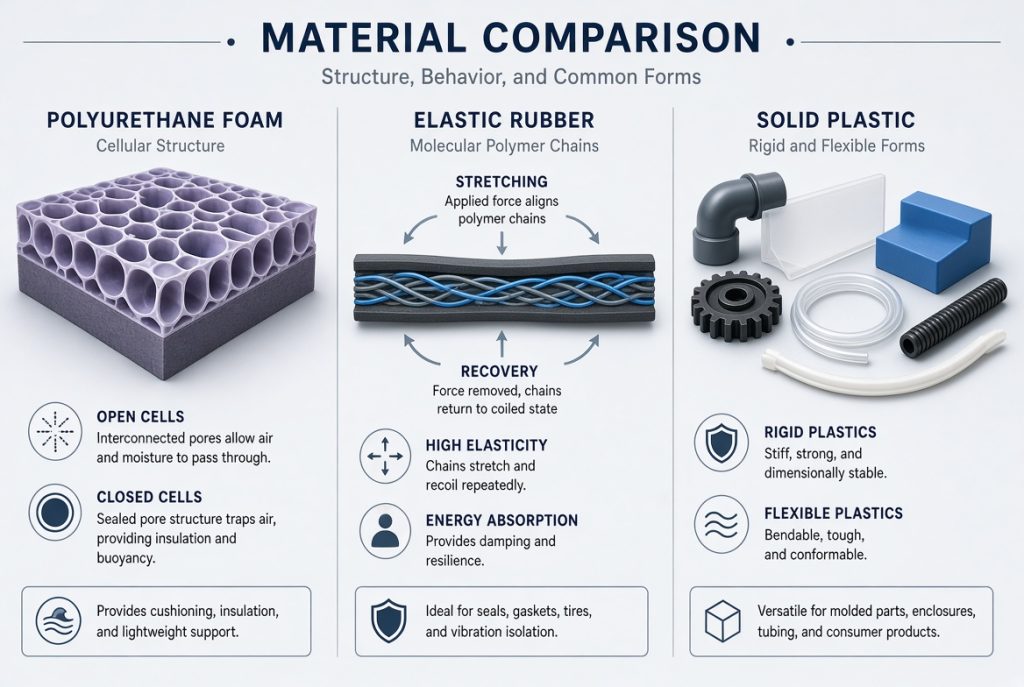
Polyurethane foam (PU foam) is a cellular polymer material created through a chemical reaction between polyols and isocyanates, together with catalysts, blowing agents, surfactants, and other additives. By controlling the formulation and foaming process, PU foam can be designed as flexible, rigid, high-resilience, memory, or other specialized foam systems.
Rubber is an elastic polymer material known for flexibility, resilience, abrasion resistance, and sealing performance. It is widely used in tires, gaskets, seals, vibration-control components, and various industrial products.
Plastic is a broad family of polymer materials that can be rigid, semi-rigid, or flexible. Different plastics provide different combinations of strength, chemical resistance, temperature resistance, weight, and processability.
In simple terms:
- PU foam: lightweight + cushioning/insulation + customizable structure
- Rubber: elasticity + sealing + wear resistance
- Plastic: strength + rigidity + versatile processing
The best material depends on the application’s actual performance requirements.
2. Why Do We Need Different Materials?
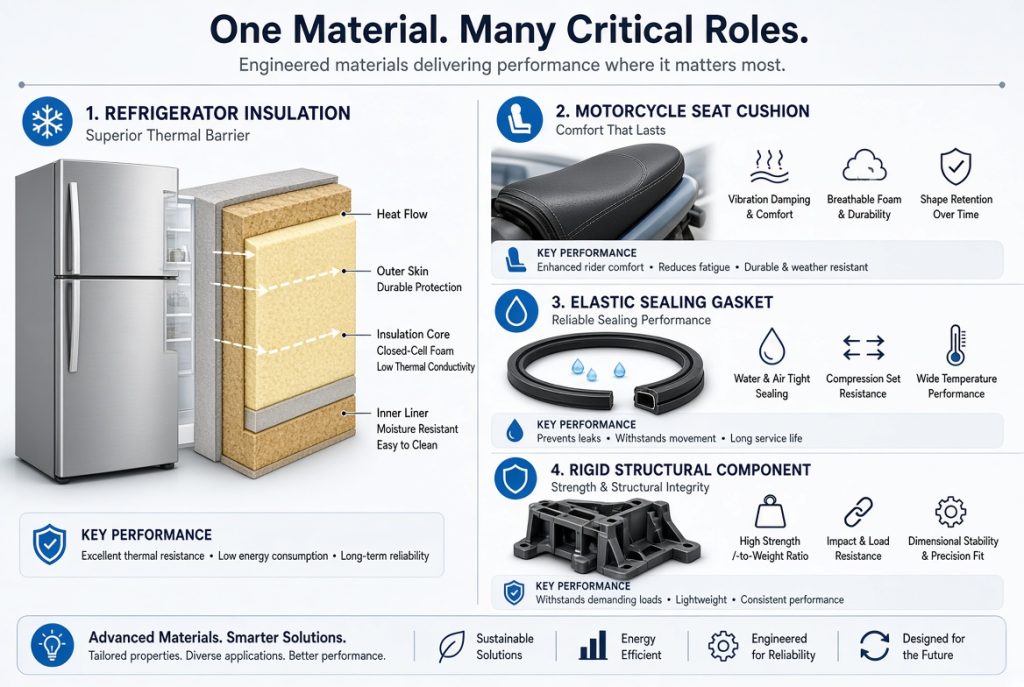
No single material can deliver every property.
For example, a refrigerator needs thermal insulation and low weight, while a motorcycle seat needs comfort, resilience, and durability. A sealing gasket may require elastic recovery and chemical resistance, while a structural component may prioritize rigidity and impact strength.
This is why material selection matters.
PU foam is particularly attractive when manufacturers need to combine low density with cushioning, thermal insulation, sound absorption, or energy absorption. Its cellular structure allows engineers to adjust density, hardness, resilience, and other properties through formulation and processing.
3. How Do They Work?
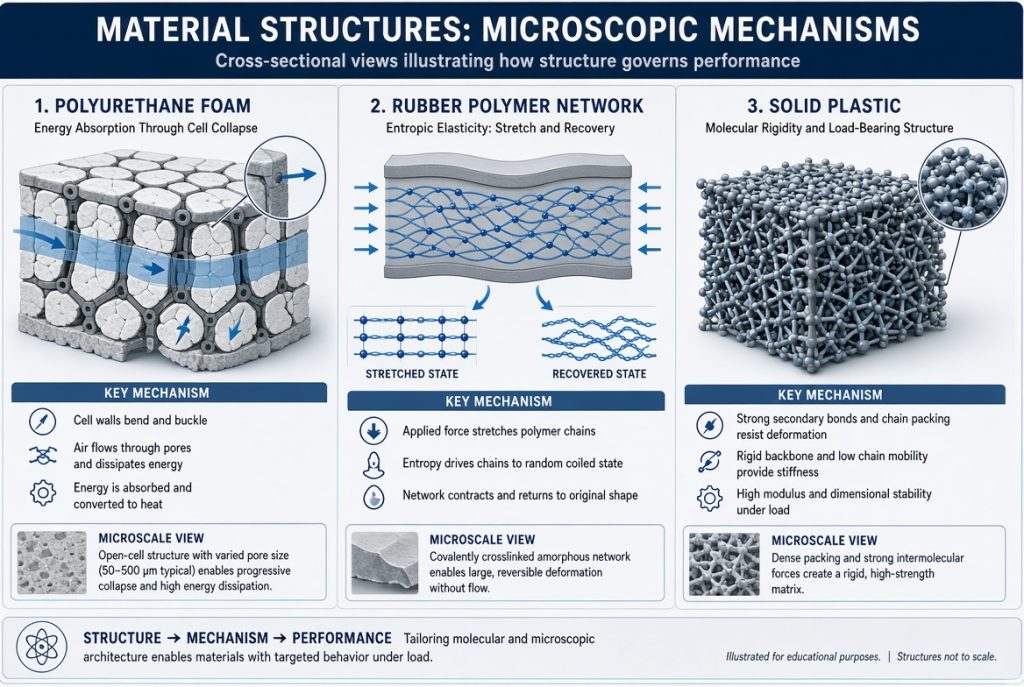
The biggest difference is their internal structure.
Polyurethane Foam
PU foam contains millions of microscopic or visible cells. These cells can absorb energy, reduce heat transfer, provide cushioning, or lower product weight.
For example:
Flexible PU foam → absorbs impact and provides comfort
Memory foam → responds slowly to pressure and recovers gradually
High-resilience foam → provides fast recovery and support
Rigid PU foam → reduces heat transfer and provides structural support
Rubber
Rubber relies primarily on its elastic polymer network. When compressed or stretched, the material deforms and then attempts to return to its original shape.
This makes rubber suitable for seals, tires, vibration isolation, and flexible components.
Plastic
Plastics generally rely more on their polymer structure and solid form to provide rigidity, strength, toughness, or flexibility. Manufacturing methods such as injection molding, extrusion, and blow molding allow plastics to be formed into complex shapes.
4. PU Foam vs Rubber vs Plastic: Which Is Better?
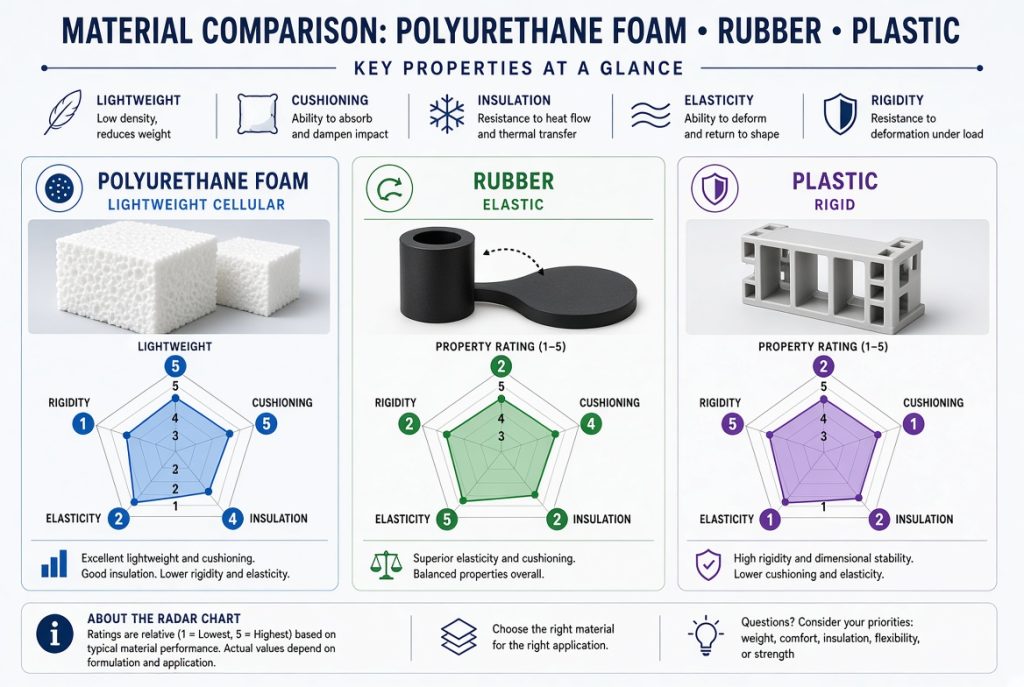
There is no universal winner.
| Property | PU Foam | Rubber | Plastic |
| Lightweight | ⭐⭐⭐⭐⭐ | ⭐⭐⭐ | ⭐⭐⭐⭐ |
| Cushioning | ⭐⭐⭐⭐⭐ | ⭐⭐⭐⭐ | ⭐⭐ |
| Thermal insulation | ⭐⭐⭐⭐⭐ | ⭐⭐ | ⭐⭐–⭐⭐⭐ |
| Elasticity | ⭐⭐⭐⭐ | ⭐⭐⭐⭐⭐ | ⭐⭐–⭐⭐⭐ |
| Structural rigidity | ⭐⭐⭐ | ⭐⭐–⭐⭐⭐ | ⭐⭐⭐⭐⭐ |
| Energy absorption | ⭐⭐⭐⭐⭐ | ⭐⭐⭐⭐ | ⭐⭐⭐ |
| Design flexibility | ⭐⭐⭐⭐⭐ | ⭐⭐⭐⭐ | ⭐⭐⭐⭐⭐ |
The key advantage of polyurethane foam is formulation flexibility. Instead of simply selecting a material, manufacturers can often adjust the PU system to achieve a target balance of density, hardness, resilience, flow, cell structure, and processing behavior.
5. Common PU Foam Problems
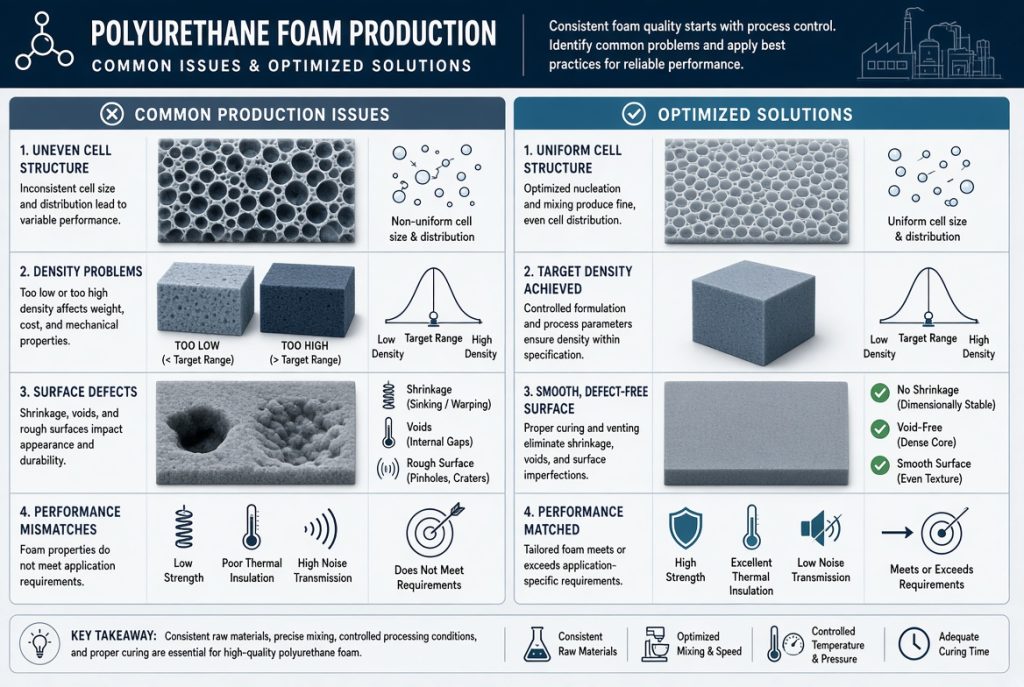
Even when polyurethane foam is the right material, production problems can occur.
Problem 1: Uneven Cell Structure
Possible causes include poor mixing, unstable blowing behavior, incorrect catalyst balance, or unsuitable surfactants.
Solution: Optimize the formulation, mixing ratio, catalyst package, surfactant system, and processing conditions.
Problem 2: Density Is Too High or Too Low
Foam density is affected by blowing efficiency, formulation design, mold conditions, temperature, and processing parameters.
Solution: Adjust the blowing system and formulation while keeping the target physical properties in balance.
Problem 3: Poor Surface Quality
Shrinkage, voids, open cells, or surface defects may result from incorrect cream time, rise profile, mold temperature, or chemical balance.
Solution: Fine-tune the reaction profile and match the formulation to the production equipment and mold.
Problem 4: Performance Does Not Meet the Target
A foam may be too soft, too hard, too slow to recover, or insufficiently resilient.
Solution: Instead of simply changing one raw material, optimize the entire formulation system according to the final application.
6. How Can GST Help?
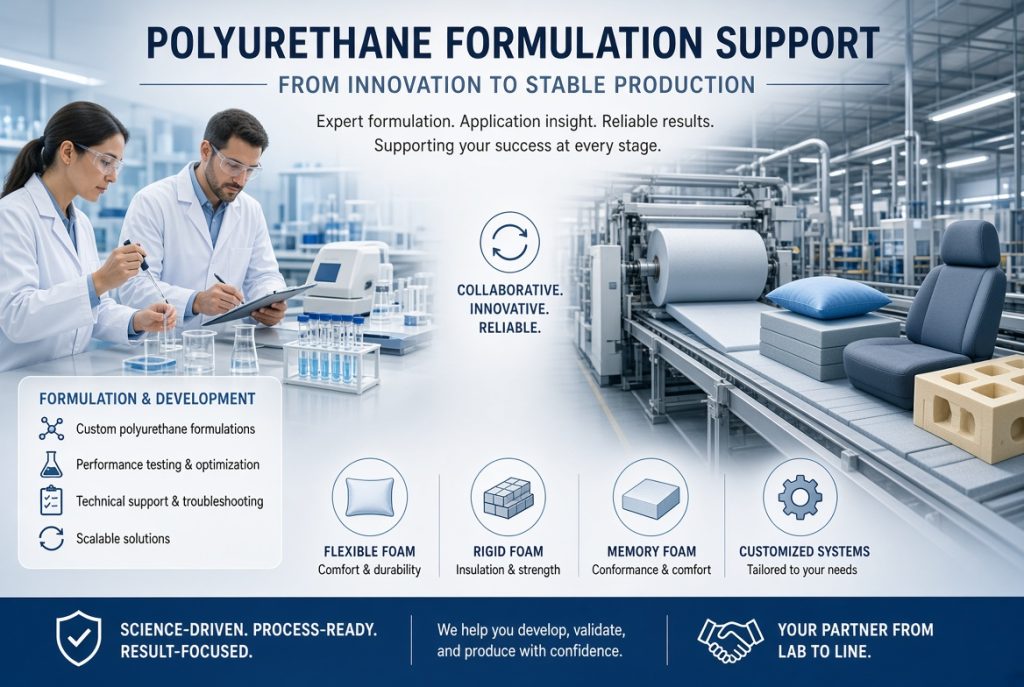
For manufacturers, choosing polyurethane foam is only the beginning. The real challenge is developing a stable formula that works consistently on the production line.
GST provides polyurethane combination materials, formulation development, and technical application solutions for different industries and production requirements.
Depending on the application, GST can provide:
- Flexible PU foam systems
- High-resilience PU foam systems
- Memory foam systems
- Rigid PU foam systems
- Gel polyurethane systems
- Self-skinning PU systems
- Customized formulations and combination materials
- Foaming process optimization and technical support
From memory pillows, cushions, motorcycle seats, packaging, and sports products to refrigerator insulation, cold storage, construction insulation, and industrial applications, the formulation can be adjusted according to the customer’s target density, hardness, resilience, reaction profile, and production process.
Material Selection Is Only the First Step
PU foam, rubber, and plastic each have their strengths. The better question is not simply “Which material is better?”
It is:
“Which material delivers the right performance, processing efficiency, and cost for my application?”
When PU foam is the right solution, the combination material and formulation become critical.
GST combines polyurethane formulation R&D, combination materials, and application technology to help manufacturers move from laboratory formulation to stable mass production.
PREVIOUS:Flexible vs Rigid Polyurethane Foam
CATEGORIES
LATEST NEWS
- Aromatic vs Aliphatic Isocy...
- What Is Modified MDI?
- MDI vs TDI: What’s th...
- TDI 80/20 vs TDI 65/35
- What Is TDI?
- What Is Polymeric MDI (pMDI)?
- What Is MDI?
- What Is Isocyanate?
- How to Select the Right Pol...
- How Does Polyol Affect Foam...
CONTACT US
Tel:+86 18688691634
Email:sam@1688pu.com
Add:No. 91 Central East Rd, Luxi Village, Gaobu Town, Dongguan 523283, China.