What Determines Polyurethane Properties?
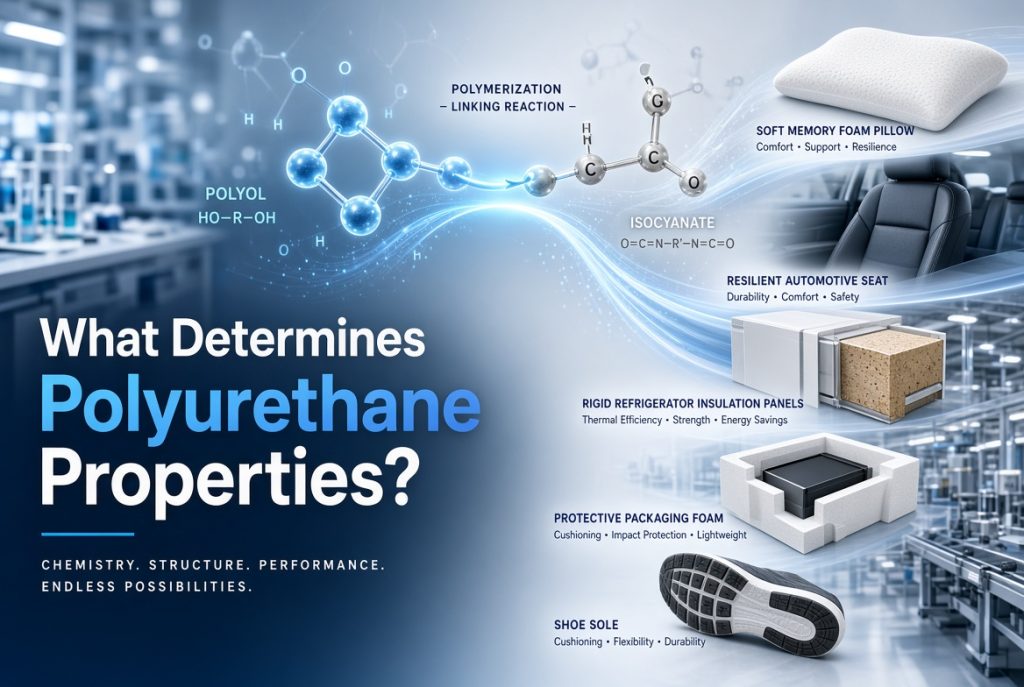
Polyurethane (PU) is often described as a “versatile material,” but its versatility does not come from polyurethane itself. The real secret lies in how its chemistry and processing are designed.
Why can one polyurethane be soft and elastic, while another is rigid, strong, and highly insulating? Why can the same basic PU chemistry be used for memory foam, automotive seats, refrigerator insulation, packaging, shoe soles, and industrial components?
The answer is simple: polyurethane properties are determined by the formulation, raw materials, chemical reactions, and processing conditions working together.
1. What Determines Polyurethane Properties?
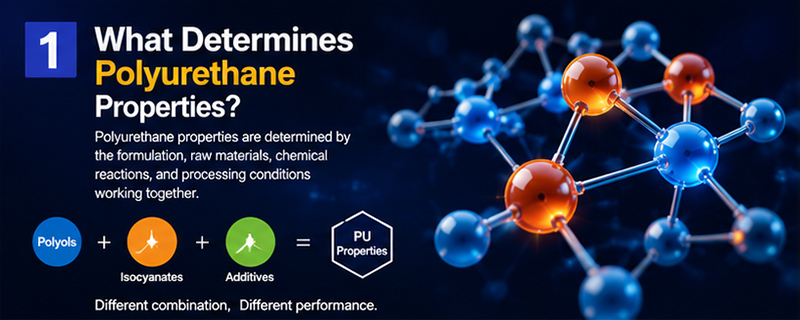
Polyurethane is mainly formed through the reaction of polyols and isocyanates, together with catalysts, blowing agents, surfactants, chain extenders, crosslinkers, and other additives.
By adjusting these components, manufacturers can control important properties such as:
- Hardness and softness
- Density
- Resilience and rebound
- Tensile and tear strength
- Compression set
- Flexibility
- Cell structure
- Thermal insulation
- Flame resistance
- Surface appearance
- Curing and demolding behavior
This is why PU is not simply one material with one fixed performance. It is a material platform that can be engineered for specific applications.
2. Why Do Polyurethane Properties Matter?
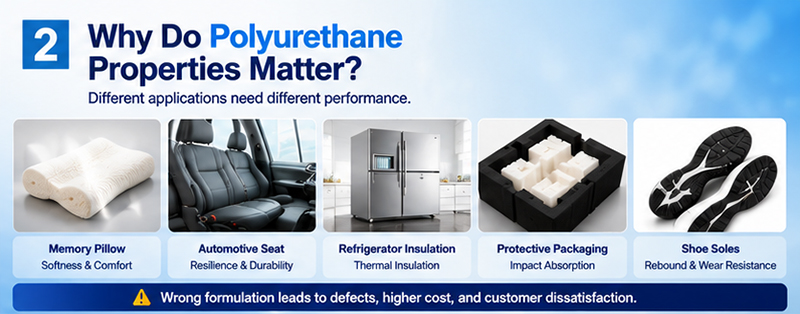
Different products require completely different performance.
A memory pillow needs slow recovery and comfortable softness. An automotive seat needs resilience, durability, and good compression performance. A refrigerator insulation system needs low thermal conductivity and a stable closed-cell structure. A protective package may require lightweight cushioning and impact absorption.
Using the wrong formulation can result in:
- Foam that is too hard or too soft
- Poor rebound or slow recovery
- Uneven cell structure
- Excessive shrinkage
- Surface defects
- Poor adhesion
- High density or insufficient expansion
- Cracking or deformation
Therefore, controlling PU properties is not just about product quality—it directly affects production efficiency, cost, durability, and customer satisfaction.
3. How Are Polyurethane Properties Controlled?
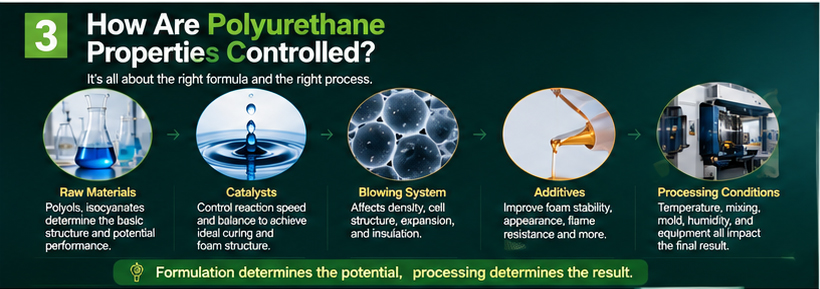
Think of PU formulation like tuning a recipe. Changing one ingredient can influence several properties at the same time.
Raw Materials
Different polyols and isocyanates provide different molecular structures and reactivity. Their functionality, molecular weight, and chemical structure strongly influence hardness, flexibility, strength, and resilience.
Catalysts
Catalysts control the speed and balance of the chemical reactions. They affect cream time, rise time, gel time, curing, and final foam structure.
Too much or too little catalyst can create problems such as poor flow, uneven cells, incomplete curing, or surface defects.
Blowing System
For foam products, the blowing system determines how the material expands and forms its cellular structure. It has a major influence on density, cell size, thermal insulation, and dimensional stability.
Surfactants and Additives
Surfactants help stabilize the foam structure, while additives can modify properties such as flame resistance, color, processing behavior, and surface quality.
Processing Conditions
Even a well-designed formulation can fail if production conditions are not controlled.
Material temperature, mold temperature, mixing ratio, injection speed, mold filling, ambient humidity, and equipment conditions can all influence the final PU properties.
In other words: formulation determines the potential, while processing determines whether that potential becomes reality.
4. Common Problems and How to Solve Them
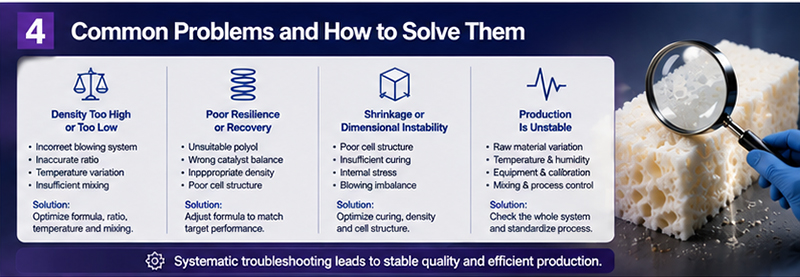
Problem 1: Foam Density Is Too High or Too Low
Possible causes include an incorrect blowing system, inaccurate material ratio, temperature variation, or insufficient mixing.
Solution: Check the formulation, A/B ratio, material temperature, mixing efficiency, and processing parameters together rather than changing only one component.
Problem 2: Poor Resilience or Recovery
This can result from an unsuitable polyol structure, incorrect catalyst balance, inappropriate density, or poor cell structure.
Solution: Optimize the formulation based on the target rebound, hardness, density, and recovery requirements.
Problem 3: Shrinkage or Dimensional Instability
Shrinkage may be related to cell structure, insufficient curing, excessive internal stress, or an unsuitable blowing balance.
Solution: Review the formulation and curing conditions, then optimize foam density and cell structure through controlled testing.
Problem 4: Production Is Unstable
If the same formulation produces different results from batch to batch, the problem may not be the formula alone.
Raw-material consistency, temperature, humidity, equipment calibration, mixing ratio, and production procedures should all be checked.
The key is systematic troubleshooting—not simply adding more additives.
5. How Can GST Help?
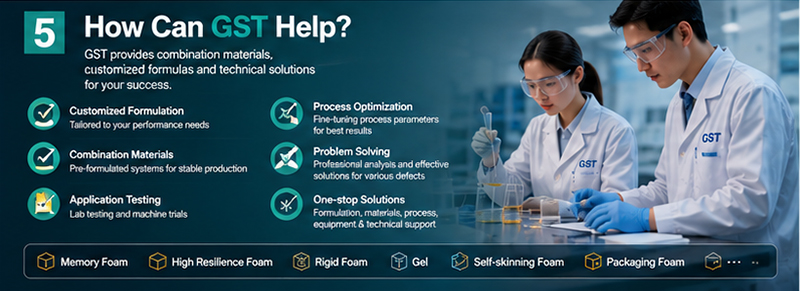
At GST, we understand that customers are not simply buying polyurethane raw materials. They are looking for a stable solution that can be successfully applied to their products and production lines.
GST provides polyurethane combination materials, customized formulations, and technical application solutions for different requirements.
Our technical support can focus on:
- Customized formulation: Adjusting hardness, density, resilience, recovery, insulation, strength, and other properties according to the application.
- Combination materials: Pre-formulated polyol systems designed to simplify production and improve consistency.
- Application testing: Laboratory sampling and machine trials to verify formulation performance before mass production.
- Process optimization: Supporting customers with mixing ratio, material temperature, mold temperature, injection, curing, and other processing parameters.
- Problem solving: Analyzing defects such as shrinkage, poor rebound, uneven cells, surface defects, insufficient curing, and dimensional instability.
- One-stop technical solutions: Combining formulation development, raw materials, equipment compatibility, process guidance, and application testing.
From memory foam and high-resilience foam to rigid insulation, packaging, gel, self-skinning, and other PU applications, the goal is the same: turn the required product performance into a workable polyurethane solution.
6. The Bottom Line
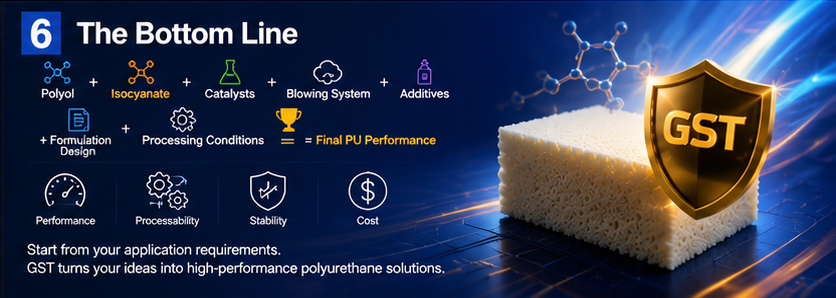
So, what determines polyurethane properties?
It is not a single ingredient.
Polyol + Isocyanate + Catalysts + Blowing System + Additives + Formulation Design + Processing Conditions = Final PU Performance
The most effective polyurethane solution is one that balances performance, processability, stability, and cost.
Whether you need softer foam, faster curing, better rebound, lower density, improved insulation, or more stable production, the right approach is to start with the application requirement and work backward to the formulation.
GST combines polyurethane formulation development, combination materials, laboratory testing, and technical application support to help customers transform specific performance requirements into practical PU solutions.
CATEGORIES
LATEST NEWS
- Aromatic vs Aliphatic Isocy...
- What Is Modified MDI?
- MDI vs TDI: What’s th...
- TDI 80/20 vs TDI 65/35
- What Is TDI?
- What Is Polymeric MDI (pMDI)?
- What Is MDI?
- What Is Isocyanate?
- How to Select the Right Pol...
- How Does Polyol Affect Foam...
CONTACT US
Tel:+86 18688691634
Email:sam@1688pu.com
Add:No. 91 Central East Rd, Luxi Village, Gaobu Town, Dongguan 523283, China.