Polyurethane From Raw Materials to Finished Products
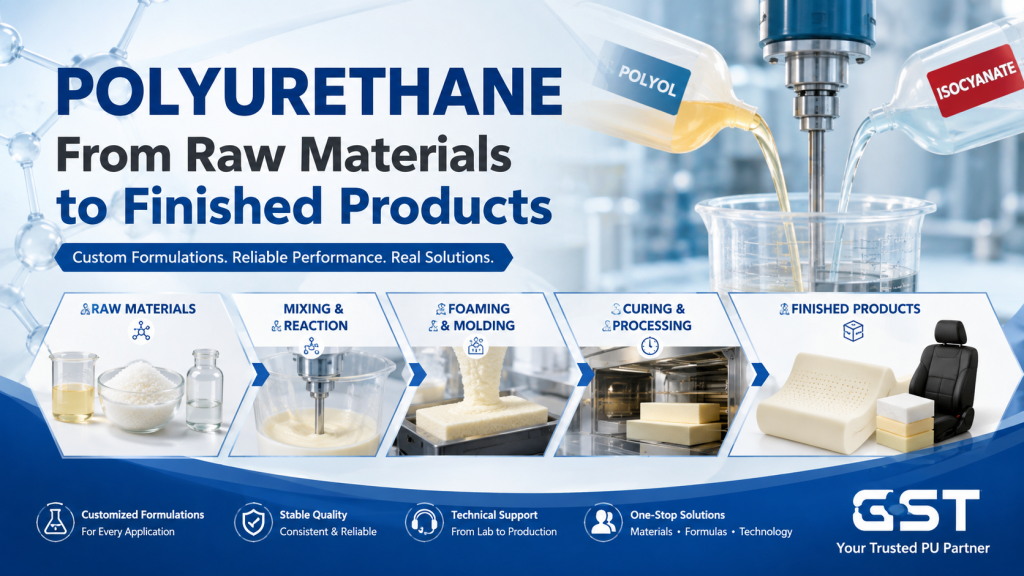
Polyurethane (PU) is not simply a single material—it is a highly customizable polymer system. From raw materials and chemical reactions to foaming, molding, and final processing, every step can influence the performance of the finished product.
So, how does polyurethane go from basic raw materials to a finished product? And when production problems occur, how can they be solved?
1. What Is Polyurethane?
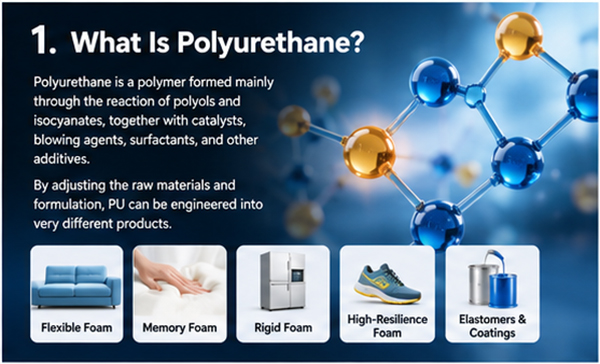
Polyurethane is a polymer formed mainly through the reaction of polyols and isocyanates, together with catalysts, blowing agents, surfactants, and other additives.
By adjusting the raw materials and formulation, polyurethane can be engineered into very different products, including:
- Flexible foam for mattresses, sofas, and automotive seats
- Memory foam for pillows and cushions
- Rigid foam for insulation and refrigeration
- High-resilience foam for sports and automotive applications
- Elastomers, gels, coatings, adhesives, and sealants
This flexibility is one of the biggest reasons PU is widely used across modern manufacturing.
2. Why Do We Need Polyurethane?
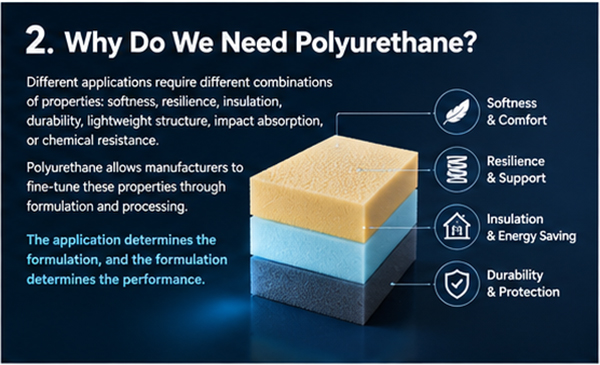
Different applications require different combinations of properties: softness, resilience, insulation, durability, lightweight structure, impact absorption, or chemical resistance.
Polyurethane allows manufacturers to fine-tune these properties through formulation and processing.
For example, a refrigerator needs rigid PU foam with excellent thermal insulation, while a memory pillow needs a completely different formulation to achieve controlled softness and slow recovery.
In other words, the application determines the formulation, and the formulation determines the performance.
3. From Raw Materials to Finished Products: How Does It Work?
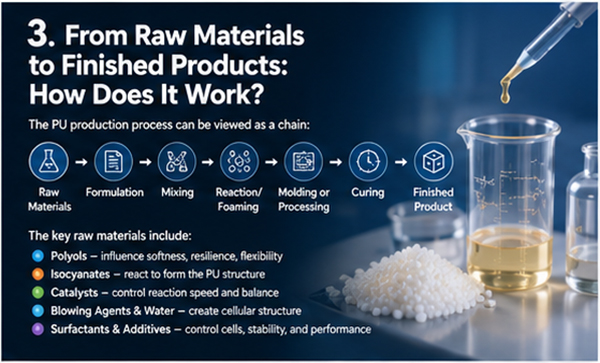
The PU production process can be viewed as a chain:
Raw Materials → Formulation → Mixing → Reaction/Foaming → Molding or Processing → Curing → Finished Product
The key raw materials generally include:
- Polyols – provide the main polymer backbone and influence softness, resilience, and flexibility.
- Isocyanates – react with polyols to form the polyurethane structure.
- Catalysts – control reaction speed and balance different reactions.
- Blowing agents / water – help create cellular structures in foam products.
- Surfactants and additives – control cell structure, stability, flame performance, color, and other properties.
During production, these components must be precisely balanced. Small changes in catalyst level, material temperature, mixing, or density can significantly affect the final product.
4. Common Problems in PU Production
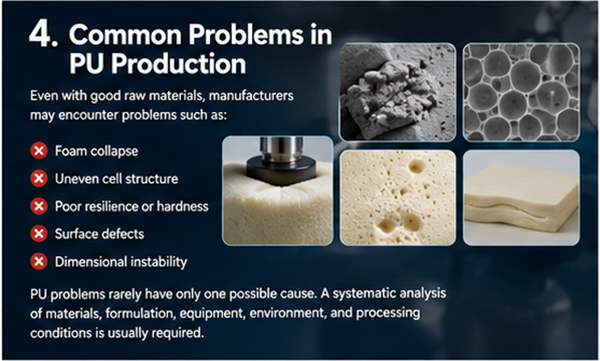
Even with good raw materials, manufacturers may encounter problems such as:
Foam collapse: The foam structure is unstable or the reaction balance is incorrect.
Uneven cell structure: Mixing, surfactant selection, blowing conditions, or formulation may be unsuitable.
Poor resilience or hardness: The polyol system, isocyanate index, catalyst balance, or density may need adjustment.
Surface defects: Mold temperature, release conditions, moisture, processing parameters, or formulation can contribute.
Dimensional instability: Incorrect formulation, insufficient curing, excessive internal stress, or unsuitable raw materials may be involved.
The important point is that PU problems rarely have only one possible cause. A systematic analysis of materials, formulation, equipment, environment, and processing conditions is usually required.
5. How Can These Problems Be Solved?
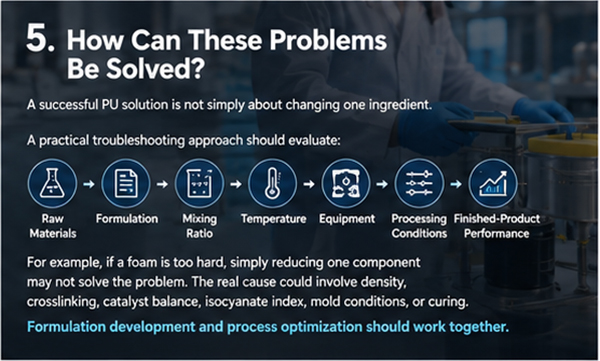
A successful PU solution is not simply about changing one ingredient.
A practical troubleshooting approach should evaluate:
Raw materials → Formulation → Mixing ratio → Temperature → Equipment → Processing conditions → Finished-product performance
For example, if a foam is too hard, simply reducing one component may not solve the problem. The real cause could involve density, crosslinking, catalyst balance, isocyanate index, mold conditions, or curing.
This is why formulation development and process optimization should work together.
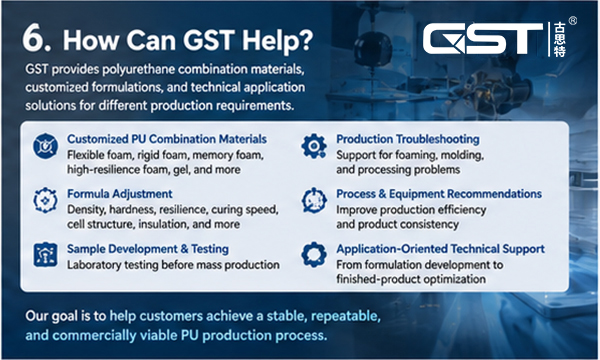
6. How Can GST Help?
For manufacturers, choosing the right polyurethane system can significantly shorten development time and reduce production risks.
GST (Dongguan Jiaxin New Materials Co., Ltd.) provides polyurethane combination materials, customized formulations, and technical application solutions for different production requirements.
Depending on the application, GST can support:
- Customized PU combination materials for flexible foam, rigid foam, memory foam, high-resilience foam, gel, and other applications
- Formula adjustment according to density, hardness, resilience, curing speed, cell structure, insulation, and other performance requirements
- Sample development and laboratory testing before mass production
- Production troubleshooting when problems occur during foaming, molding, or processing
- Process and equipment recommendations to improve production consistency
- Application-oriented technical support from formulation development to finished-product optimization
The goal is not simply to supply chemicals, but to help customers achieve a stable, repeatable, and commercially viable polyurethane production process.
7. From Chemistry to Performance

A successful polyurethane product is the result of many factors working together.
Good raw materials provide the foundation.
A well-designed formulation creates the right reaction.
Proper processing builds the structure.
Technical optimization turns that structure into reliable performance.
That is the journey of polyurethane from raw materials to finished products—and it is also where professional formulation and application technology make the difference.
Looking for a polyurethane combination material or a customized PU formulation? GST can provide material, formulation, and technical solutions tailored to your application.
CATEGORIES
LATEST NEWS
- Aromatic vs Aliphatic Isocy...
- What Is Modified MDI?
- MDI vs TDI: What’s th...
- TDI 80/20 vs TDI 65/35
- What Is TDI?
- What Is Polymeric MDI (pMDI)?
- What Is MDI?
- What Is Isocyanate?
- How to Select the Right Pol...
- How Does Polyol Affect Foam...
CONTACT US
Tel:+86 18688691634
Email:sam@1688pu.com
Add:No. 91 Central East Rd, Luxi Village, Gaobu Town, Dongguan 523283, China.