What Is a Urethane Bond?
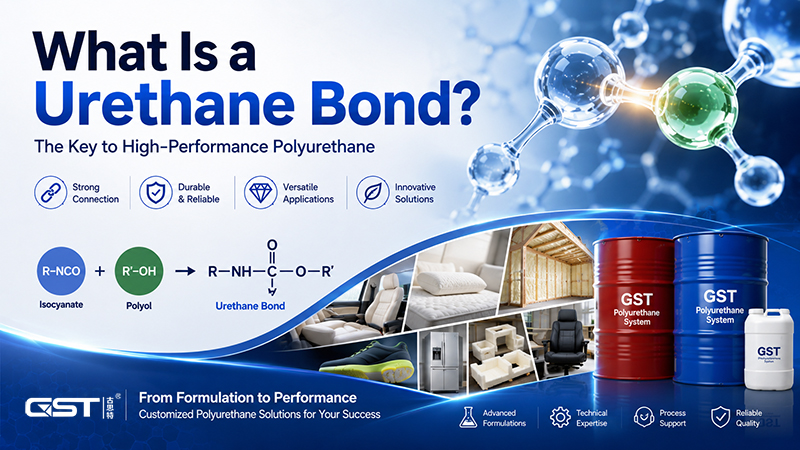
Polyurethane is found in products ranging from mattresses and automotive seats to insulation, footwear, packaging, and industrial components. But what actually gives polyurethane its unique combination of flexibility, strength, durability, and chemical resistance?
A key answer is the urethane bond.
Understanding how this bond forms helps manufacturers better control polyurethane performance—and choose the right polyurethane system, formulation, and processing conditions for each application.
1. What Is a Urethane Bond?
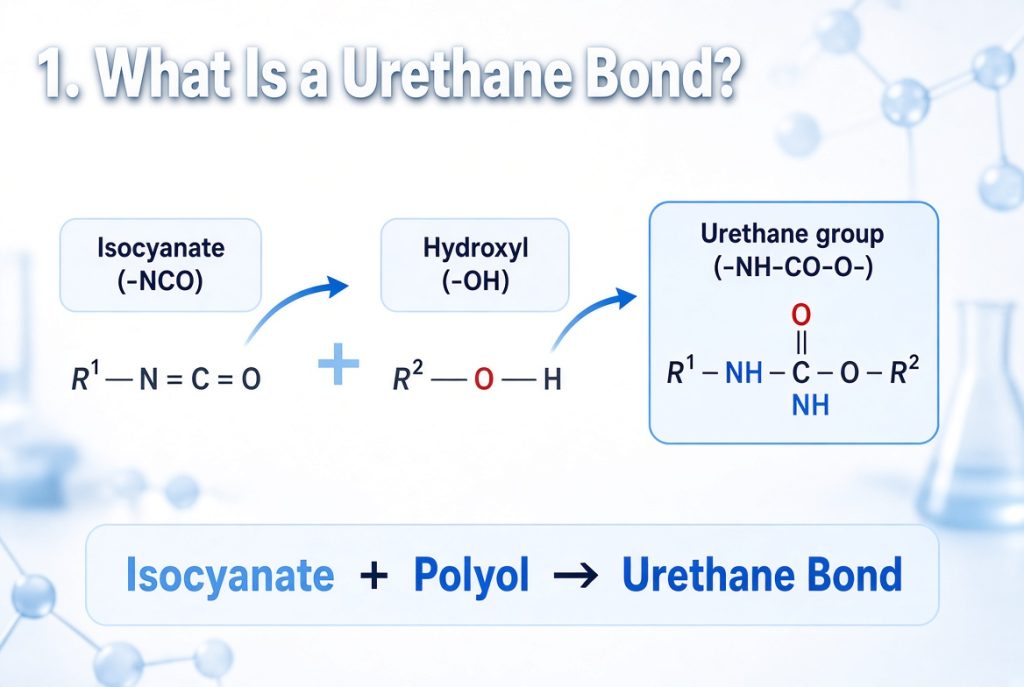
A urethane bond is a chemical linkage formed when an isocyanate group (-NCO) reacts with a hydroxyl group (-OH), typically from a polyol.
In simplified form:
Isocyanate + Polyol → Urethane Bond
This reaction creates the characteristic urethane group (-NH-CO-O-) within the polyurethane polymer chain.
The important point is that polyurethane is not simply “one material.” By changing the polyols, isocyanates, catalysts, additives, and formulation ratios, manufacturers can create materials ranging from soft and elastic foam to rigid, strong insulation materials.
2. Why Do We Need Urethane Bonds?
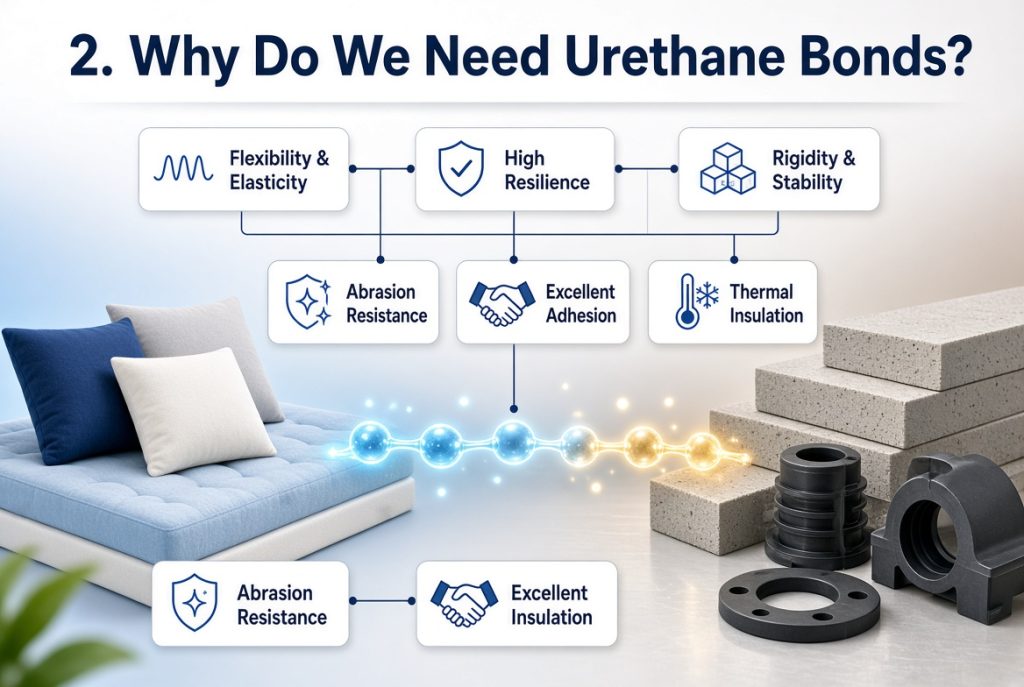
The urethane bond is one of the building blocks that allows polyurethane to achieve such a wide range of properties.
Depending on the overall molecular structure and formulation, polyurethane can provide:
- Flexibility and elasticity for mattresses, cushions, and automotive seating
- High resilience for sports products and impact-absorbing components
- Rigidity and dimensional stability for insulation and structural applications
- Abrasion and wear resistance for industrial products
- Excellent adhesion to selected substrates
- Lightweight thermal insulation in refrigeration and construction
In other words, the urethane bond itself is important—but the final performance depends on the entire polyurethane formulation and processing system.
3. How Does a Urethane Bond Work?
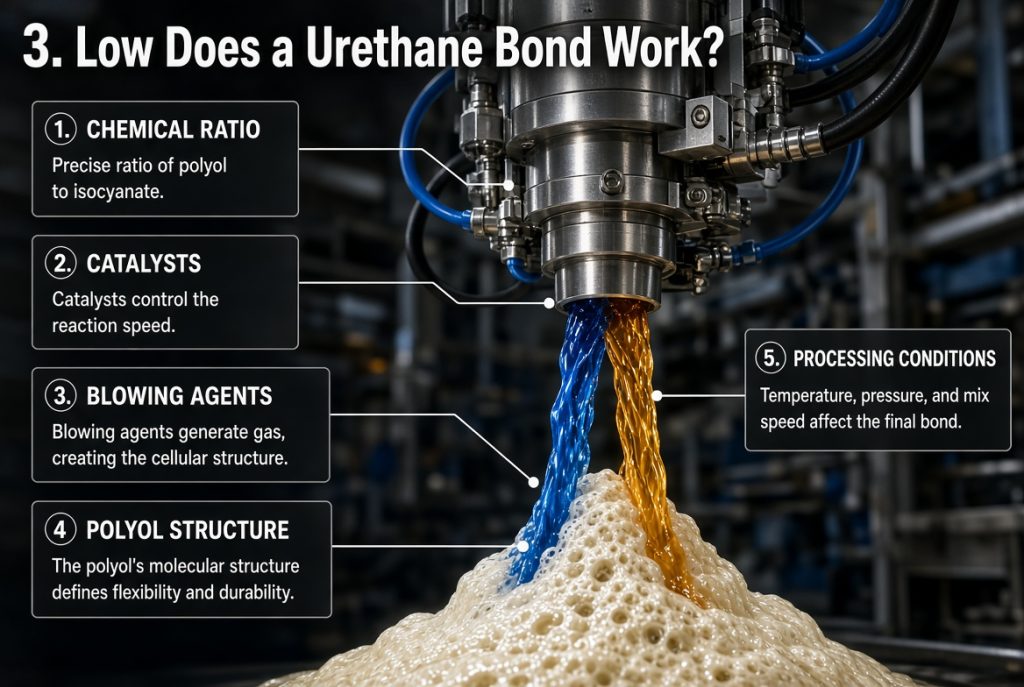
During polyurethane production, the isocyanate and polyol components are mixed under controlled conditions.
The reaction proceeds through several important factors:
1. Chemical ratio
The balance between isocyanate and hydroxyl groups affects reaction completeness, crosslinking, density, hardness, and other properties.
2. Catalysts
Catalysts regulate the reaction speed and influence the balance between polymerization and blowing reactions, particularly in polyurethane foam.
3. Blowing agents and water
For foam applications, gas generation creates the cellular structure. The resulting cell size and structure strongly influence density, insulation performance, and mechanical properties.
4. Polyol structure and functionality
Different polyols can significantly change flexibility, resilience, hardness, processing behavior, and durability.
5. Processing conditions
Temperature, mixing, mold conditions, cream time, rise time, curing, and demolding all affect the final product.
So, creating a good polyurethane product is not simply about “forming urethane bonds.” It is about controlling the entire reaction system.
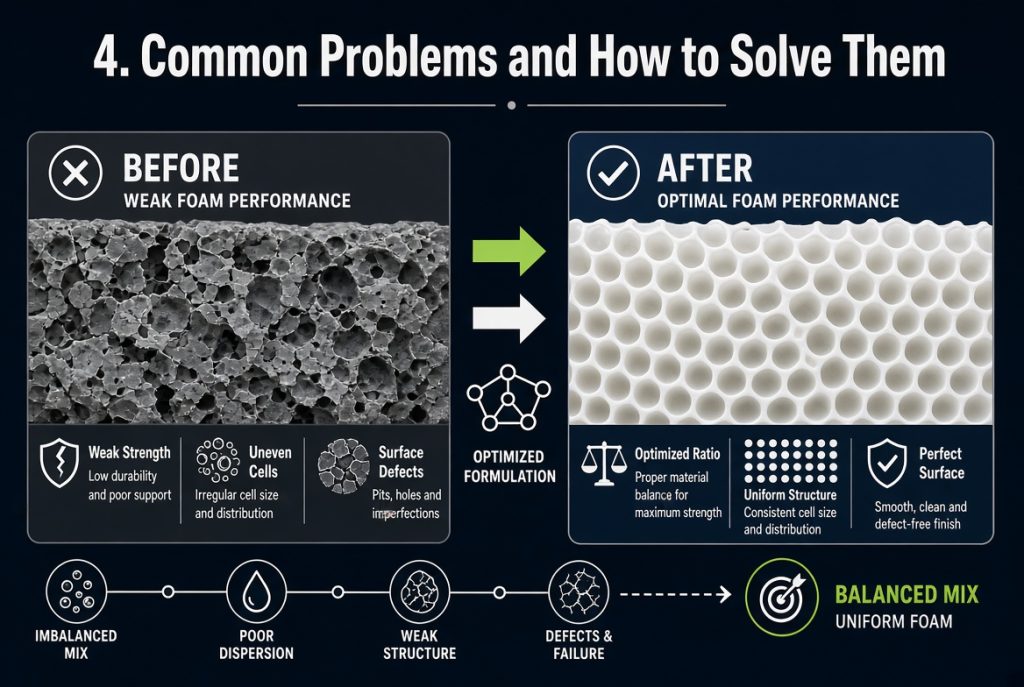
4. Common Problems and How to Solve Them
Poor Mechanical Strength
If the product is too weak, brittle, or easily deformed, possible causes include an unsuitable formulation balance, insufficient crosslinking, incorrect density, or poor processing conditions.
Solution: Optimize the polyol/isocyanate ratio, functionality, density, catalyst system, and curing conditions.
Slow or Unstable Reaction
A formulation may react too slowly, too quickly, or show inconsistent rise and curing behavior.
Solution: Adjust the catalyst package, component temperature, mixing conditions, and formulation balance.
Uneven Foam Cells
Large or irregular cells can reduce mechanical strength and thermal insulation performance.
Solution: Check mixing efficiency, blowing balance, surfactant selection, catalyst levels, raw-material temperature, and equipment settings.
Surface Defects or Poor Demolding
Surface shrinkage, sticking, voids, or incomplete curing can occur when the formulation and processing conditions are not properly matched.
Solution: Optimize the release system, mold temperature, catalyst balance, curing profile, and formulation.
5. How Can GST Help?

For polyurethane manufacturers, the challenge is rarely just understanding the chemistry. The real challenge is turning chemistry into a stable, repeatable production process.
GST provides polyurethane combination materials, customized formulations, and application-focused technical solutions for different production requirements.
Our technical support can focus on:
- Customized polyurethane combination systems
- Soft foam, high-resilience, memory foam, and rigid foam solutions
- Catalyst and additive optimization
- Density, hardness, resilience, and reaction-time adjustment
- Foam structure and surface-quality optimization
- Laboratory sample development and formula testing
- Production troubleshooting and process optimization
- Equipment and application technology support
Instead of simply supplying raw materials, GST focuses on helping customers find the right material + formulation + process combination.
The urethane bond is a fundamental chemical link in polyurethane, but it is only one part of the bigger picture.
The final performance of polyurethane depends on how polyols, isocyanates, catalysts, additives, blowing systems, formulation design, and processing conditions work together.
That is why choosing the right polyurethane system and technical partner can make a major difference.
GST — From polyurethane formulation to finished-product performance, providing combination materials and customized technical solutions for your application.
PREVIOUS:Polyurethane From Raw Materials to Finished Products
CATEGORIES
LATEST NEWS
- Aromatic vs Aliphatic Isocy...
- What Is Modified MDI?
- MDI vs TDI: What’s th...
- TDI 80/20 vs TDI 65/35
- What Is TDI?
- What Is Polymeric MDI (pMDI)?
- What Is MDI?
- What Is Isocyanate?
- How to Select the Right Pol...
- How Does Polyol Affect Foam...
CONTACT US
Tel:+86 18688691634
Email:sam@1688pu.com
Add:No. 91 Central East Rd, Luxi Village, Gaobu Town, Dongguan 523283, China.