What Is the Difference Between PU and PU Foam?
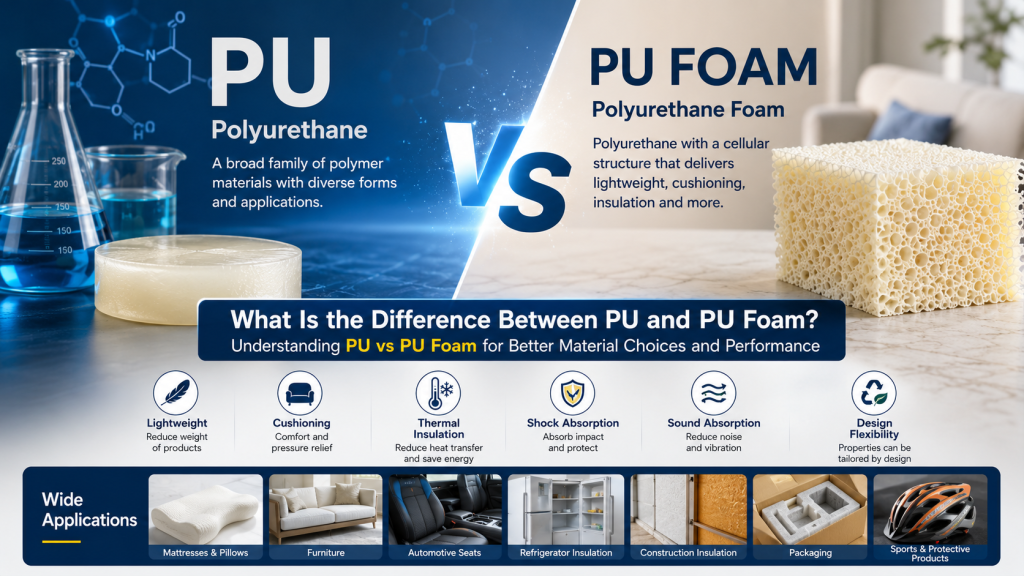
When people first enter the polyurethane industry, one question often causes confusion: What is the difference between PU and PU foam?
The short answer is simple:
PU (Polyurethane) is a broad family of polymer materials, while PU foam is a specific type of polyurethane material with a cellular, foam-like structure.
In other words, PU is the bigger category, and PU foam is one important member of that category.
But this distinction becomes much more important when you are selecting materials, designing formulations, choosing equipment, or developing a new application. A PU coating, PU adhesive, PU elastomer, and PU foam may all be polyurethane, but their formulations, processing methods, properties, and applications can be completely different.
For manufacturers, the real question is not simply “PU or PU foam?” It is:
Which polyurethane system is right for my application, and how can the formulation be engineered to deliver the required performance?
This is where professional polyurethane formulation and system solutions become important.
1. What Is PU?
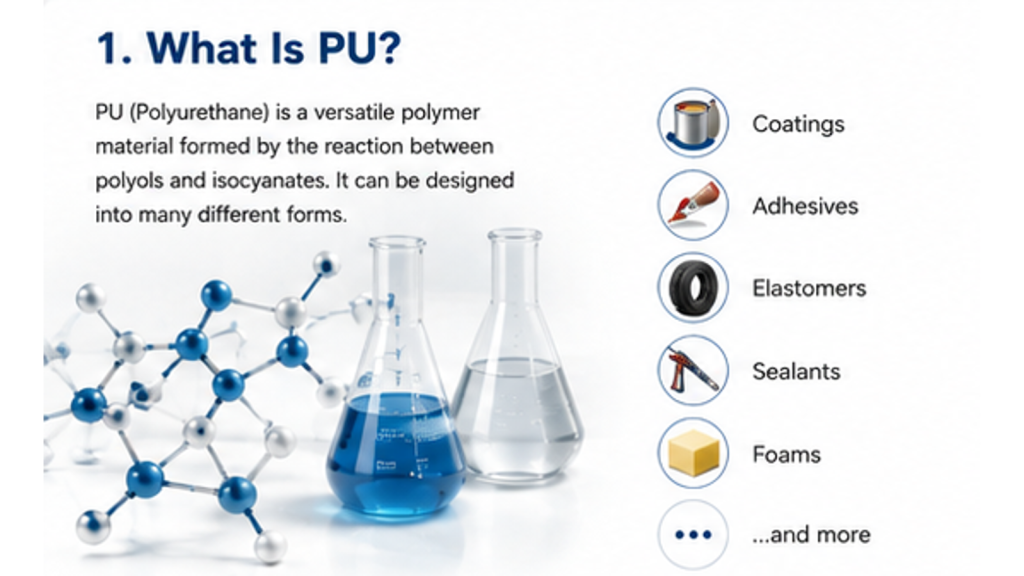
PU stands for Polyurethane.
Polyurethane is a versatile polymer formed mainly through a chemical reaction between compounds containing hydroxyl groups, such as polyols, and isocyanates.
Depending on the raw materials, formulation, catalysts, additives, processing conditions, and cellular structure, polyurethane can be engineered into many different forms.
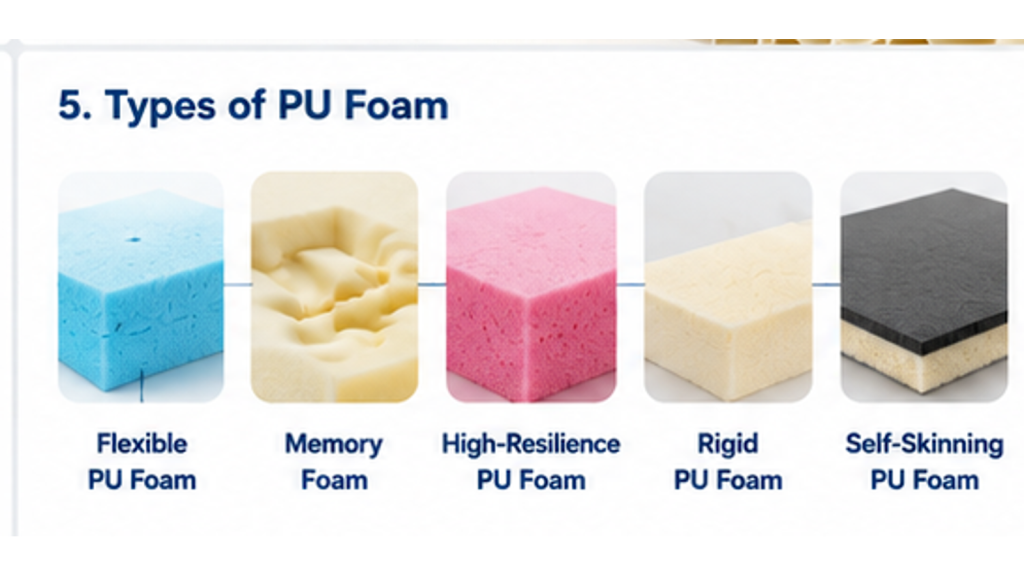
Common polyurethane products include:
- Flexible PU foam
- Rigid PU foam
- Memory foam
- High-resilience foam
- Self-skinning foam
- PU elastomers
- PU adhesives
- PU coatings
- PU sealants
- PU integral skin materials
This is why simply saying “PU material” does not tell you exactly what the product will look like or how it will perform.
A polyurethane can be soft or hard, flexible or rigid, solid or cellular, elastic or highly structural.
That versatility is one of the biggest advantages of polyurethane.
2. What Is PU Foam?
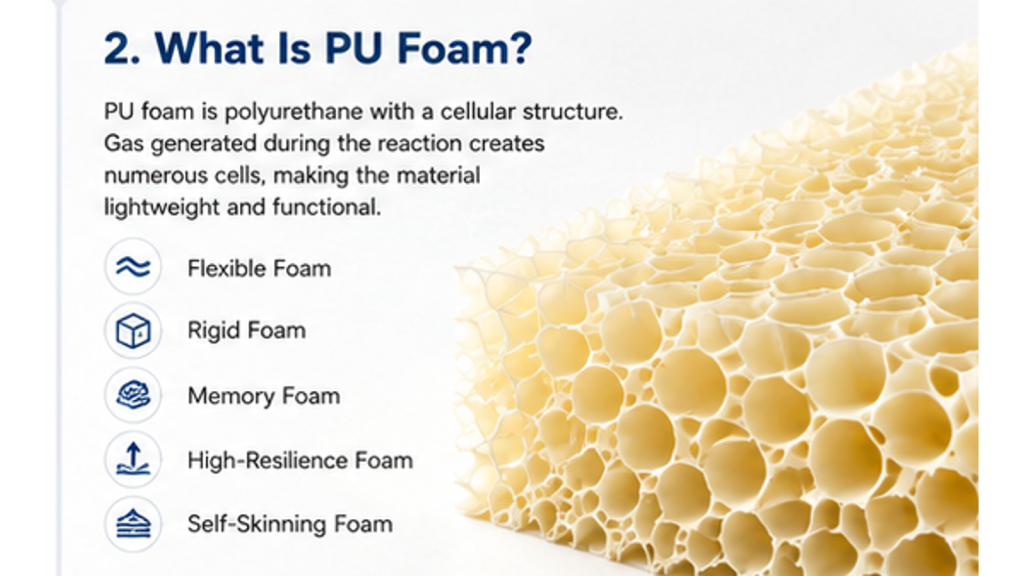
PU foam is polyurethane that has been processed into a cellular structure.
During the foaming process, gas is generated and dispersed throughout the reacting polymer system. The gas creates numerous small cells, transforming the liquid reaction mixture into a lightweight foam.
Depending on the formulation and process, these cells can be predominantly open-cell, closed-cell, or a combination of both.
This cellular structure gives PU foam properties that ordinary solid polyurethane may not have, such as:
- Low density
- Cushioning
- Shock absorption
- Thermal insulation
- Sound absorption
- Lightweight construction
- Energy absorption
- Comfort and resilience
PU foam can therefore be found in everything from mattresses and memory pillows to automotive seats, furniture cushions, refrigerators, cold-storage insulation, packaging and construction insulation.
3. PU vs PU Foam: What Is the Key Difference?
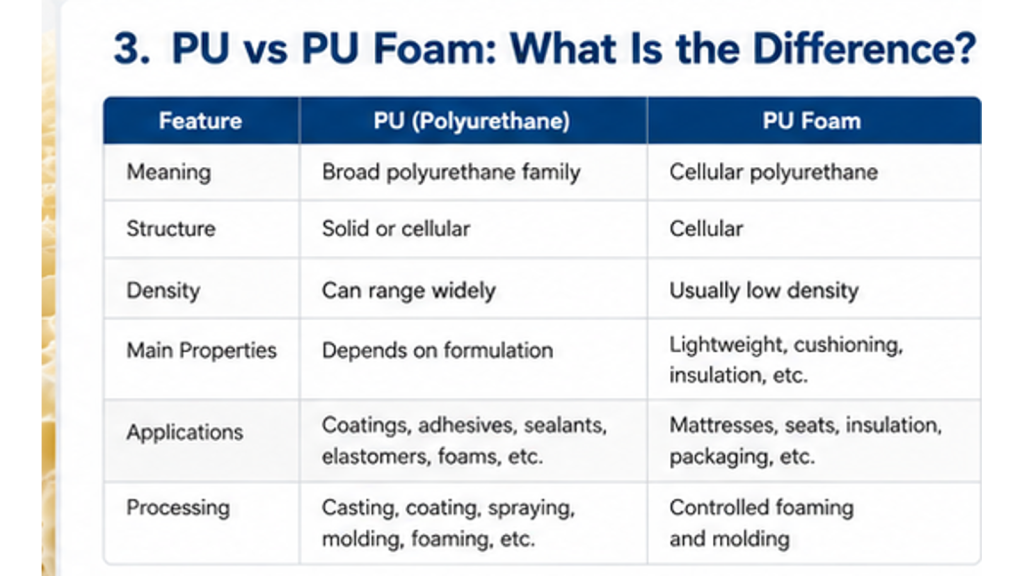
The easiest way to understand PU vs PU foam is to think about material category versus material structure.
| Feature | PU / Polyurethane | PU Foam |
| Meaning | Broad polyurethane material family | Foamed polyurethane |
| Structure | Solid or cellular | Cellular |
| Density | Can vary widely | Usually designed for low density |
| Main characteristics | Depends on formulation | Lightweight, cushioning or insulating |
| Applications | Coatings, adhesives, elastomers, foams, sealants, etc. | Furniture, automotive, insulation, packaging, mattresses, etc. |
| Processing | Casting, coating, spraying, molding, foaming, etc. | Primarily controlled foaming and molding processes |
| Formulation focus | Polymer properties and processing | Polymer reaction + cell formation + density control |
So, PU is not the same thing as PU foam.
Instead:
PU foam is a type of polyurethane material whose properties are strongly influenced by its cellular structure.
This distinction is particularly important when communicating with suppliers. If a customer says they need “PU,” that is usually not enough information to develop the correct formulation.
A professional supplier will want to know the application, density, hardness, resilience, processing method, mold, machine, environmental requirements and final performance targets.
4. Why Do We Need PU Foam?
Why not simply use solid polyurethane?
Because creating a cellular structure can provide a combination of properties that is difficult to achieve with a solid material.
Lightweight
Foaming introduces gas cells into the polymer structure, significantly reducing material density.
This is valuable in applications where weight reduction matters, such as:
- Automotive components
- Furniture
- Sports products
- Packaging
- Transportation
Cushioning and Comfort
Flexible PU foam can deform under load and recover after compression.
This makes it ideal for:
- Mattresses
- Memory pillows
- Sofa cushions
- Motorcycle seats
- Automotive seats
- Headrests
Thermal Insulation
Rigid PU foam can contain a large amount of gas within its cellular structure, reducing heat transfer.
That makes it particularly useful for:
- Refrigerators
- Freezers
- Cold-storage systems
- Insulated panels
- Building insulation
- Spray insulation
Energy Absorption
The cellular structure can absorb mechanical energy through controlled deformation.
This is why specially designed PU foam can be used in:
- Protective packaging
- Automotive components
- Sports equipment
- Safety products
- Impact-absorbing structures
The key is that different applications require completely different foam structures and formulations.
5. How Does PU Foam Work?
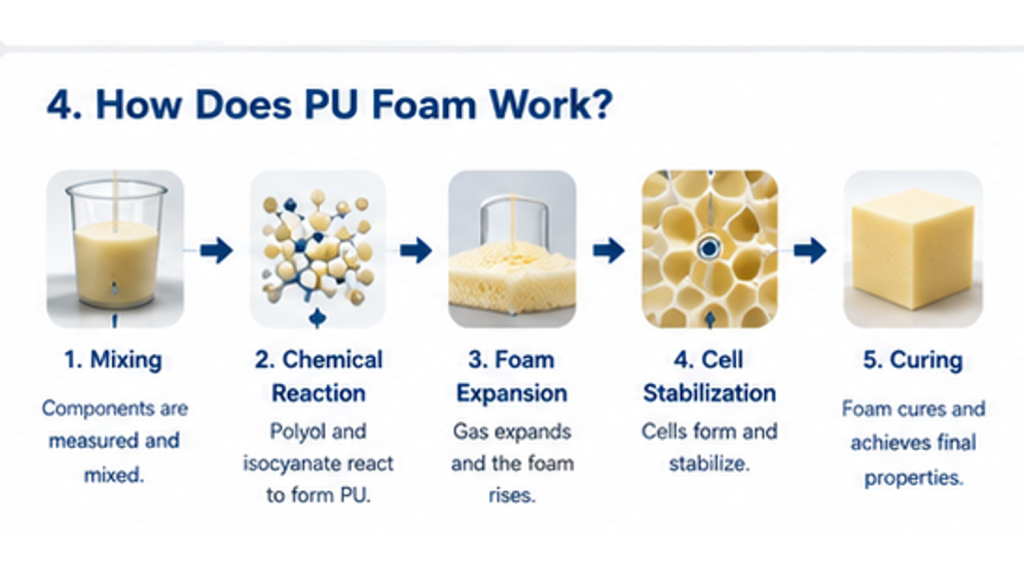
The basic PU foam process can be understood through several stages.
Step 1: Raw Materials Are Prepared
A typical polyurethane foam system may contain:
- Polyol
- Isocyanate
- Blowing agents
- Catalysts
- Surfactants
- Crosslinkers or chain extenders
- Flame retardants
- Other functional additives
The exact formulation depends on the target foam.
For example, a memory foam formulation and a rigid insulation foam formulation may use completely different formulation strategies.
Step 2: The Components Are Mixed
The polyol-side system and isocyanate are mixed under controlled conditions.
Mixing quality is extremely important.
Poor mixing can lead to:
- Uneven density
- Poor cell structure
- Local hardness differences
- Shrinkage
- Surface defects
- Inconsistent physical properties
Step 3: Chemical Reactions Begin
The isocyanate reacts with hydroxyl-containing components to form polyurethane structures.
At the same time, blowing reactions and other formulation reactions influence the formation of the foam cells.
This means PU foaming is not simply “mixing chemicals and letting them expand.”
It is a carefully balanced combination of:
chemical reaction + gas generation + nucleation + cell growth + cell stabilization + polymer curing.
Step 4: Foam Expansion
Gas generated during the reaction expands the reacting polymer.
The foam rises and the cells develop.
At this stage, parameters such as:
- Cream time
- Rise time
- Tack-free time
- Foam height
- Density
- Cell size
- Flowability
can become critical.
Step 5: Cell Stabilization and Curing
As the polymer structure develops, the foam becomes more stable and eventually reaches its required physical properties.
The final foam performance depends on the entire reaction balance rather than one individual raw material.
6. Why Does PU Foam Sometimes Fail?
This is where polyurethane manufacturing becomes much more interesting.
Two manufacturers can use apparently similar raw materials but obtain completely different foam results.
Why?
Because polyurethane foam is a system, not a single ingredient.
Common problems include:
Problem 1: Foam Shrinkage
The foam rises correctly but later contracts.
Possible causes include:
- Incorrect formulation balance
- Poor cell stabilization
- Excessive open-cell formation
- Insufficient curing
- Incorrect blowing-agent balance
- Processing temperature problems
Solution: Optimize the complete formulation rather than simply increasing or decreasing one ingredient.
Problem 2: Uneven Density
The foam may have different densities in different areas.
Possible causes include:
- Poor mixing
- Incorrect machine settings
- Uneven mold filling
- Incorrect cream/rise profile
- Poor flowability
- Raw-material temperature differences
Solution: Evaluate the complete processing system, including formulation, mixing ratio, temperature, equipment and mold design.
Problem 3: Foam Is Too Soft or Too Hard
Hardness is not determined by one factor alone.
It can be influenced by:
- Polyol structure
- Isocyanate index
- Crosslinking
- Density
- Cell structure
- Additives
- Curing conditions
For example, simply increasing density does not automatically produce the exact hardness or comfort required by a customer.
Solution: Design the formulation around the required physical properties instead of adjusting density alone.
Problem 4: Poor Resilience or Slow Recovery
This is especially important for memory foam and high-resilience foam.
If the foam recovers too quickly, it may not provide the desired slow-rebound effect.
If recovery is too slow, the product may feel heavy or uncomfortable.
Solution: Adjust the polymer structure, catalysts, formulation balance, density and cell structure to achieve the target recovery profile.
Problem 5: Surface Defects
Common surface problems include:
- Pinholes
- Voids
- Cracks
- Poor skin
- Uneven texture
- Mold marks
These can originate from formulation, mixing, mold temperature, release conditions, moisture, or processing parameters.
The correct solution requires identifying the actual cause rather than simply changing the formula blindly.
7. PU vs PU Foam: Why Formulation Matters
One of the biggest misunderstandings about polyurethane is that the raw material determines the final product by itself.
In reality:
Performance = formulation + raw materials + chemical reactions + equipment + processing conditions + mold + environment
This is why a professional polyurethane system supplier does more than sell chemicals.
For example, if a customer wants to manufacture a memory pillow, the target may include:
- Specific density
- 5-second or customized slow rebound
- Comfortable softness
- Good compression recovery
- Low odor
- Stable production
- Consistent color and appearance
The formulation must be designed around these targets.
On the other hand, if the customer is producing a refrigerator insulation system, the priorities may shift toward:
- Low thermal conductivity
- Dimensional stability
- Closed-cell structure
- Adhesion
- Density control
- Processing speed
- Flame-retardant requirements
Same polyurethane family.
Completely different formulation strategy.
8. How Can GST Help With PU and PU Foam Solutions?
For manufacturers, the biggest challenge is often not understanding the definition of PU foam.
It is getting a formulation that actually works on their production line.
This is where GST’s polyurethane combination material and technical solution approach can provide value.
GST focuses on polyurethane application solutions, including soft foam, rigid foam, memory foam, high-resilience foam, self-skinning systems and other customized polyurethane systems.
1. GST Combination Materials
A polyurethane combination material, often called a system or blended polyol, integrates multiple formulation components into a controlled system.
Depending on the application, the system may incorporate:
- Polyols
- Catalysts
- Silicone surfactants
- Blowing-system components
- Crosslinkers
- Flame retardants
- Other functional additives
This simplifies production and helps improve formulation consistency.
Instead of requiring every manufacturer to develop the entire formulation from scratch, a properly designed combination material can provide a more practical starting point for production.
2. Customized PU Formulation Development
Different customers have different requirements.
For example:
Memory pillow
→ Slow rebound
→ Comfortable softness
→ Stable density
→ Good recovery
Motorcycle seat
→ High resilience
→ Compression resistance
→ Comfortable support
→ Long-term durability
Refrigerator insulation
→ Low thermal conductivity
→ Dimensional stability
→ Closed-cell structure
→ Efficient foaming
Protective packaging
→ Lightweight
→ Energy absorption
→ Appropriate hardness
→ Good dimensional stability
GST can develop and adjust the formulation according to the customer’s application, equipment and target performance.
3. Production-Line Technical Support
A formulation that works in a laboratory may not automatically work on a customer’s production line.
Production conditions can differ significantly.
Important parameters may include:
- Mixing ratio
- Material temperature
- Mold temperature
- Machine pressure
- Mixing efficiency
- Injection time
- Demolding time
- Ambient humidity
- Mold design
Therefore, polyurethane technical support should not stop at providing a formula.
The goal is to help the customer achieve stable and repeatable mass production.
4. Application Testing and Sample Development
Before large-scale production, formulation validation is extremely important.
GST can support customers through processes such as:
Requirement → Formulation design → Laboratory testing → Sample development → Machine trial → Parameter adjustment → Production validation
This approach helps reduce trial-and-error costs and shortens the path from an idea to a commercially viable polyurethane product.
9. PU vs PU Foam: Which One Should You Choose?
The answer depends on the application.
If you need a solid, elastic, adhesive, coating or structural polyurethane, you may not need a foam system.
If you need:
- Cushioning
- Lightweight construction
- Thermal insulation
- Shock absorption
- Comfort
- Energy absorption
then PU foam may be the better solution.
But choosing PU foam is only the beginning.
You still need to determine:
What type of foam?
- Flexible foam?
- Rigid foam?
- Memory foam?
- High-resilience foam?
- Self-skinning foam?
- Integral skin foam?
- Specialty foam?
And then:
What formulation and processing conditions are required?
That is where technical expertise becomes essential.
10. Frequently Asked Questions About PU vs PU Foam
Is PU the same as PU foam?
No.
PU refers to the broader polyurethane material family. PU foam is polyurethane that has been processed into a cellular foam structure.
Is all polyurethane foam called PU foam?
Generally, yes. PU foam is a common abbreviation for polyurethane foam.
However, different PU foams can have dramatically different formulations and properties.
Is PU foam plastic?
Yes, polyurethane is generally classified as a polymer/plastic material, although polyurethane can have very different physical forms, from flexible foams to rigid materials and elastomers.
Is PU foam waterproof?
Not necessarily.
Water resistance depends on the foam structure, formulation, cell structure, surface treatment and application conditions. Some PU foams can provide good moisture resistance, while others are more susceptible to water absorption.
Why does PU foam shrink?
Shrinkage can result from an imbalance between gas generation, cell stabilization and polymer curing. Formulation, moisture, catalyst balance, surfactant selection and processing conditions can all play a role.
Can PU foam density be customized?
Yes.
Density can be adjusted through formulation and processing design, but the final density should always be considered together with hardness, cell structure, resilience, dimensional stability and other target properties.
Can the same PU formulation be used for every application?
No.
A memory pillow, automotive seat, refrigerator insulation panel and packaging foam have different performance requirements and therefore generally require different system designs.
11. The Bottom Line: Understanding PU vs PU Foam
The easiest way to remember the difference is:
PU = the polyurethane family.
PU foam = a cellular form of polyurethane.
PU is a broad material platform with applications ranging from coatings and adhesives to elastomers and foams.
PU foam takes advantage of a cellular structure to provide properties such as low density, cushioning, insulation, resilience and energy absorption.
But successful PU foam production is not simply about selecting a chemical.
It is about controlling the entire system:
Raw materials → formulation → chemical reactions → cell structure → equipment → processing → final performance
That is why professional polyurethane suppliers need more than product knowledge. They need formulation development, application experience, testing capability and production-line support.
With GST’s polyurethane combination materials, customized formulations and technical application solutions, manufacturers can move beyond simply buying raw materials and instead work toward a complete polyurethane production solution—from laboratory formulation and sample development to machine trials and mass-production optimization.
Whether you are developing flexible foam, rigid foam, memory foam, high-resilience foam, self-skinning products or another polyurethane application, the right system design can make the difference between a foam that simply expands and a product that performs consistently in real-world production.
Need a customized PU or PU foam solution? GST can help you develop the right combination material, formulation and technical process for your application.
PREVIOUS:What Is PU Foam?
CATEGORIES
LATEST NEWS
- Aromatic vs Aliphatic Isocy...
- What Is Modified MDI?
- MDI vs TDI: What’s th...
- TDI 80/20 vs TDI 65/35
- What Is TDI?
- What Is Polymeric MDI (pMDI)?
- What Is MDI?
- What Is Isocyanate?
- How to Select the Right Pol...
- How Does Polyol Affect Foam...
CONTACT US
Tel:+86 18688691634
Email:sam@1688pu.com
Add:No. 91 Central East Rd, Luxi Village, Gaobu Town, Dongguan 523283, China.