How Does Isocyanate React With Polyol?
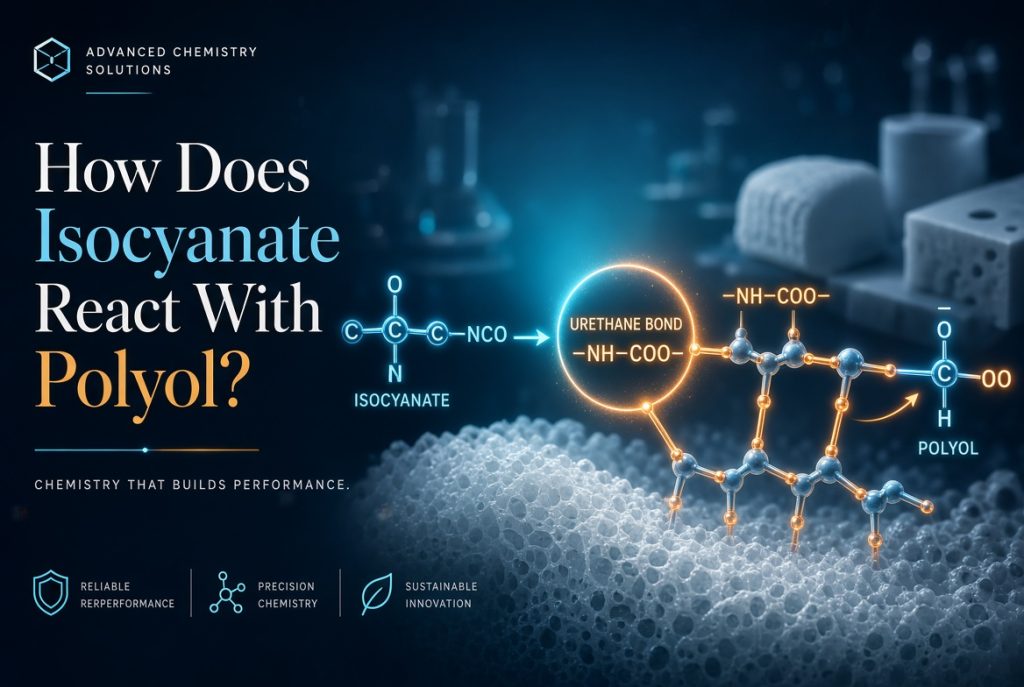
Polyurethane may look simple from the outside—a foam, coating, adhesive, elastomer, or molded part. But behind its performance is a carefully controlled chemical reaction between two key components: isocyanate and polyol.
So, how does isocyanate react with polyol? Why is this reaction so important? And what happens when the reaction is not properly controlled?
1. What Happens When Isocyanate Meets Polyol?
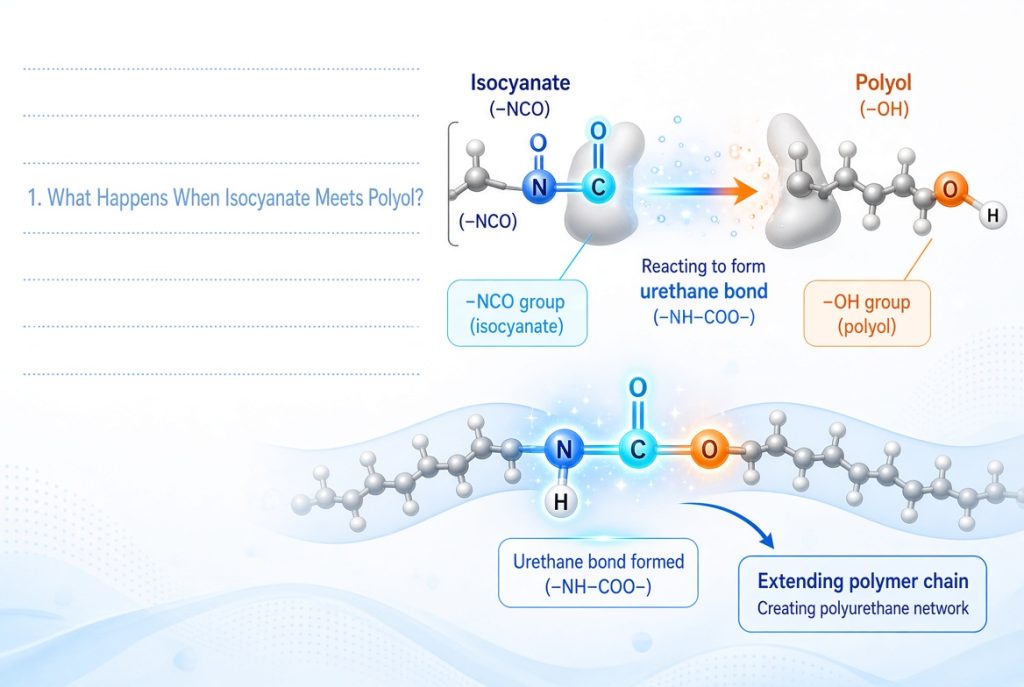
At the heart of polyurethane chemistry is the reaction between the –NCO groups of isocyanate and the –OH groups of polyol.
In simple terms:
Isocyanate + Polyol → Polyurethane
The –NCO group reacts with the hydroxyl group of the polyol to form a urethane bond. As this reaction continues, individual molecules connect into longer polymer chains and, depending on the formulation, a three-dimensional polyurethane structure can be formed.
This is the chemical foundation behind many PU products—from flexible memory foam and high-resilience foam to rigid insulation, elastomers and structural components.
2. Why Is This Reaction Needed?
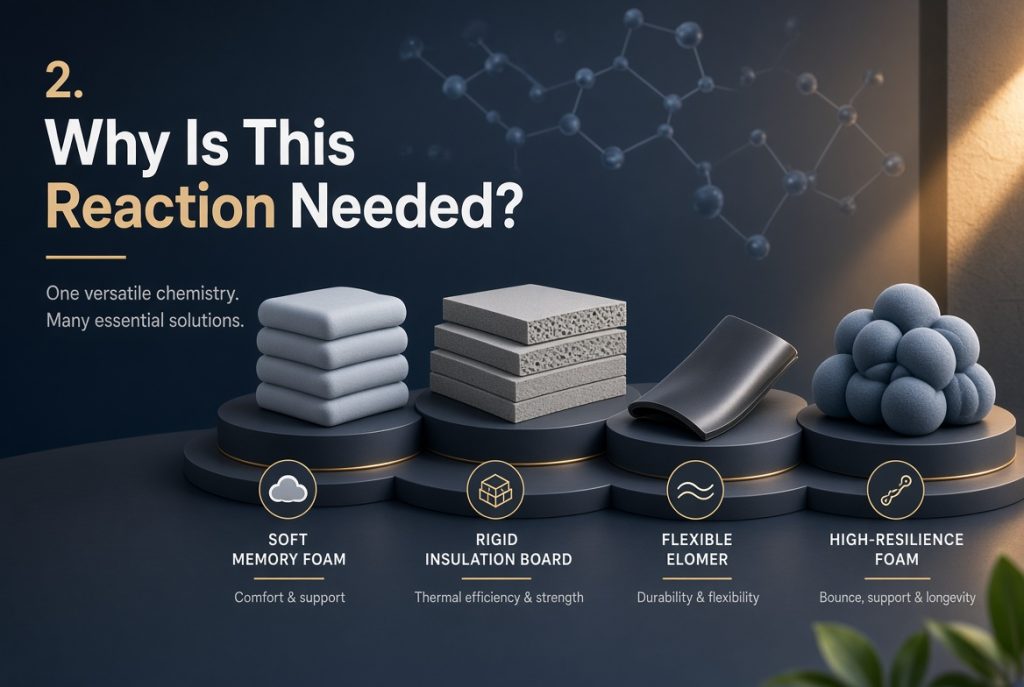
The reaction is not simply about “making polyurethane.” It determines many of the final material’s properties.
By adjusting the type and functionality of polyol, isocyanate index, catalysts, blowing agents, additives and processing conditions, manufacturers can influence:
- Foam density and cell structure
- Hardness and flexibility
- Resilience and compression recovery
- Reaction and curing speed
- Dimensional stability
- Thermal insulation performance
- Mechanical strength
That is why two products made from “polyurethane” can behave completely differently.
The chemistry is the same foundation—the formulation determines the personality.
3. How Does the Reaction Work?
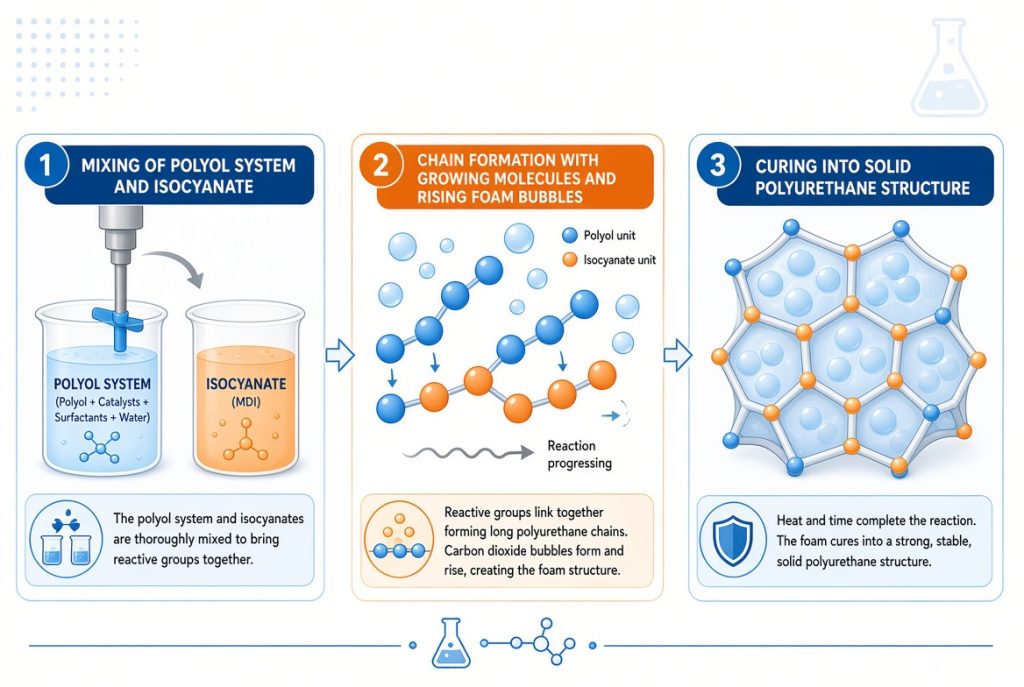
The process can be understood in three stages.
Step 1: Mixing
Polyol, catalysts, additives and other ingredients are prepared as a formulated system. When the system is mixed with isocyanate, the reaction starts almost immediately.
Step 2: Chain Formation
Isocyanate groups react with hydroxyl groups, creating urethane bonds. As more functional groups react, the molecular chains grow.
For foam systems, this chemical reaction happens alongside blowing reactions, which generate gas and create the cellular structure.
Step 3: Curing and Structure Development
As the reaction proceeds, viscosity increases and the polymer structure develops. The final properties depend heavily on whether the chemical reaction, foaming process and curing process are properly balanced.
This is where formulation technology becomes critical.
4. Common Problems During Isocyanate–Polyol Reaction
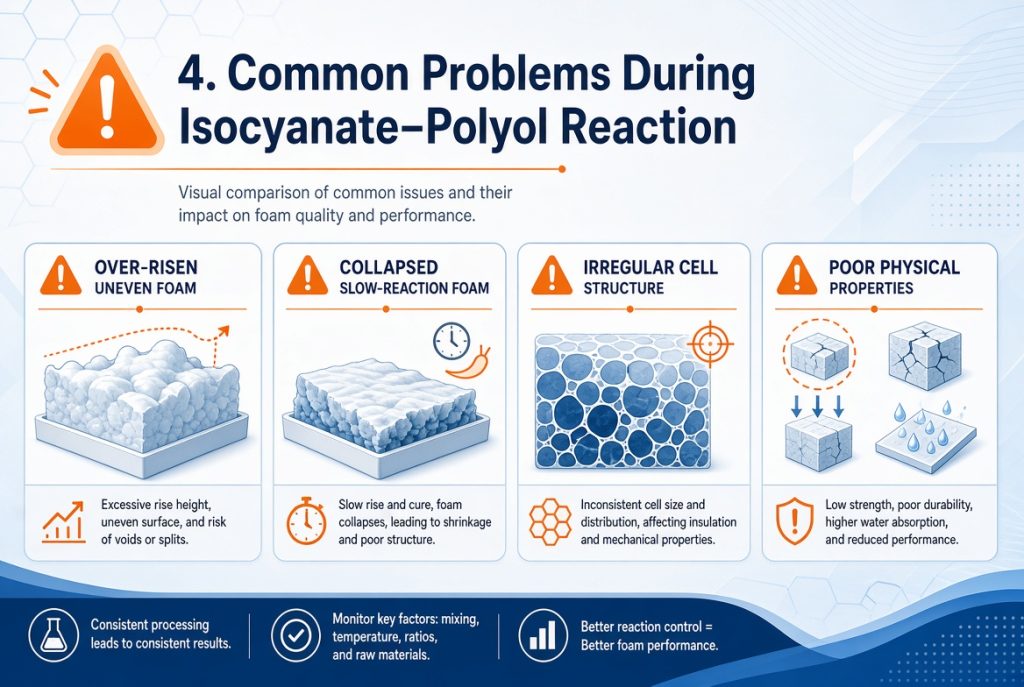
Even when the basic chemistry is well understood, production problems are common.
Reaction Too Fast
The material may rise or cure too quickly, causing poor flow, uneven cells, incomplete filling or processing difficulties.
Possible solution: Optimize catalyst selection, catalyst dosage, cream/rise/gel balance and processing temperature.
Reaction Too Slow
Slow reaction can lead to poor productivity, insufficient curing, collapse or dimensional instability.
Possible solution: Adjust catalyst levels, raw-material temperature, formulation balance and isocyanate index.
Uneven Foam Structure
Large cells, closed-cell problems, surface defects or density variation may occur when chemical reaction and gas generation are not synchronized.
Possible solution: Optimize surfactant, catalyst, blowing system, mixing efficiency and mold/process conditions.
Poor Physical Properties
Low resilience, excessive hardness, shrinkage or insufficient strength may indicate that the formulation is not properly balanced.
Possible solution: Review polyol selection, functionality, isocyanate index, crosslinking level and additive package rather than simply changing one raw material.
5. Why Formulation Design Matters
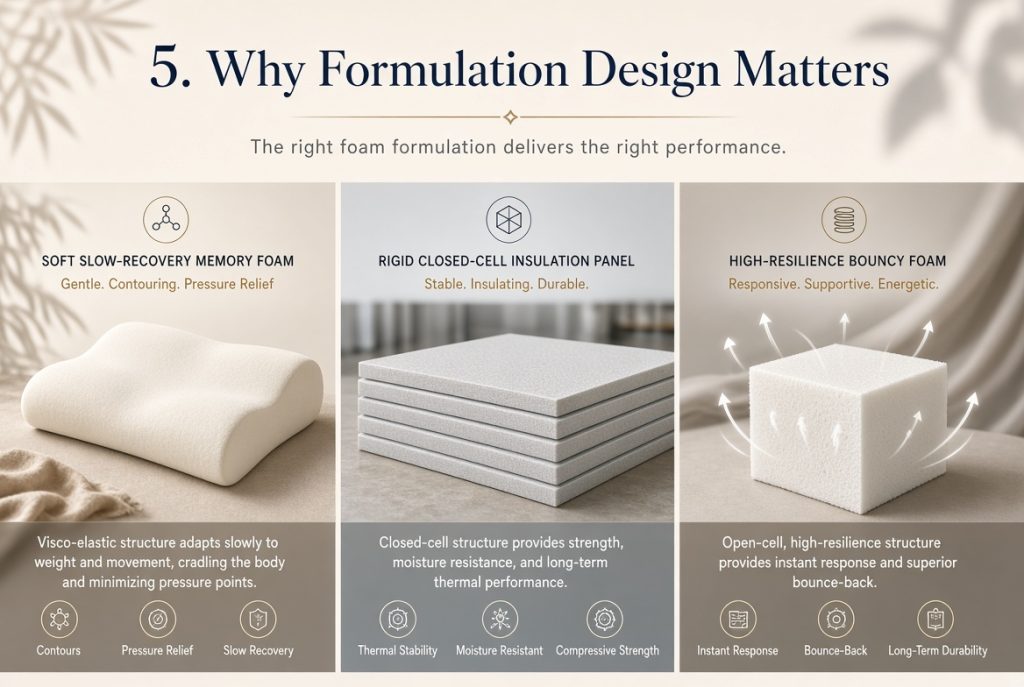
There is no universal “perfect” isocyanate-to-polyol ratio.
Different applications require different chemical balances.
A memory foam pillow needs excellent softness and slow recovery. A rigid insulation foam focuses more on dimensional stability, closed-cell structure and thermal insulation. A high-resilience foam requires a different balance of reaction kinetics, polymer structure and resilience.
Therefore, successful PU production is not just about choosing good raw materials. It is about matching the formulation to the final application.

At GST, we focus on turning polyurethane chemistry into practical production solutions.
Our polyurethane combination materials (blended polyol systems) integrate polyols, catalysts, surfactants, blowing agents and other functional additives into application-oriented formulations.
Depending on the project, GST can provide:
Customized Combination Materials
Flexible foam, rigid foam, memory foam, high-resilience foam, self-skinning systems and other PU solutions can be developed according to application requirements.
Formula Development
Need a specific density, hardness, rebound, curing speed or surface finish? Our R&D team can adjust the formulation according to the customer’s product and production process.
Technical Troubleshooting
Problems such as slow reaction, fast rise, poor cell structure, shrinkage, insufficient resilience or dimensional instability can be analyzed from both chemical and processing perspectives.
Application Support
From laboratory trials and sample development to machine testing and production optimization, GST provides technical support designed to help customers move from formula → sample → mass production.
7. From Chemical Reaction to Real-World Performance
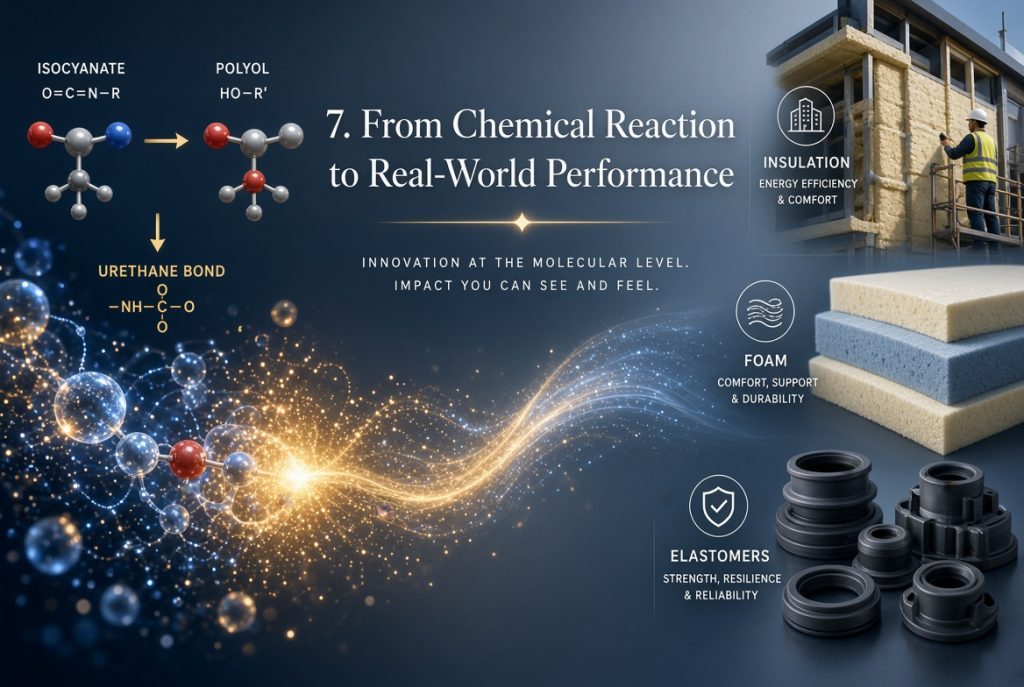
The reaction between isocyanate and polyol may look like a simple chemical equation, but in real production, dozens of variables can influence the result.
Good polyurethane is not created by chemistry alone—it is created by controlling the chemistry.
With the right combination of raw materials, catalysts, additives, equipment and process parameters, the isocyanate–polyol reaction can be transformed into the exact performance a product requires.
GST — Polyurethane Combination Materials & Application Solutions
From formulation development to production support, GST helps customers turn polyurethane chemistry into reliable products.
PREVIOUS:What Is a Urethane Bond?
CATEGORIES
LATEST NEWS
- Aromatic vs Aliphatic Isocy...
- What Is Modified MDI?
- MDI vs TDI: What’s th...
- TDI 80/20 vs TDI 65/35
- What Is TDI?
- What Is Polymeric MDI (pMDI)?
- What Is MDI?
- What Is Isocyanate?
- How to Select the Right Pol...
- How Does Polyol Affect Foam...
CONTACT US
Tel:+86 18688691634
Email:sam@1688pu.com
Add:No. 91 Central East Rd, Luxi Village, Gaobu Town, Dongguan 523283, China.