How Is Urea Formed in Polyurethane?
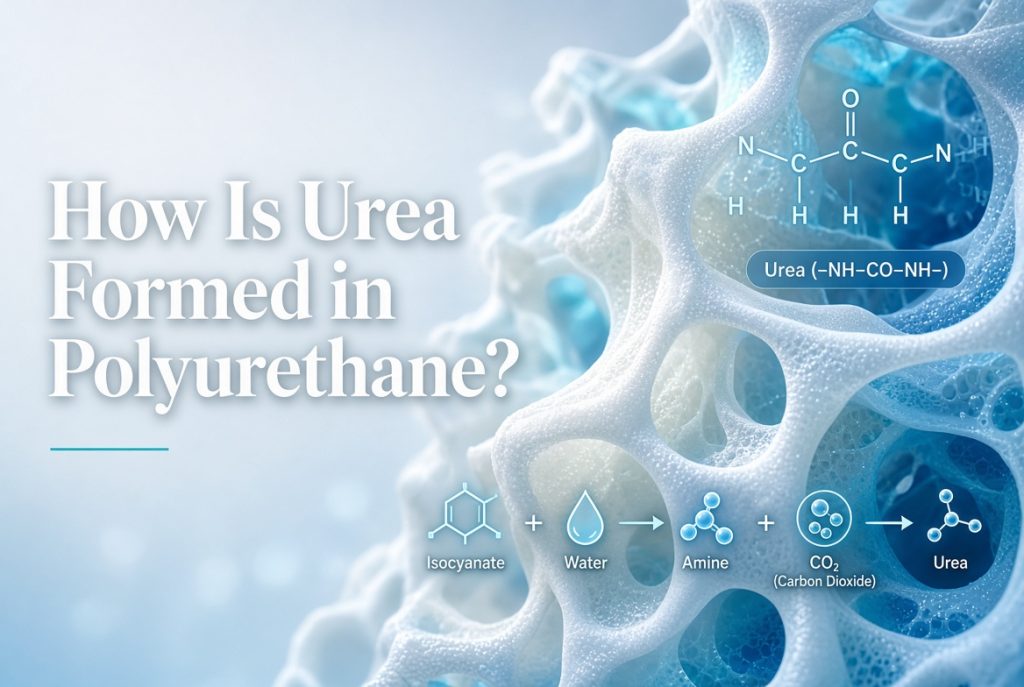
Polyurethane is known for its remarkable versatility. Depending on the formulation and processing method, it can become flexible foam, rigid insulation foam, elastomers, coatings, adhesives, or molded products.
But behind these different materials is a fascinating chemical network. One important structure in many polyurethane systems is the urea group.
So, how is urea formed in polyurethane? Why does it matter? How does it affect foam performance? And what can be done when the reaction causes problems?
Let’s take a closer look.
1. What Is Urea in Polyurethane?
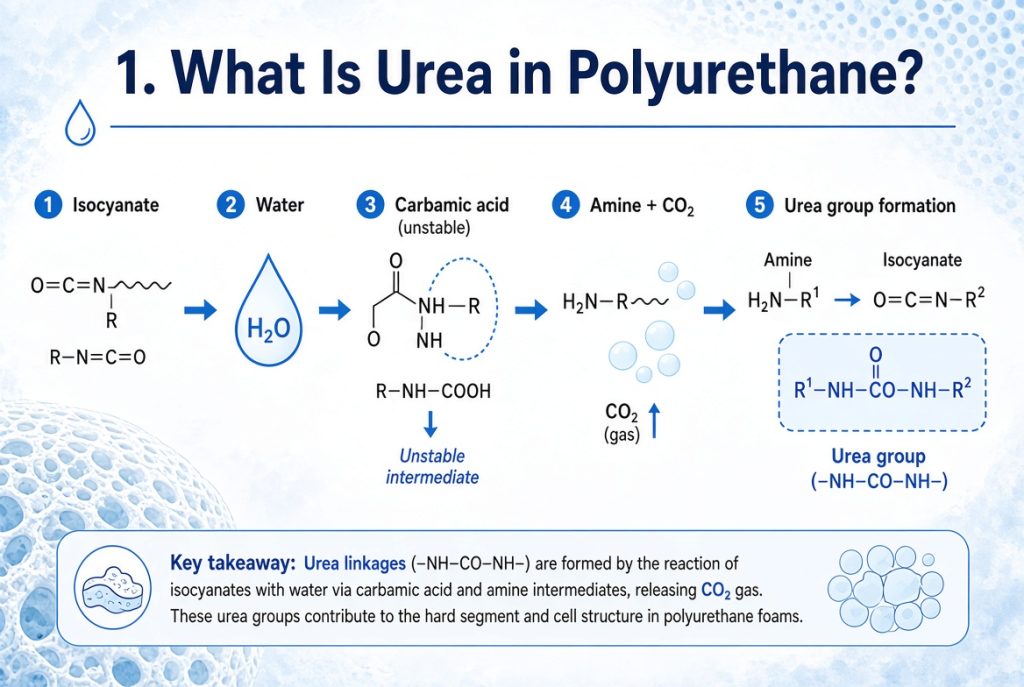
In polyurethane chemistry, urea groups are formed when an isocyanate reacts with a primary amine.
The simplified reaction is:
Isocyanate + Amine → Urea
The resulting structure contains a characteristic –NH–CO–NH– linkage.
But where does the amine come from in a typical polyurethane foam system?
The answer is often water.
When water reacts with an isocyanate, it first forms an unstable carbamic acid intermediate, which quickly decomposes into an amine and carbon dioxide (CO₂).
The overall reaction can be simplified as:
Isocyanate + Water → Amine + CO₂
The newly formed amine then reacts rapidly with another isocyanate:
Amine + Isocyanate → Urea
Therefore, in many polyurethane foams:
Water → Amine → Urea
At the same time, the generated CO₂ helps create the foam cells.
This is one reason water plays such an important role in polyurethane foam chemistry.
2. Why Is Urea Needed?
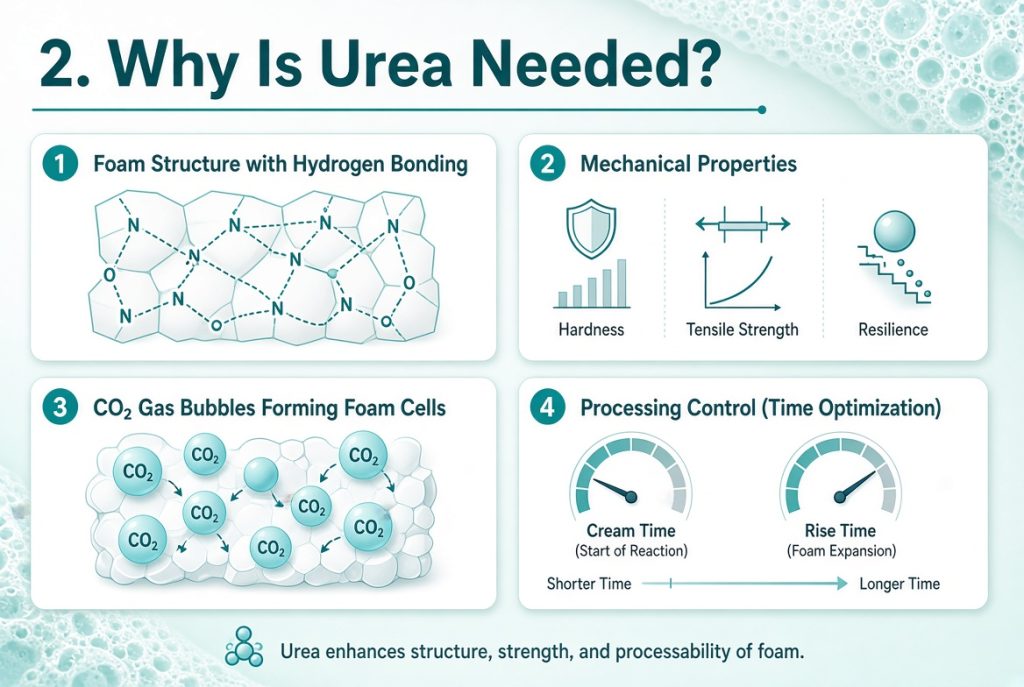
Urea is not simply an unwanted by-product. In many polyurethane systems, it is an important part of the material’s final structure.
① It contributes to foam structure
Urea groups can participate in strong hydrogen bonding. These interactions can influence the rigidity and stability of the polymer network.
② It affects mechanical properties
The amount and distribution of urea structures can influence properties such as:
- Hardness
- Tensile strength
- Compression behavior
- Resilience
- Dimensional stability
③ It helps control foam formation
The reaction between water and isocyanate produces CO₂, which contributes to chemical blowing. The balance between gas generation and polymer formation is therefore critical to obtaining the desired cell structure.
④ It influences processing behavior
Too little or too much water can change cream time, rise time, curing behavior, density, and final foam performance.
That means urea formation is closely connected to both chemistry and processing.
3. How Does Urea Formation Work?
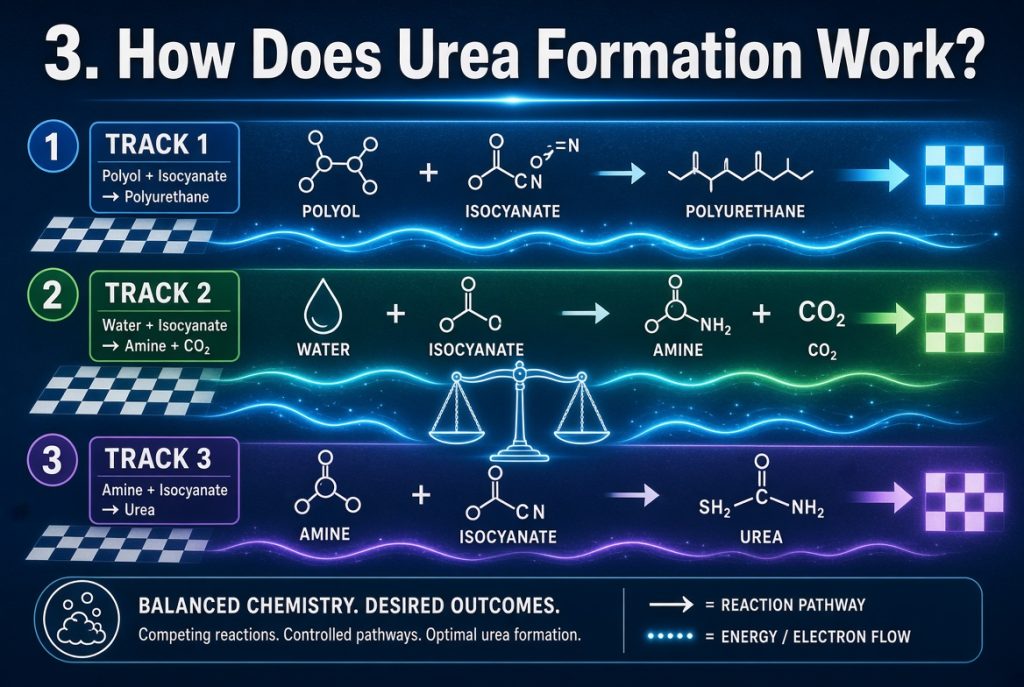
Think of polyurethane foaming as a carefully synchronized race.
Several reactions may occur almost simultaneously:
Polyol + Isocyanate → Polyurethane
Water + Isocyanate → Amine + CO₂
Amine + Isocyanate → Urea
The challenge is not simply making these reactions happen.
The real challenge is controlling their speed and balance.
If the water-isocyanate reaction is too fast, CO₂ may be generated rapidly before the polymer network has developed sufficient strength. This can contribute to problems such as poor cell structure or foam collapse.
If the reaction is too slow, the foam may have insufficient expansion or an unsuitable density.
This is why catalyst selection, water level, isocyanate index, polyol structure, surfactant and processing conditions all need to work together.
4. Common Problems Related to Urea Formation
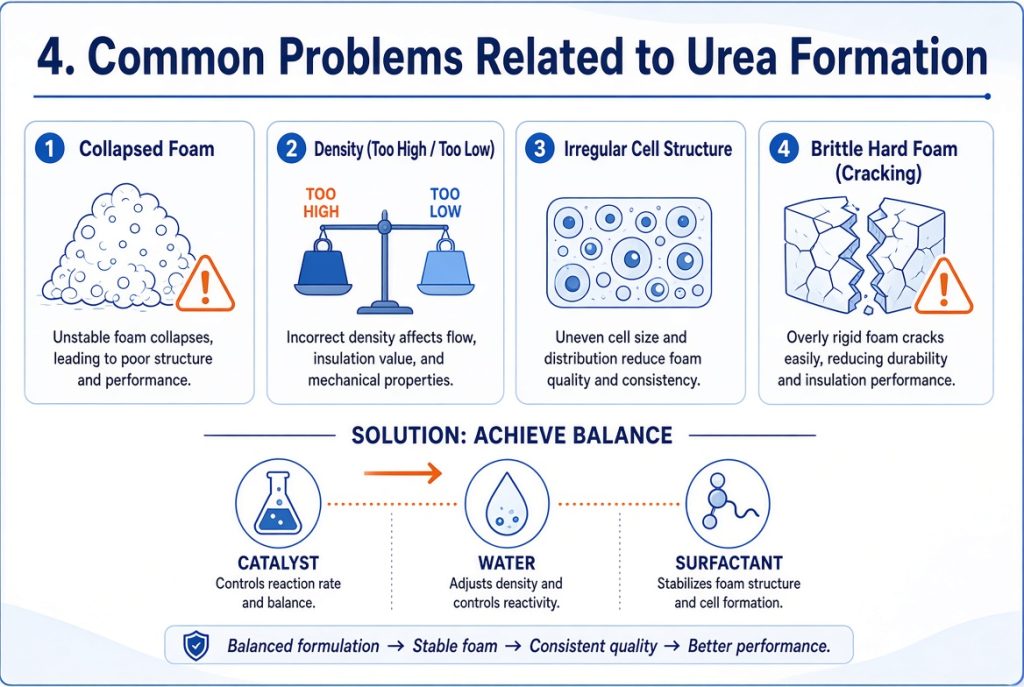
Problem 1: Foam Shrinkage or Collapse
If gas generation and polymerization are poorly balanced, the cell structure may not be strong enough to support the expanding foam.
Possible solutions:
- Adjust water content
- Optimize catalyst balance
- Adjust isocyanate index
- Optimize silicone surfactant
- Improve processing temperature
Problem 2: Density Is Too High or Too Low
Water directly influences chemical blowing. A small formulation adjustment can therefore have a noticeable effect on foam density.
Possible solutions:
Optimize the relationship between:
Water + Catalyst + Isocyanate Index + Cell Stabilization
rather than changing water alone.
Problem 3: Uneven Cell Structure
Poor mixing, unsuitable surfactant selection, or an unbalanced reaction profile may result in irregular cells.
Possible solutions:
- Improve mixing conditions
- Select a more suitable silicone surfactant
- Optimize catalyst combinations
- Adjust cream and rise characteristics
- Review raw material compatibility
Problem 4: Foam Becomes Too Brittle or Too Hard
Excessive hard-segment or urea-related interactions can significantly influence foam hardness and brittleness.
The solution is usually not simply reducing one ingredient. The entire formulation should be evaluated.
5. How Can GST Help?
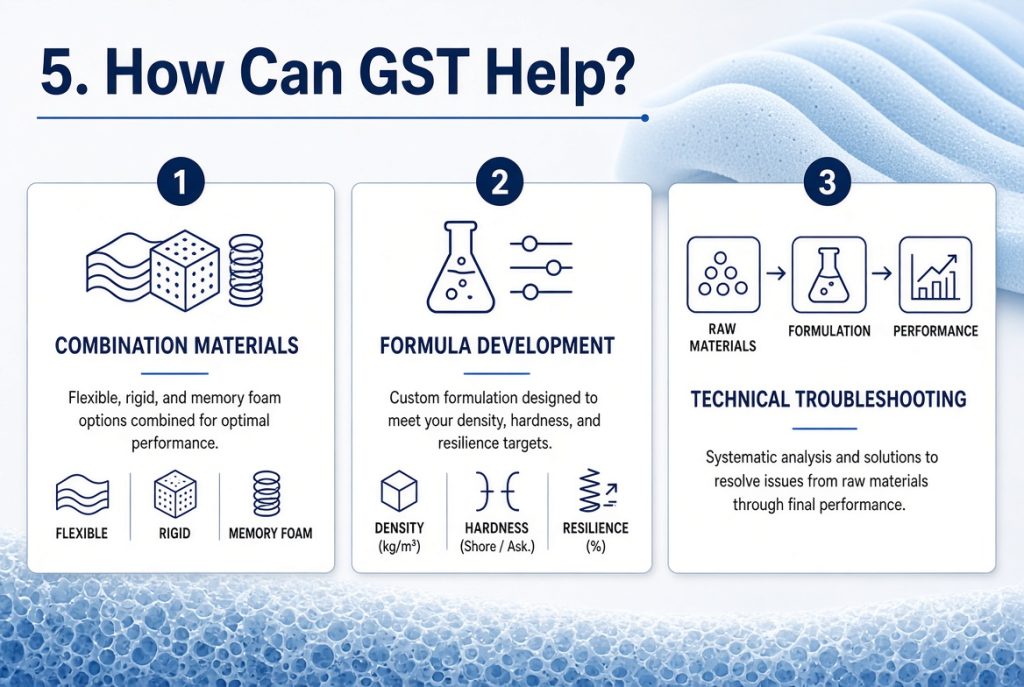
For polyurethane manufacturers, the biggest challenge is often not understanding a single chemical reaction—it is turning chemistry into a stable production formula.
This is where GST polyurethane combination materials can provide practical support.
GST can provide customized polyurethane solutions covering:
Combination Materials
Different applications require different reaction profiles and physical properties. GST can develop suitable polyurethane blended polyol / system solutions for applications such as:
- Flexible foam
- High-resilience foam
- Memory foam
- Rigid foam
- Spray foam
- Self-skinning foam
- Packaging foam
- Automotive components
- Insulation applications
Formula Development
The formulation can be optimized around specific targets such as:
Density | Hardness | Resilience | Cell Structure | Demold Time | Flowability | Reaction Profile
Instead of focusing on a single raw material, GST evaluates the complete formulation system.
Technical Troubleshooting
When customers encounter problems such as shrinkage, poor cell structure, unstable density, slow curing, excessive brittleness, or inconsistent production, GST can help analyze the relationship between:
Raw Materials → Formulation → Chemical Reactions → Processing → Final Performance
This approach makes troubleshooting much more efficient.
6. From Chemical Reaction to Real Production
Understanding urea formation is more than learning a chemical equation.
It helps us understand why water, isocyanate, catalysts and polymerization must be carefully balanced in polyurethane production.
A successful polyurethane formulation is rarely about maximizing one reaction.
It is about controlling multiple reactions at the same time.
That is exactly where formulation expertise becomes valuable.
GST focuses on polyurethane combination materials, customized formulations and application-oriented technical solutions, helping customers move from laboratory trials to stable production.
Whether you need a new polyurethane formulation, want to improve an existing system, or are facing foam production problems, GST can work with you to develop a practical solution based on your application and performance requirements.
Need a customized polyurethane solution? Contact GST and let’s turn polyurethane chemistry into a production-ready solution.
CATEGORIES
LATEST NEWS
- Aromatic vs Aliphatic Isocy...
- What Is Modified MDI?
- MDI vs TDI: What’s th...
- TDI 80/20 vs TDI 65/35
- What Is TDI?
- What Is Polymeric MDI (pMDI)?
- What Is MDI?
- What Is Isocyanate?
- How to Select the Right Pol...
- How Does Polyol Affect Foam...
CONTACT US
Tel:+86 18688691634
Email:sam@1688pu.com
Add:No. 91 Central East Rd, Luxi Village, Gaobu Town, Dongguan 523283, China.